
MAF 236 is the National Archives series identified with the Crichel Down public inquiry of 1954, a major case in the history of government land disposal. The important distinction is that the Air Ministry bought the land outright for wartime use: it was not merely occupied under a temporary requisition. Inquiry papers, parliamentary statements and later rules answer different questions. A sound local-history account fixes each event to its source and date, then tests ownership, compensation or return claims using actual property and administrative records rather than later shorthand.
State the Acquisition Correctly Before Tracing Disposal
The National Archives explicitly cautions that Crichel Down was not strictly requisitioned: the Air Ministry purchased the land. In the Commons debate of 20 July 1954, the Minister described the acquisition as an outright purchase of land before the war for a bombing range. Rather than replacing this with a simple phrase such as “wartime seizure,” quote the exact category reported by each source and check the underlying conveyance if a legal conclusion is needed.
Create an acquisition worksheet containing original owner, public purchaser, legal mechanism, parcel description, transaction date as supported, price if independently documented and intended use. Historical accounts can disagree over whether to emphasize a purchase date or the earlier decision to obtain the property. Preserve conflicting dates and their sources instead of forcing them into one reconstructed transaction.
Separate Each Government Department’s Role
The land had a history after the original military requirement. The National Archives’ guidance directs researchers to several government series on wartime land, including property and ministry files, while specifically locating the inquiry in MAF 236 and related Crichel Down material in CRES 44. Do not assume that a file held by one department documents the complete history of every transfer or land-use decision.
Use a custody-versus-ownership table. A ministry may administer a property or retain a correspondence file without being the owner at a given date. Track which department sent each letter, who held title as evidenced by conveyance documents, and which public body made a later disposal decision. An interdepartmental handover is not necessarily a sale to a private owner.

Read Inquiry Papers as Evidence, Not as a Single Verdict
The 1954 inquiry concerns the handling and disposal of land after wartime use. Identify the inquiry’s terms of reference, documents placed before it, witnesses, reported findings and any recommendations in the actual records. A witness assertion and a final finding are different evidential categories. Newspaper coverage or a later summary can help locate the controversy but does not replace the inquiry report.
The original Commons debate reports the minister discussing Sir Andrew Clark’s investigation and the response to its findings. Attribute that account as a statement made in Parliament. It is valuable primary evidence of what the government publicly said at the time, but it should not be silently converted into an objective account of every undisputed property fact.
Put the 1954 Debate Beside the Archive File
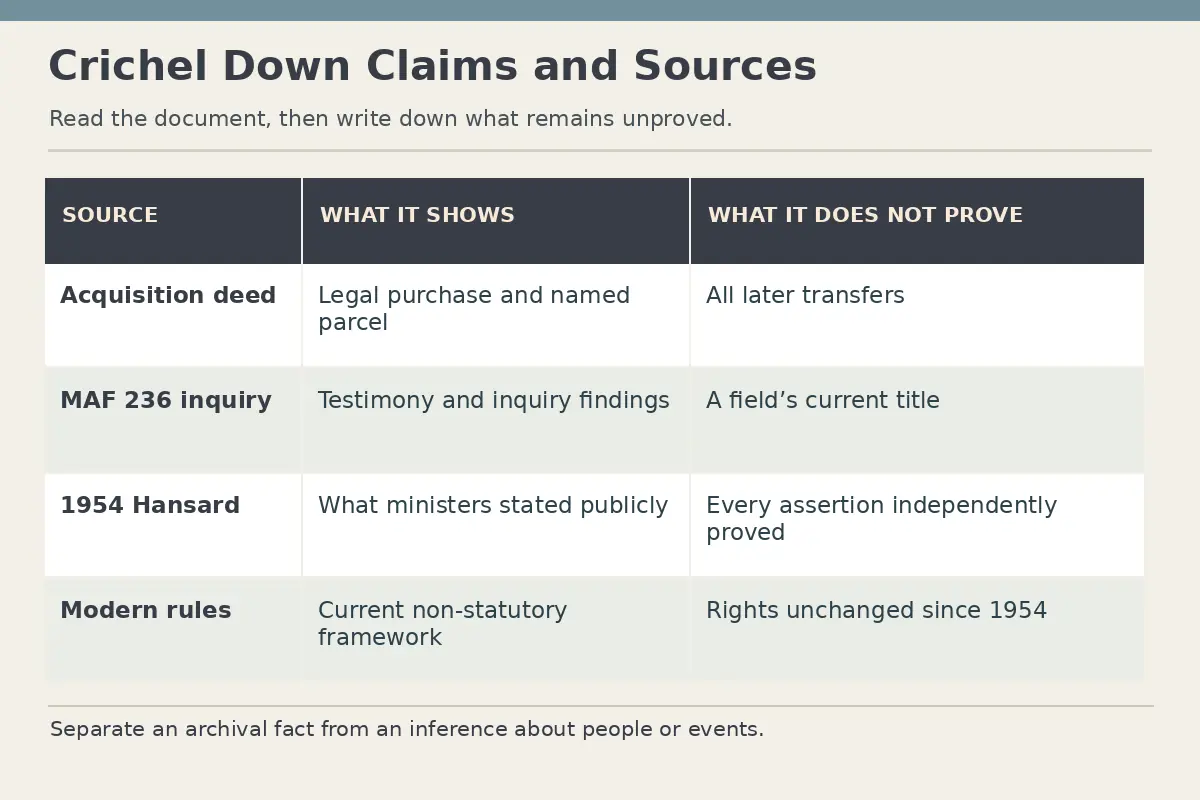
Use the Commons debate dated 20 July 1954 as a chronological anchor. Record claims about purchase, land extent, previous owners, administrative actions and proposed remedies exactly where they appear. Then open the relevant MAF 236 document and mark whether the source corroborates, narrows or contradicts the parliamentary statement. A debate is a record of the speech, not automatic proof of each assertion in it.
A careful research table separates event date, date of testimony or speech, document creation and later publication. An old government statement can have a reliable transcript and still contain a disputed factual interpretation. Flag the difference explicitly, especially when legal forms of acquisition, tenure or compensation are being discussed.
Do Not Apply Modern Rules Backward
Government guidance describes the Crichel Down Rules as non-statutory arrangements for offering certain surplus land back to former owners, successors or sitting tenants when it was acquired compulsorily or under threat of compulsion. These modern rules are useful context for the case’s continuing significance. They do not automatically establish that the same procedures governed every transaction in the 1940s or that a historic claimant met current eligibility conditions.
If you need to discuss a property’s later eligibility, identify which version of the guidance was operative at that time and the precise circumstances of acquisition and disposal. Avoid claiming that a modern guidance page overrides an old deed. The historical narrative should clearly mark legal framework, policy statement, administrative action and property transfer as four different source types.
Check a Fictional Parcel-Mismatch Scenario
Imagine that a family photograph is captioned “Crichel Down field, returned in 1954,” while a contemporary government document refers to proposed disposal of a much larger area. The photograph may locate a familiar landscape, but it does not identify the legal parcel or prove that the photographed land changed hands in that year. Check old plans, deed boundaries, acreages and dated ownership evidence first.
This is a hypothetical example. A later ordinance survey map or estate plan may show field boundaries, yet a mapped field does not reveal its owner without supporting title records. If the family story says land was “taken for the war,” preserve the oral phrase while explaining the difference between purchase and requisition in contemporary official accounts. Do not erase the story; annotate the point that remains unverified.

Cite the Inquiry and Leave Open Questions Visible
A reproducible file citation includes The National Archives, MAF 236, exact piece, document or hearing date and page where known. Add the Hansard debate with house and date, and cite CRES 44 or land deeds independently if consulted. The fact that the National Archives lists a series does not mean you have read a particular transcript or found a parcel-level title record.
A supportable conclusion may be that the land was bought outright, that a 1954 inquiry investigated subsequent government handling, or that Parliament publicly discussed the findings. A specific entitlement to repurchase, the legal title of one field and financial compensation all demand more targeted evidence. State exactly which stage is documented and which would require archival inspection.
More House and Local History Guides
How We Research the Archive and Check Historical Claims
Our starting point is the relevant official research guidance, cross-checked with a separate authoritative description. We distinguish the series purpose from the contents of a particular piece and from family or local claims made later. A source may be an original, an official summary, a commercial transcript or a modern interpretation; each deserves an explicit label. The original date, jurisdiction, informant and document’s administrative purpose determine which proposition it can support. Illustrative scenarios in this article are invented for teaching, not disguised transcriptions.
Availability depends on the particular item: indexes can be incomplete, paper files may need an archive visit or copy request, and some records have legal access restrictions. We describe verifiable research routes, not guaranteed individual results. We do not infer sponsorship from citing a repository, and we do not recommend unconfirmed commercial links. See our affiliate disclosure for site policies. Where evidence conflicts or a necessary piece has not been examined, we preserve that uncertainty in the conclusion rather than filling the gap with a convenient story.
The National Archives and 1954 Commons debate describe an outright Air Ministry purchase, not temporary requisition.
The National Archives identifies MAF 236 as records of the Crichel Down inquiry; check individual piece descriptions.
No. It records parliamentary statements that should be compared with inquiry documents.
No. Distinguish modern non-statutory guidance from the historical legal and policy context.
Find the precise deed, parcel plan, dated government correspondence and transfer evidence.