
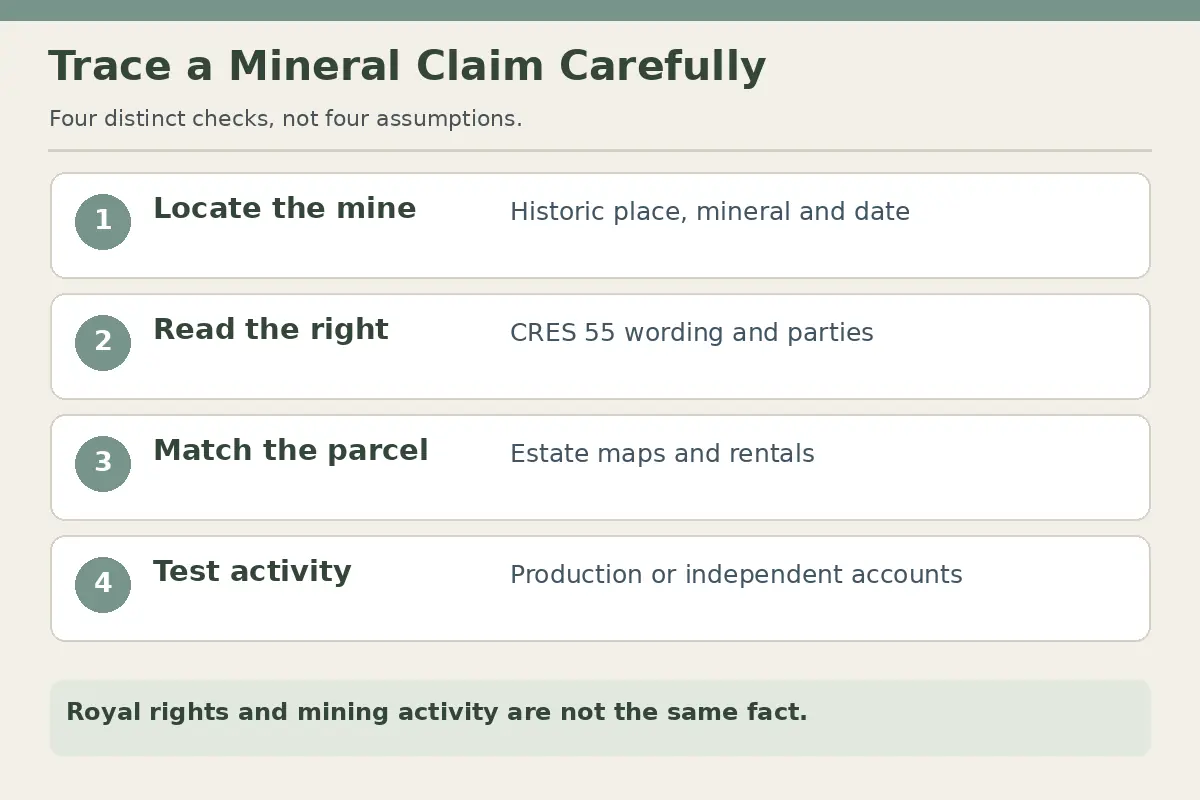
CRES 55 is a Crown Estate series relevant to royal gold and silver mines. It can be a valuable route into historical mineral rights, Crown administration and disputes over revenue, but its existence does not mean that the Crown owned the entire surface estate or that a mine was actually producing ore. The National Archives also warns that early mining material is scattered among Exchequer, Land Revenue and private estate records. Begin with a historically located mine or mineral claim, then separate right, lease, extraction and ownership into different questions.
Define the Mineral and the Historical Jurisdiction
Mining rights can differ from ownership of the surrounding fields, roads and buildings. The National Archives explains that Crown prerogatives concerning precious metals reached beyond the simple fact of an estate being owned by the Crown. The Royal Mines Act 1688 altered older rights in mines producing other minerals where precious metals were found, although historical revenue arrangements could continue. This is legal and administrative context, not an automatic answer about one parcel.
Before searching CRES 55, write down mineral type, historic county or mining district, approximate period, local mine name and the precise claim under investigation. “Royal mine” may be a term of administration, a mineral-rights issue or a local nickname. Check the language in the dated original document rather than applying a modern legal definition across centuries.
Search CRES 55 by Place, Mine Name and Record Creator
A series-level reference is a starting point rather than a specific document citation. Browse CRES 55 in The National Archives catalogue, then try historical spellings of the mine, stream, estate, parish, lessee or company. Look at piece descriptions and the originating office. A later file may summarize an earlier claim, and its date should not be confused with the date of the mineral transaction it discusses.
When a result describes a grant, license, correspondence or account, confirm that wording from the actual record. Not every piece necessarily contains the same form or fields. If an expected name is absent from a modern index, also browse the locality and historical administrative context rather than concluding that no Crown interest existed.

Separate the Crown’s Right From a Private Lease
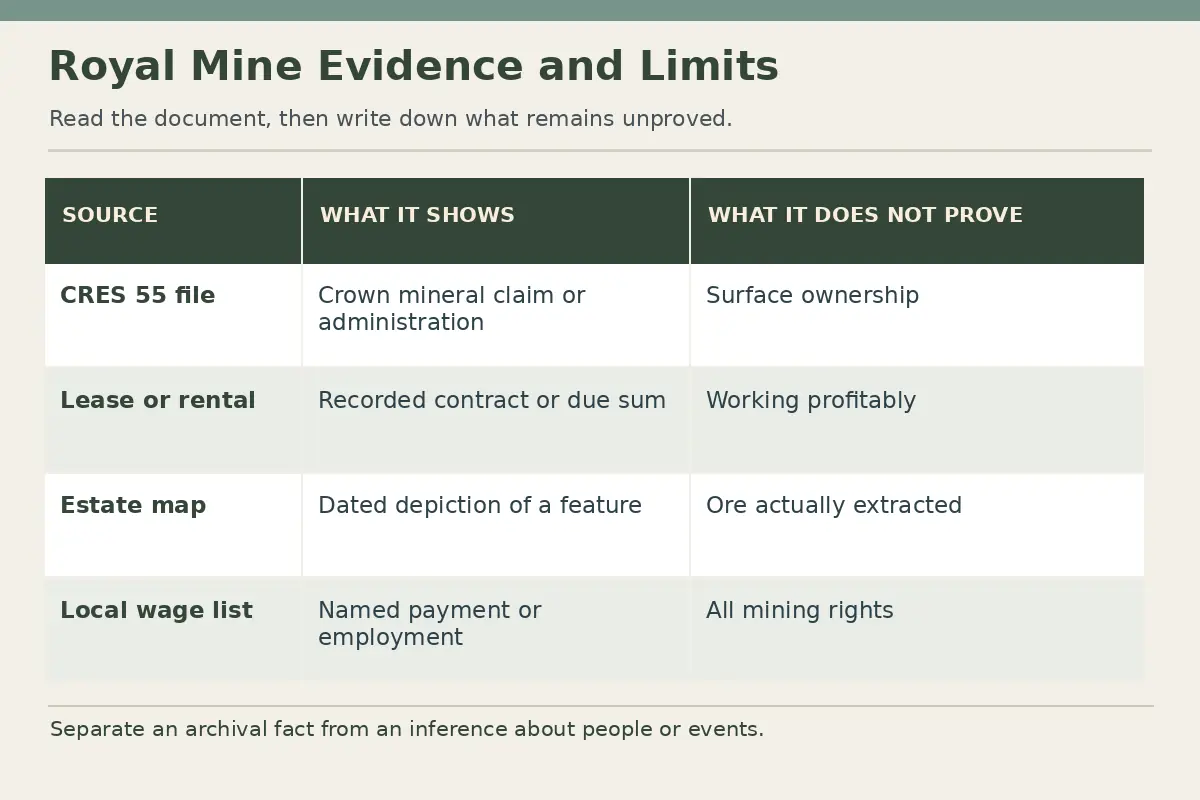
Construct a five-column ledger: date, claimant or office, type of right, named mine or land, and evidence of exercise. A document about a Crown right may show legal position or administrative concern; a lease may give contractual permission; neither automatically proves that a mine was opened, worked profitably or owned by its lessee. Preserve the exact term used—grant, lease, rent, royalty or claim.
Private estate deeds and rentals may reveal a different layer of tenure. The National Archives’ landed estates guide notes that such papers are dispersed across local and family collections. A surface landowner may not hold every mineral right below, while a party entitled to mining revenue need not have resided at the mine. Avoid drawing an unbroken chain of title from one isolated filing.
Compare the Crown File With Earlier Revenue Accounts
Early mining administration appears in several Exchequer and Land Revenue classes. The National Archives points readers toward E 101 and LRRO material, including rentals and accounts, when searching for mines and quarries. These are alternatives selected by century, location and transaction. Do not assume that every CRES 55 claim necessarily has a preceding account or a matching private estate file.
Record both the nominal right and any dated payment evidence. An assessed rent can be different from collected revenue; production figures can refer to quantities reported rather than minerals independently measured. When old currency or measure units appear, preserve them before conversion. If two records differ in area or mine name, test changes in boundaries or clerical usage instead of merging figures.
Use Maps to Identify the Workings Without Inventing Output
Map a named mine using a period-appropriate estate or topographical plan. A shaft symbol, spoil heap or boundary suggests a feature present or represented at a particular survey, but maps vary in date, purpose and scale. A plan created for a lease may be prospective. Compare it with a later survey or industrial report before claiming that an intended working was built or remained open.
Keep original geographic descriptions separate from modern coordinates. Parishes, estates and mine names can change; an associated house or manor does not identify an underground boundary. A person’s surname on a lease could indicate a contractual party without placing that person at the mine. Residence and employment each need independent personal or local records.
Try a Fictional Mine-Rights Dispute
Imagine a nineteenth-century letter stating that an estate’s copper mine contained traces of silver and that Crown rights were discussed. A later estate rental names a private landowner, while a map shows a shaft near the boundary. The three documents are not contradictory merely because they name different parties. Each might concern a different legal interest or geographic extent.
This example is invented. To decide whether ore was extracted, locate dated output accounts, working-company records or government mining reports; do not infer a commercial operation from the letter alone. To identify a worker, consult payroll, census or local records. If the Crown correspondence and rental cannot be connected to the same parcel, leave the mineral-rights attribution unresolved.
Write a Conclusion That Names the Specific Right
A complete citation identifies The National Archives, CRES 55, piece, document description and date, followed by the consulted page. Cite E 101, LRRO and local estate records individually. Make a source map showing which claim each document directly supports and where later copies depend on the same administrative origin. A catalogue snippet is evidence of a record’s description, not a substitute for that record.
State whether you have established a Crown interest, a recorded contract, a payment, a mapped working or production. These are different achievements. Crown mineral rights do not prove ownership of a nearby cottage; a lease does not prove extraction; and a named estate does not establish that an ancestor was a miner. Preserve unanswered questions rather than completing the history with conjecture.
More House and Local History Guides
How We Research the Archive and Check Historical Claims
Our starting point is the relevant official research guidance, cross-checked with a separate authoritative description. We distinguish the series purpose from the contents of a particular piece and from family or local claims made later. A source may be an original, an official summary, a commercial transcript or a modern interpretation; each deserves an explicit label. The original date, jurisdiction, informant and document’s administrative purpose determine which proposition it can support. Illustrative scenarios in this article are invented for teaching, not disguised transcriptions.
Availability depends on the particular item: indexes can be incomplete, paper files may need an archive visit or copy request, and some records have legal access restrictions. We describe verifiable research routes, not guaranteed individual results. We do not infer sponsorship from citing a repository, and we do not recommend unconfirmed commercial links. See our affiliate disclosure for site policies. Where evidence conflicts or a necessary piece has not been examined, we preserve that uncertainty in the conclusion rather than filling the gap with a convenient story.
The National Archives points to CRES 55 for records relevant to royal gold and silver mines.
No. Mineral rights, surface tenure, leases and revenue can be different interests.
Explore Exchequer E 101, Land Revenue records and local estate collections as appropriate.
No. A map needs dates and comparison with production or account records.
Not alone. Use independent personal and residential records.