
Royal Navy Exploration Journals ADM 55: Locate a Voyage, Not a Named Sailor is a guide to one identifiable archive series, not a substitute for the original record. Start with the official series guidance, identify the correct custodian and date range, then separate the administrative event actually recorded from the person or family claim you are trying to prove. The research tables below distinguish what is evidenced, what remains uncertain and which next document would test the claim.
Start With the Ship, Keeper, and Voyage Date
ADM 55 is a collection of 164 volumes of journals and log books for scientific voyages, not a comprehensive alphabetical list of Royal Navy personnel. Most journals were created between 1757 and 1861; one exceptional volume dates to 1904. A family story about an Arctic or Pacific journey is a clue to search, not proof that a particular sailor appears in the surviving book.
Write the claimed vessel, spellings of its name, approximate departure date, area explored and any named officer or keeper. Search these separately. A candidate journal is relevant when the ship and time period fit the story; the fact that it documents the expedition cannot, by itself, identify every crew member aboard.
Understand Why Scientific Logs Differ From Routine Ship Logs
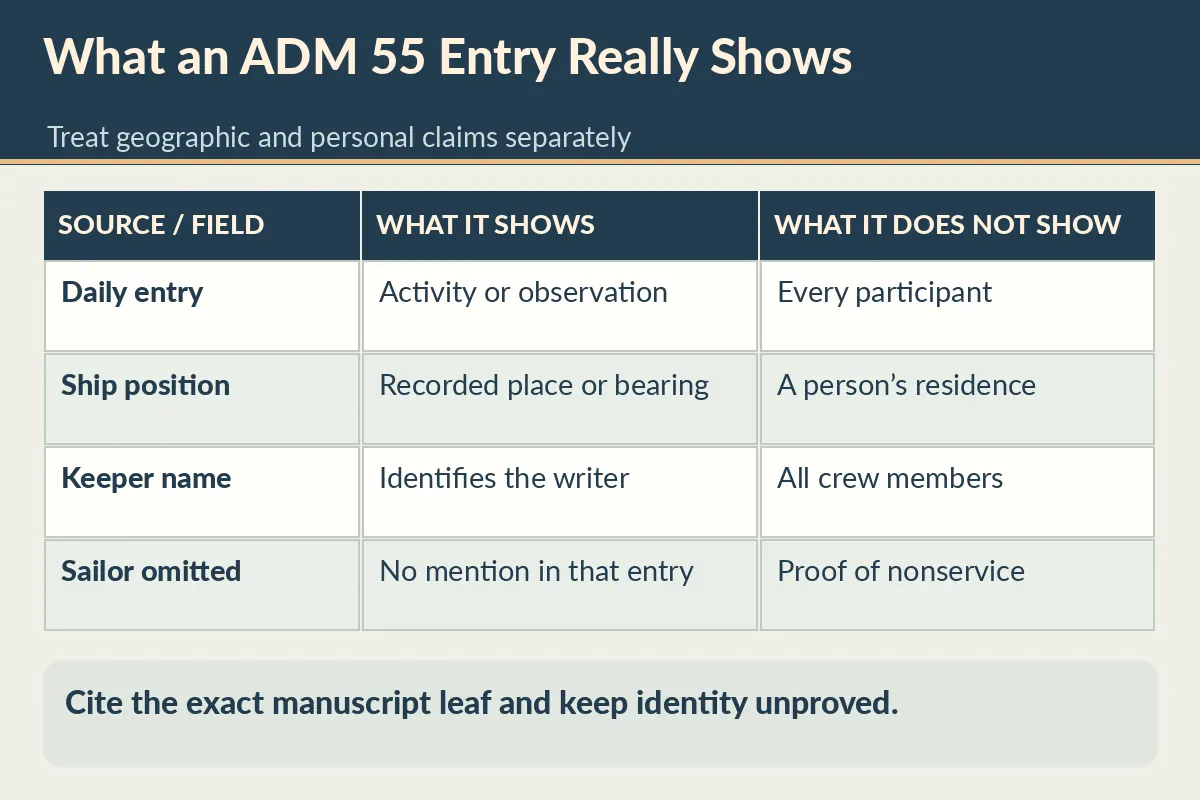
ADM 55 accounts can contain daily activities of an exploring party, navigational notes, weather and scientific observations. Because the subject is the expedition, a page may mention observations and locations without naming any ordinary sailor. Some surviving journals come from merchant vessels, so the administrative description should be checked before calling every writer a serving naval officer.
Ordinary Royal Navy ships’ logs are mostly found in ADM 53; historic captains’ logs are in ADM 51. Those series have different provenance and do not automatically provide the same viewpoint. A diary copied from another observer, and an original firsthand entry, also require different descriptions. Record the writer’s role when established and avoid calling every sentence a personal experience.

Use Discovery as a Finding Aid, Not as the Journal
Search the National Archives Discovery catalogue using the ship’s name and the keeper’s name, independently and with variants. The Archives warns that keyword results may reflect a term anywhere in the item description. This means a name hit is not necessarily a name found on a manuscript page. Confirm the series, piece reference, described dates and actual images before making a family claim.
The exploration guide provides a search-and-download route, but available access and charges must be checked at the individual item. If the online viewer lacks a needed leaf, check the item’s catalogue details or ask about access. Save the item reference and image or folio number rather than citing an unrepeatable search-results screen.
Convert Observations Into a Geographically Dated Route
Build a voyage table with columns for manuscript date, recorded position or place name, type of observation and the exact page citation. Preserve whether a coordinate was recorded, converted or estimated by the modern researcher. Historical place spellings and coastlines may not align with present maps. A weather entry can be useful context even if it contains no passenger or crew names.
If an officer’s account reports “the party landed,” identify who the phrase actually includes only when the writer specifies people. Do not extend the event to every member of a vessel’s complement. Record alternative locations or date-conversion issues explicitly instead of silently correcting the journal to match a modern map.
Search for Named People Only After Finding the Correct Vessel
A name in a journal could be an officer, scientist, local contact, passenger, interpreter or crew member. Transcribe the person’s recorded role, not an invented relationship to an ancestor. A person absent from the journal might still have sailed: the purpose of the book was not to be a complete personnel register. Conversely, a surname found in the correct ocean is too weak to identify an ancestor.
To test service, look for contemporary crew or individual service documentation appropriate to the period and administrative organization. Keep separate evidence notes for the voyage, the vessel and the proposed sailor. This avoids the common reasoning error of moving directly from “my family said he visited the Pacific” to “ADM 55 proves his arrival.”
Avoid Confusing an Original Journal With a Later Copy
Check title pages, handwriting changes, subsequent annotations, printed headings, official compilation notes and evidence that material was recopied. These details affect how directly a page reports an event. Be especially careful with attributed journal titles: a digitized book’s catalogue title may be a modern archivist’s description rather than the keeper’s own wording.
A photographed image can establish what appears on the page but does not validate the accuracy of the observation. Compare dates with another independent journal or known port records where available. Clearly label differences between the observed text, your interpretation and the independent corroboration.

Keep a Four-Column Log of Successful and Failed Searches
Record every tested ship spelling and date filter, plus whether a result was an ADM 55 volume, a different naval series or only a secondary mention. A “no result” in one keyword query is not evidence that an expedition never sailed. Narrow by keeper, then voyage date; search alternative series only after documenting the coverage of the primary collection.
The best final finding identifies ship, keeper, item, folio, date and what it actually says. If crew identity is the question, add a separate list of personnel sources still needed. This makes the output useful even when the exploration journal does not mention the ancestor directly.
Worked Evidence Check: One Expedition and Two Similar Names
Imagine a journal catalogued to an Arctic expedition in the correct decade and a family tradition involving a sailor named Thomas Reed. The journal describes ice conditions and a landing party but never names Reed. State that the voyage and circumstances are documented, while Reed’s presence is still unverified. Do not claim the story has been disproved merely because his name is absent.
If another record connects Thomas Reed to the ship with a matching service period, reassess the voyage together with that independent source. If two sailors share the name, compare age, rank, home port and dates. Retain both candidates until a record distinguishes them. This is a hypothetical method example, not an extracted historic case.
How We Research This Record Set and Its Limits
We first inspect the custodian’s archival guide and its second source description. We confirm the series title, date spans and document creator, then distinguish indexes, piece-level descriptions, images and secondary transcriptions. A description without the item is a lead rather than an inspected original. For every person-level assertion we ask which field records the event, whether the writer witnessed it, whether a contemporary correction exists and what independent source could identify a same-name alternative. We record negative searches with precise coverage rather than claiming an event never happened. Diagrams illustrate workflows and are not reproductions of historical documents.
More Records and Archives Guides
Archive Access, Citation, and Affiliate Disclosure
The first archive reference supports this scope: 164 exploration journals, predominantly 1757–1861 with one 1904 exception, search by ship and keeper. The second archive reference supplies this additional distinction: Different types of naval logs; ADM 55 exploration versus ADM 51 captains and ADM 53 ships logs. Consult the item-level catalogue record before assuming a particular volume is digitized, name indexed, open to the public or available to order. Note the series and piece, manuscript page or folio, relevant column headings, date, and access method used. Any fees are set by the provider and should be checked at the time of use. Read the site’s affiliate disclosure before using commercial links.
No. It is a defined collection of 164 surviving exploration volumes; check other ship and officer series.
The Archives describes 1757–1861 as the core period, with one exceptional 1904 volume.
Only if the person is actually identified there, ideally corroborated by a service or crew source.
Test each vessel spelling and keeper name against individual Discovery descriptions and actual pages.
No. Cite an original dated page and distinguish recorded positions from later plotting.