
A Chancery decree summarizes an equity court’s decision; the underlying evidence may survive elsewhere. For suits handled by the Chancery Masters, C 103–114 can hold affidavits, witness examinations, accounts, wills and drafts. The key to finding these materials is the name of the master, not simply a litigant’s surname. The National Archives estimates that about 20% of documents mentioned in the contemporary master indexes are missing, so an indexed item cannot be assumed to survive.
The practical method is to distinguish a catalogue locator, a document you have actually read, and an independently verified conclusion. Use the relevant National Archives research guide to understand what this series was created to record. Start a research log with your exact question, place, time period, preferred spelling variants and the piece reference; a search result alone is not a complete citation.
Begin with the suit, decree and responsible master
In equity litigation, the court could refer accounting or factual questions to a Chancery Master. A decree or subsequent order may identify that officer. The National Archives directs researchers to establish the master’s name before trying to locate the master’s working papers. A litigant’s name by itself is not a reliable finding key for these series and can lead to the wrong master’s file.
Build a case identity sheet with plaintiff, defendant, dates, court references, master named in the order and the question referred to him. A dispute about an estate may produce several orders over years, and different documents can address different stages. Do not assume the final decree includes all witness statements or property particulars that were placed before the court.
Use the C 103 binder to identify a master’s series
The research guide describes a paper catalogue workflow at the Map and Large Document Reading Room at Kew. Locate the binder for C 103 and the ‘Alphabetical List of Chancery Masters in Ordinary.’ This list links a master to the C series attributed to his office. Often there are two series for a master, one for exhibits and another for documents; do not silently treat them as interchangeable.
The series names typically refer to the last master who occupied the office when it was abolished in 1852. For example, C 103 is associated with Master Blunt, while C 114 contains material from unknown masters. That arrangement explains why searching only a nineteenth-century officeholder’s surname may miss much older papers within a series. Record the actual mapping used.

Move from the master to the relevant IND index
After identifying the series, consult the associated contemporary IND index, as directed by the C 103 binder. The indexes are a way into a document arrangement, not the underlying sworn testimony. Transcribe the case, entry and finding information exactly; the index may abbreviate names or specify an account, exhibit or witness examination without explaining the document’s whole significance.
A crucial warning from The National Archives is that roughly 20% of documents cited in these indexes are missing, with survival unknown. Record a located index entry and an unavailable exhibit as separate outcomes. An index can establish that an item was once catalogued, but it cannot allow you to quote the text of a paper that has not been seen.
Read original exhibits for the precise claim at issue
Masters’ material can include wills, estate accounts, affidavits, examinations of witnesses and draft reports. These are different document types with different authors, informants and purposes. An account may list payments; a witness might report hearsay; a will may express a proposed distribution rather than completed possession. Treat each statement according to its maker and the date it was created.
Make a claim ledger for names, relationships, property, dates and money. Mark which items are directly written in an exhibit, which are allegations from a party and which are later judicial findings. A person named as a witness need not be kin to a plaintiff; a tenant named in an account need not be the owner of the estate. These distinctions prevent impressive legal records from creating invented family links.
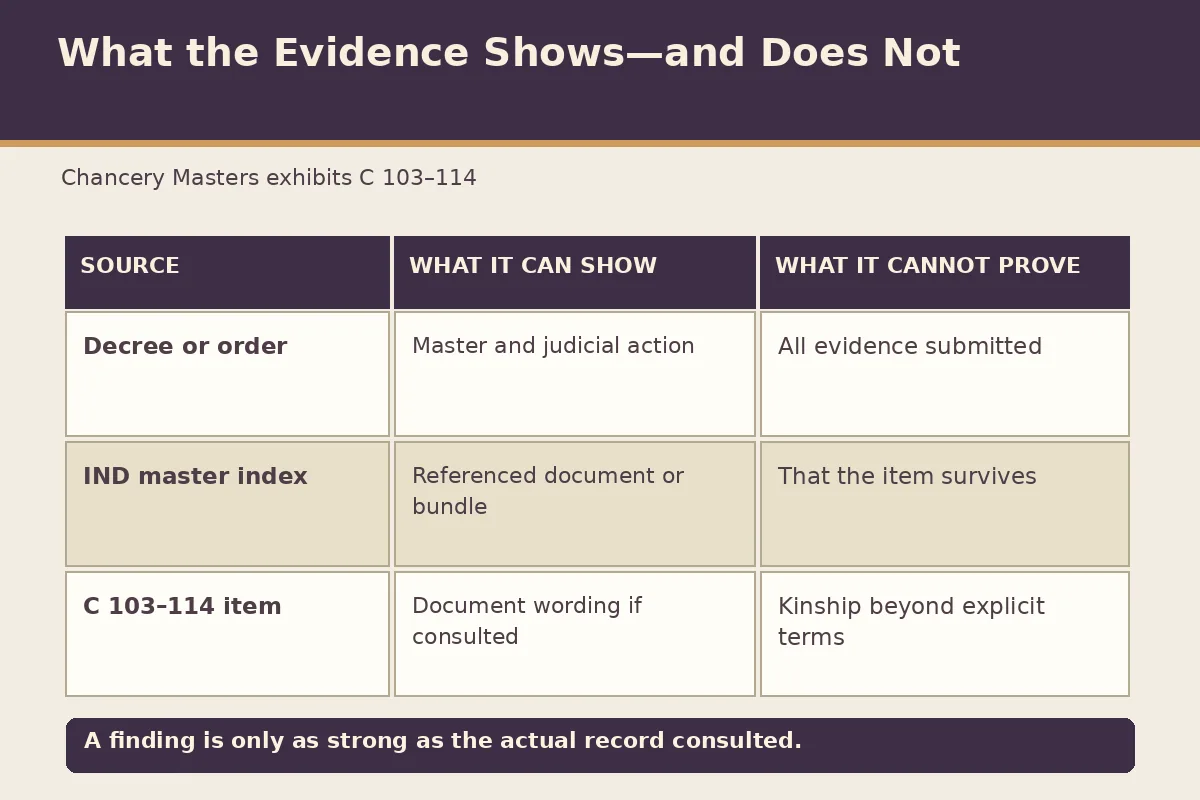
| Record | What it can establish | What it cannot establish |
|---|---|---|
| Decree or order | Master and judicial action | All evidence submitted |
| IND master index | Referenced document or bundle | That the item survives |
| C 103–114 item | Document wording if consulted | Kinship beyond explicit terms |
Follow related court records without merging their roles
The Masters’ exhibits can complement pleadings, decrees, orders and reports, but each answers a different procedural question. A pleading states a party’s claim; an order records an instruction or decision; a master’s report can present findings; an exhibit may show the raw document used in the inquiry. Building a chronology across these stages is more reliable than treating the last paper as a full history.
If the original piece cannot be located, search related Chancery series for context rather than inventing the missing exhibit’s contents. A report’s summary of an account may be accurate for a narrow question yet omit names or qualifications in the underlying papers. Be explicit whenever a finding is based on the report alone.
Understand dates and the risks of broad catalogue ranges
C 103–114 contain material whose dates stretch over many centuries; individual series may have very different date ranges. An unusually early item is not necessarily evidence that a nineteenth-century master personally handled the medieval case. The office-based series classification can bring older deposited exhibits together with later working material. Date the original document separately from the court case in which it was used.
Historical spellings, regnal-year dates, legal formulas and manuscript hands may complicate readings. If a date has been converted into a modern calendar year, preserve the original notation in a research note. When uncertain about a word determining kinship or ownership, mark an unresolved reading and seek a second transcription rather than smoothing the ambiguity out.

Cite both the index and the surviving document
Cite the Chancery suit reference that identified the master, the C 103 binder or derived mapping, the appropriate IND index entry, and the complete C 103–114 piece for any document you actually inspect. The index and the exhibit are separate sources. Record whether the evidence was an original, a copy, a transcript or a later abstract, because the chain affects how confidently others can reproduce it.
End with a finding limited to what the papers support: a stated claim, a sworn recollection, an estate payment or a judicial act. Include open questions and a next-source recommendation. If a missing exhibit is essential, say so plainly; the absence of one document does not prove that the event described in the litigation never happened.
More Records and Archives Guides
How We Research This Archive Route
We checked the first official archival guide against the second repository guide and compared the series purpose, documentary limits and access instructions. The illustrations are explanatory reconstructions, not scans or transcriptions of an archival document; no imaginary named ancestor has been inserted into a record.
Use a reproducible evidence log: the exact piece reference; what was actually consulted; the document creator and date; a transcription of critical words; contrary evidence; and the next document needed. A page in a catalogue and a page of evidence serve different purposes. When a record is missing, closed or only available in a reading room, state that limitation rather than inventing its contents. Roughly 20% of indexed Masters’ documents may be missing. Please read our affiliate disclosure; this research guide does not assert any paid provider relationship.
Find the suit’s decree or order and identify the Chancery Master who dealt with the relevant inquiry.
The papers are arranged around offices of particular Masters in Ordinary and their related indexes.
It locates or references masters’ papers but does not reproduce the complete original exhibit.
The National Archives estimates roughly 20% of indexed documents are missing; note the missing item and seek other surviving court evidence.
Not necessarily. Read its wording and context; a payment or mention may not establish title or a family relationship.