
HO 481 contains Operation Post Reports, assessments of foreign nationals living in Britain from the mid-1940s into the 1950s, including displaced persons and refugees. The National Archives describes up to 400,000 reports and a distinctive catalogue trap: two alphabetical runs have been intermingled. The series is closed for 100 years, although a review can be requested through Discovery. A catalogue-level reference is not permission to access or reproduce private information.
The practical method is to distinguish a catalogue locator, a document you have actually read, and an independently verified conclusion. Use the relevant National Archives research guide to understand what this series was created to record. Start a research log with your exact question, place, time period, preferred spelling variants and the piece reference; a search result alone is not a complete citation.
What an Operation Post Report was created to do
The reports arose from a mid-twentieth-century government initiative to examine foreign nationals living in Britain, partly through interviews and police assessments. They are administrative security documents, not neutral oral histories. According to The National Archives, they may include arrival information, birthplace, address, occupation, marital status, official numbers, and an assessment of perceived security risk; which fields appear varies.
The series includes people who fled eastern Europe after the Second World War and some refugees from later crises, including Hungary in 1956. Not every immigrant received a surviving report, and being mentioned in an administrative assessment is not evidence that the assessment was accurate. Write the research question first: arrival, identity, or a dated residence rather than general curiosity about surveillance material.
Search both alphabetical runs before declaring failure
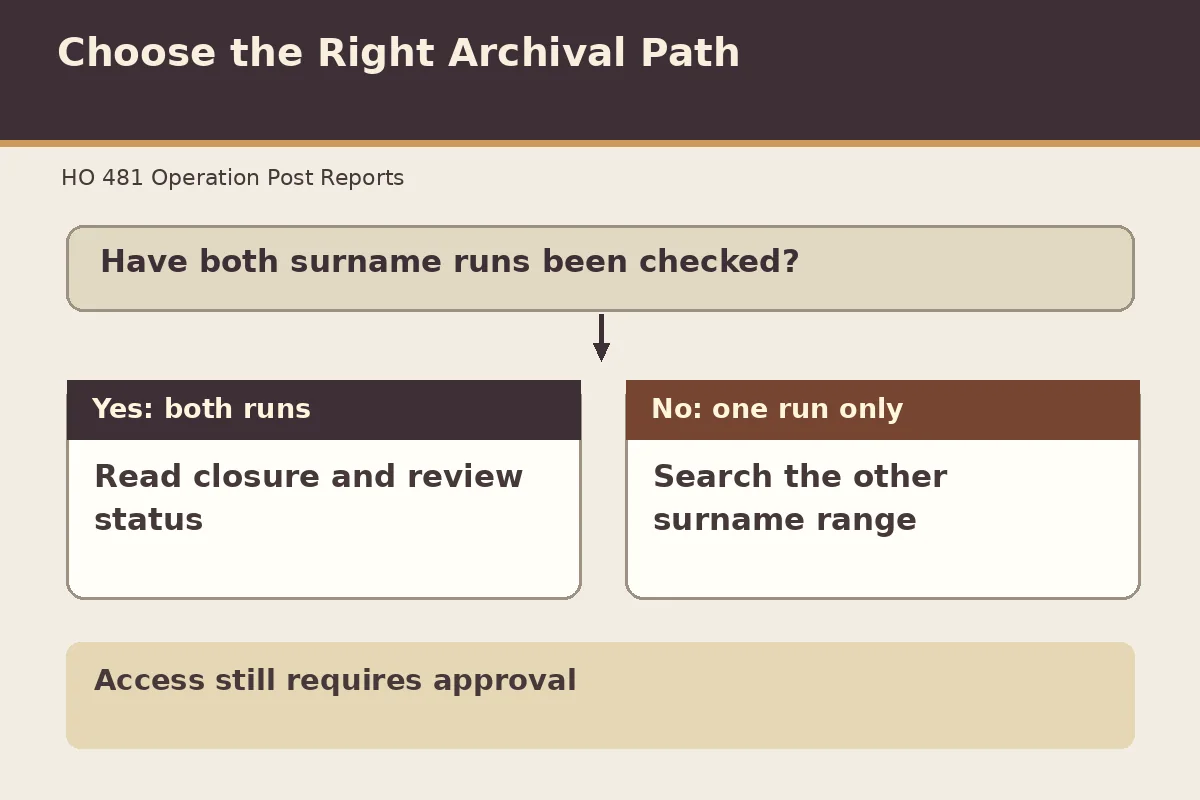
Within HO 481, two separate runs organized roughly A–Z were combined into a single archive sequence. Consequently a single surname can fall in two separate piece descriptions. The National Archives explicitly instructs researchers to inspect both candidate volumes, even when they have similar or identical surname ranges. One catalogue hit therefore cannot be treated as a complete surname search.
List surname spellings and transliterations before searching. Identify each candidate piece by its full archival reference and note the range displayed by Discovery. A surname-range match shows that a piece might contain a relevant report; it does not verify that the named person is in it. Do not convert a range heading into a fabricated individual index entry.
Understand the 100-year closure and lawful review route
The National Archives states that HO 481 records are closed for 100 years, while an access review may be requested under Freedom of Information through its Discovery catalogue. The archival description should be used to locate the specific piece or item and to follow the displayed request process. Neither an application nor passage of time automatically guarantees immediate release.
A review may involve personal information or other exemptions. Explain what your research question is and use the repository’s published procedures, not a workaround, scraped cache or third-party leak. Keep correspondence and decisions separate from evidence in the record. If access is refused or a review remains outstanding, describe the status honestly and use open independent sources instead.
Read security assessments as allegations and context
Reports may contain historical terms that are offensive today, or claims about political associations based on an interviewer’s perspective. Preserve wording where citation requires it, but do not repeat a stigmatizing characterization as an established fact. Distinguish a subject’s statement, an investigator’s inference and an official administrative conclusion; they are not equivalent kinds of evidence.
A report can be useful for dates and documentary identifiers if lawfully released, but those details still need corroboration. A family recollection of refugee status, an identity document and an official risk assessment may describe different parts of the same story. Conflict is a research finding to explain, not a reason to choose whichever source appears most formal.

| Record | What it can establish | What it cannot establish |
|---|---|---|
| HO 481 catalogue | Surname range and piece | Permission to read contents |
| Operation Post Report | Official assessment if released | An objective or error-free biography |
| Independent records | Dated identity or arrival facts | Automatic disclosure of private data |
Corroborate identity without exposing living people
For a historical subject, look for independent passenger records, naturalization documentation, local directories, employment archives or family-held records that can legally be consulted. Compare names, approximate dates and geographic transitions rather than relying only on a similar surname. Some records can relate to living people or their close relatives; respect permissions and avoid publishing identifiers unnecessarily.
Create a private evidence ledger with columns for record type, created date, authority, explicit facts, disputed interpretation and access status. If sharing a family history, consider summarizing the relevant historical conclusion instead of reproducing intimate personal detail. The existence of a file is not an ethical justification for publishing every statement inside it.
Recognize selection bias in surviving reports
The HO 481 series reflects a specific administrative program and the concerns of its officials. It is not a census of all migrants, all refugees or every person who crossed the British border. Geographic origin, perceived political relevance and individual encounters with officials may affect who was documented. Without understanding these selection mechanisms, a search outcome can be misread as proof about a person’s whole life.
A missing name among accessible descriptions does not establish that a person lacked refugee status. Record both alphabetical runs consulted, exact surname variants, current catalogue limitations and any closure barriers. Distinguish ‘no matching catalogue piece found’ from ‘a relevant piece is closed’ and from ‘a released report did not name the person.’ These are substantially different findings.

Describe a responsible HO 481 research conclusion
A strong citation identifies HO 481, the full piece or item identifier, its catalogue description, the date you checked access information and the condition under which material could be seen. If the report has not been released, do not cite unobserved contents. A Discovery page tells you where an item may exist, not the private facts you hope it contains.
Finish with a specific next action: verify the second volume sequence, request a lawful review if appropriate, or pursue open sources for the particular migration date. Keep the person’s account central where family testimony exists, while distinguishing memory from contemporaneous evidence. This process can preserve dignity without erasing genuine archival complexity.
More Research Method Guides
How We Research This Archive Route
We checked the first official archival guide against the second repository guide and compared the series purpose, documentary limits and access instructions. The illustrations are explanatory reconstructions, not scans or transcriptions of an archival document; no imaginary named ancestor has been inserted into a record.
Use a reproducible evidence log: the exact piece reference; what was actually consulted; the document creator and date; a transcription of critical words; contrary evidence; and the next document needed. A page in a catalogue and a page of evidence serve different purposes. When a record is missing, closed or only available in a reading room, state that limitation rather than inventing its contents. A closed report must not be accessed or inferred from a catalogue title. Please read our affiliate disclosure; this research guide does not assert any paid provider relationship.
The National Archives says these records are closed for 100 years; an FOI review can be requested via Discovery, without guaranteed disclosure.
Two alphabetical runs were combined; inspect both relevant surname-range pieces rather than stopping at the first match.
No. An official assessment reflects the reporting authority and may contain errors or offensive historical categories.
Identify the surname range, record the catalogue piece and follow the official request process; use lawful open sources in parallel.
No. The reports stem from a particular government initiative and do not document every migrant or refugee.