
For a traveler in the early 1830s, the unusual surviving source is not a universal immigration database but ADM 30/35, the passenger lists of HM steam packets traveling to, from and within the Mediterranean in 1831–1834. Treat a potential entry as evidence of a particular listed journey segment. It is not, by itself, evidence that someone settled at the destination, crossed every later border, or belonged to a named family. Begin with the route and month, not just a surname.
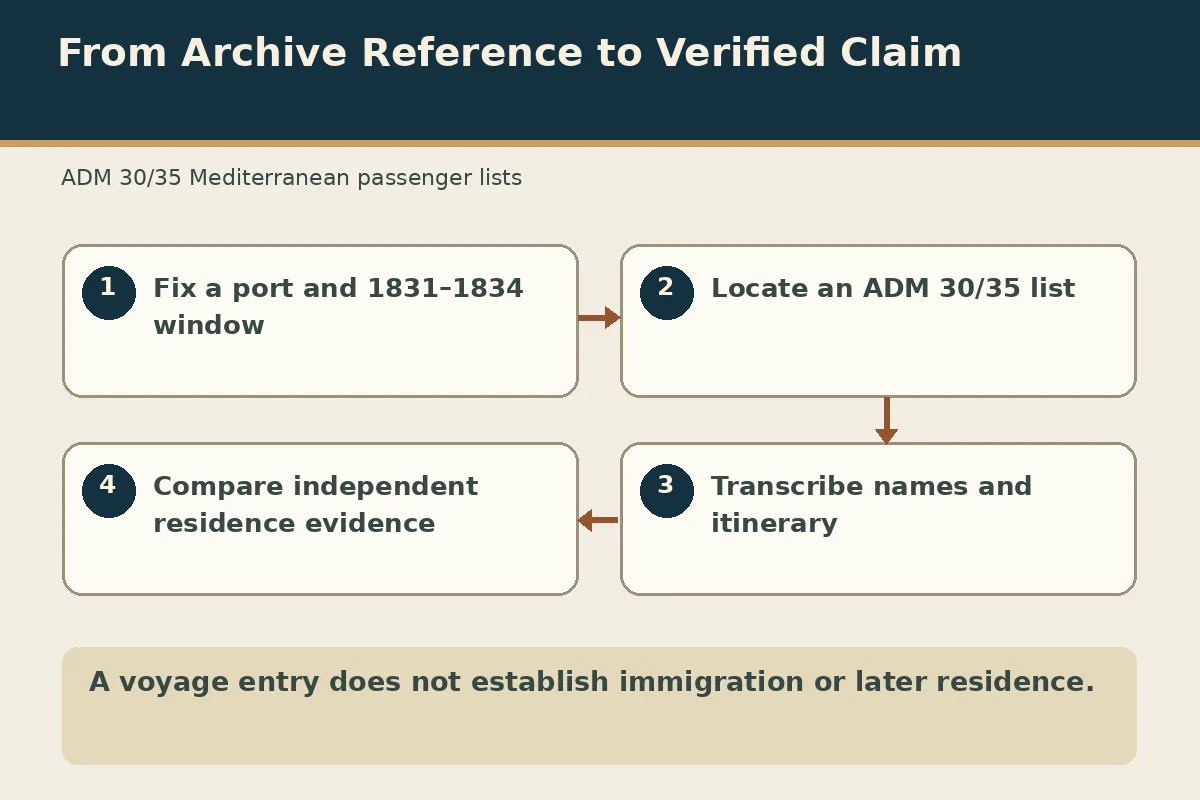
The practical method is to distinguish a catalogue locator, a document you have actually read, and an independently verified conclusion. Use the relevant National Archives research guide to understand what this series was created to record. Start a research log with your exact question, place, time period, preferred spelling variants and the piece reference; a search result alone is not a complete citation.
Why ADM 30/35 is an exceptional early passenger source
The National Archives distinguishes ADM 30/35 from the later, much larger passenger-list collections. It covers a specified group of HM steam packets in the four-year window 1831–1834, including travel between Mediterranean ports as well as journeys involving Britain. That qualification is central: an early packet list is neither a census of everyone entering a country nor proof that each traveler was a British emigrant.
Write down what makes the journey plausible before searching: a dated letter, a family account naming a port, a consular mention or a documented posting. If all you have is a surname associated with the sea, widen your place and date research first. A positive search result will be more credible when it answers an already defined historical question.
Build the port-by-port question before searching names
A person could have joined a steam packet at one Mediterranean port and left at another. Start a small route table recording intended origin, intermediate port if actually named, destination, and an acceptable date interval. Leave blanks where evidence is absent. Do not assume a packet carried the same passengers for the whole itinerary: the route of the vessel and the travel of one person are different objects.
Search the catalogue by the exact ADM 30/35 reference and inspect how the relevant piece is described. If a catalogue entry gives only a broad span, that is not an individual passenger index. Record the piece reference, leaf or page location and the image or paper source you actually consulted. A transcription without that locator is difficult to verify later.

Decide whether a name match is the traveler you seek
Early passenger references often offer fewer identity cues than a census or civil certificate. Compare spelling variations, occupation or social title if present, accompanying travelers, a plausible age if supplied and known arrival or departure plans. Never supply missing attributes as though they were written on the list. A common surname deserves a stricter comparison than a distinctive name.
Make a two-column distinction between observed facts and candidate explanations. ‘Name appears on the list for this sailing’ is observation; ‘this is the person who later married in Malta’ is an identity hypothesis requiring separate evidence. A letter written from the destination or a contemporaneous official register may bridge the gap, but only when dates and identifiers agree.
Know what a steam-packet list cannot prove
A list shows the passengers enumerated for a particular service, not all people traveling in the Mediterranean during the early 1830s. Travelers on merchant vessels, naval transports or undocumented crossings might never appear. An unproductive search therefore does not mean the alleged journey did not occur. It means this source has not supplied the expected evidence.
Even a correct passenger identification usually cannot tell you how long the traveler stayed, whether the journey was compulsory or voluntary, or whether a companion was a spouse. Treat a shared surname or adjacent names as proximity on a record, not proof of family membership. Build the family link from separate records created for the relationship.

| Record | What it can establish | What it cannot establish |
|---|---|---|
| ADM 30/35 | Passengers on listed packet | Permanent settlement |
| Port and date | A listed journey segment | Every stop on a life journey |
| Other civil records | Residence or family link if named | A guaranteed same-person match |
Compare packet entries with independent records
Useful corroboration depends on the event you want to prove. For travel, compare contemporary letters, dated ship notices or consular correspondence with the packet’s port and date. For subsequent residence, seek a church, civil, tax or address record created at the destination. For kinship, seek a birth, marriage, probate or equivalent record explicitly describing the relationship.
Preserve an event timeline with a column for the source’s actual wording. One person might appear in Britain shortly before a voyage and at a Mediterranean port later; check the chronological possibility without stretching the dates to force a match. A second record that repeats a later family story is not automatically independent confirmation.
Explain a missing result without inventing a negative fact
There are several distinct reasons for failure: the person traveled outside 1831–1834; a different type of vessel carried them; the relevant list was not retained; a leg was omitted; or the name was recorded under an unexpected form. Investigate these alternatives in the order suggested by the evidence you already have, not by an assumption that one collection is complete.
In the research log, say exactly which references, dates, names and spelling variants you searched. A search that returned nothing is valuable, but it becomes evidence that an event did not occur only after establishing that this specific source would normally have recorded that event and that the relevant material survives.
Record the reference so someone can reproduce the finding
Give the repository, series ADM 30, piece 35, the appropriate page or folio if visible, the list date, and whether you used the original, an image or a transcription. Keep place names in their contemporary written form alongside standardized modern place labels. The latter help map a journey but must not silently replace the original language of the document.
Close with a concise result statement: confirmed passenger and segment; plausible but unverified identity; and the next independently created source to consult. A genealogical finding is useful when its uncertainty is explicit. If no suitable item is found, record the exact search scope instead of converting an unlocated passenger into a non-traveler.
More Records and Archives Guides
How We Research This Archive Route
We checked the first official archival guide against the second repository guide and compared the series purpose, documentary limits and access instructions. The illustrations are explanatory reconstructions, not scans or transcriptions of an archival document; no imaginary named ancestor has been inserted into a record.
Use a reproducible evidence log: the exact piece reference; what was actually consulted; the document creator and date; a transcription of critical words; contrary evidence; and the next document needed. A page in a catalogue and a page of evidence serve different purposes. When a record is missing, closed or only available in a reading room, state that limitation rather than inventing its contents. A voyage entry does not establish immigration or later residence. Please read our affiliate disclosure; this research guide does not assert any paid provider relationship.
No. It covers surviving passenger lists for specified HM steam packets during 1831–1834, not every voyage or vessel.
No. It establishes only the particular travel entry as recorded; later residence needs an independent source.
A name can help, but searching the narrow date and route first reduces confusion between people with similar names.
Check the vessel type, year, surviving list, route segment and alternative name forms before drawing any negative conclusion.
Cite The National Archives, ADM 30/35, the relevant list date and page or folio when visible, and your consultation method.