
Identify the Demonstration Before Interpreting Medical Care
The National Archives describes a remarkably narrow group of just 18 photographs showing Esther Williams demonstrating medical reconditioning exercises in 1945. They appear in RG 112, Records of the Office of the Surgeon General (Army), under series CRP. This explicit series label is more useful than a broad internet image search for Williams or wartime hospital photographs. A demonstration can record a position, prop, assistant or sequence of movements, but it does not automatically document an ordinary patient’s treatment or a clinically tested result. First write down the photograph’s archive identity, then describe only what the frame actually displays.
Avoid assuming that every photographed exercise was performed at the same facility or on the same day. The 1945 date describes the group in the NARA guide; it is not automatically a precise exposure date for each frame. Note the original caption, visible equipment, clothing, photographer credit if present, and signs of staging. Do not call an unlabeled person a recovered veteran or therapist merely because the setting resembles a hospital gymnasium. When a relative’s name appears in a family story about Army rehabilitation, treat this series as historical context, not as an individual case index.
Keep the Exercise Sequence Separate From a Treatment Protocol
Historical photographs are especially persuasive because a movement can look reproducible. Yet one photograph can capture the beginning, middle or end of a sequence, and a demonstration may omit repetitions, clinical screening, precautions and supervision. Compare consecutive local identifiers before presenting a set as chronological. A single still does not provide the dose, intensity or instructions that a period therapist would have used. The right description is often “an exercise was demonstrated,” not “the Army prescribed this exercise to all recovering servicemembers.” Avoid offering historic movements as present-day medical advice.
Search RG 112 administrative material for instructions, reports, training policy, hospital administration and other period documentation relevant to medical reconditioning. A manual may describe why an exercise was included in a program, but a general manual cannot tell you how an individual patient responded. Distinguish publicity from curriculum: who commissioned the image, what audience it addressed and whether it was associated with training matter to interpretation. If the original mount is available, annotations could explain intended use more reliably than a later website summary. Preserve uncertainty where purpose or setting is unstated.

Find the Military Medical Context With the Correct Records
NARA’s RG 112 guide also lists wartime medical statistics, hospital records and other Army medical administrative files. The photographic CRP group sits beside these broader holdings, but the guide does not establish that a particular medical report is paired with one of the 18 images. Start by searching a date and program title in the finding aids; then compare the vocabulary used in the photograph captions with the language of contemporary Army medicine. A match in subject supports a contextual explanation, not an item-level connection unless a document explicitly references the image or demonstration.
When researching a relative’s wartime recovery, make an independent chronology: military unit, dates of reported illness or injury, known hospitals, convalescent postings and later discharge. Medical and service files have their own custody and access rules; historical images rarely supply the missing personal information. Be careful with an anecdote that says a family member “did the Esther Williams exercises.” It might mean the person encountered a similar Army program, a popular magazine illustration or a remembered celebrity name. Without a dated letter, diary, treatment note or reliable contemporary account, say the anecdote remains unverified.

Evaluate Captions, Reproductions and the Missing Frames
A photo caption may be original, supplied later by an archivist or copied from publicity material. Keep the literal language in your notes and identify its origin rather than silently updating terms. The current digital view might crop out a measuring line, handwritten label, exercise apparatus or person at the edge. Request the complete series citation and, if appropriate, ask NARA about adjoining frames, original negatives, mounts or reference copies. The 18-image total is the count described in the guide, not a guarantee that all 18 are digitized or individually described online.
Use a claim table with distinct rows for what is visible, what the catalog says and what a contemporaneous program document says. If a caption says “reconditioning,” do not treat that as evidence of a specific injury or modern rehabilitation diagnosis. If a second photograph depicts a different posture, do not supply invented minute-by-minute progression. The same standard applies to names: a demonstrator’s identified name does not identify an assistant or observer. A reliable article can reconstruct a public presentation while avoiding a fictional patient narrative.
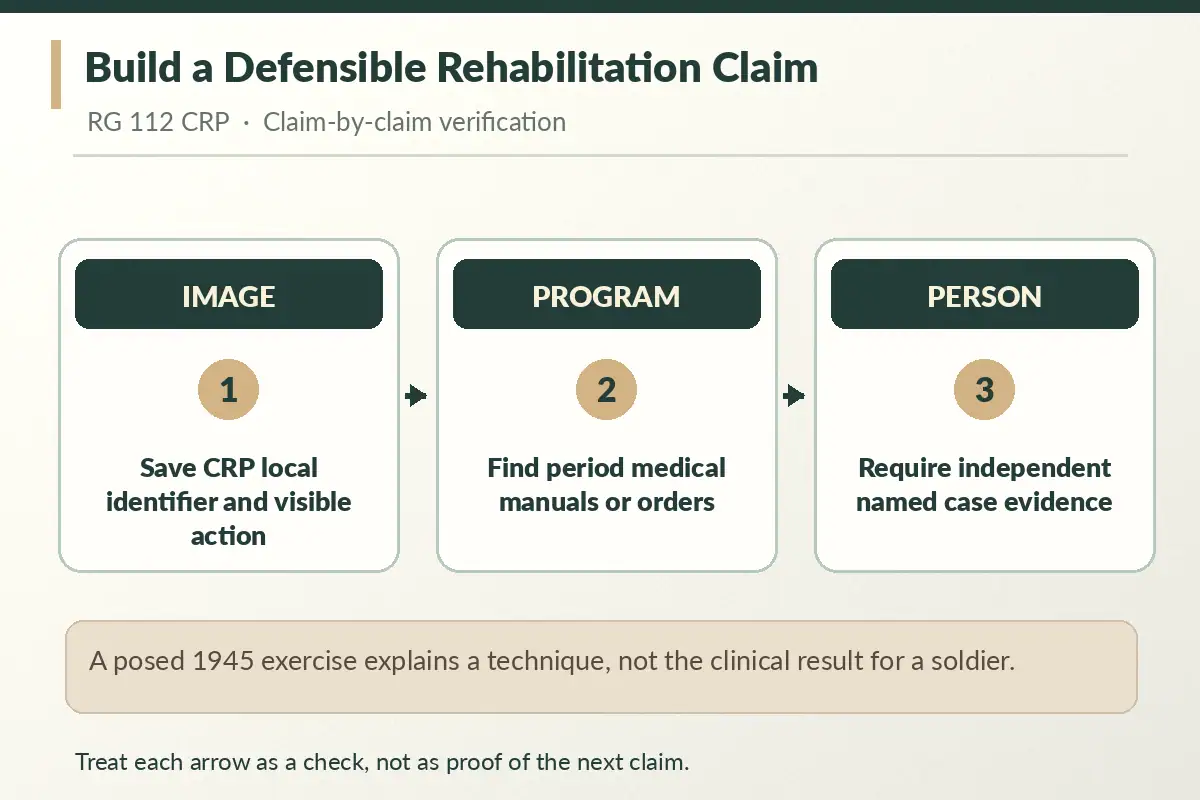
Write a Citation That Keeps the Clinical Claim Proportional
For every frame used in a family history, save “NARA, RG 112, CRP,” the local identifier, supplied title, indicated year and the URL or reference-room citation. NARA recommends recording the full item reference rather than relying on a generic subject label. Attach the citation to a modest sentence: “The CRP series documents a 1945 demonstration of medical reconditioning exercises by Esther Williams.” If you have an independent hospital or family record, cite it next to a separate sentence about the particular person. Neither citation should be made to support the other claim without a documented bridge.
Look for signs that an image may have been prepared for educational display rather than taken as routine clinical documentation: carefully repeated poses, deliberate camera viewpoint or an annotated teaching sequence. Those are research questions, not proof of a specific production intent. Record alternate explanations, including a publicity series or later copied illustration. If you cannot find an original negative, note that limitation. Your conclusion should remain useful without pretending to measure therapeutic outcomes or to recover an unknown patient’s diagnosis from eighteen historic pictures.
For a classroom or family presentation, show only the part of the image needed to support your claim, and keep any contextual caption outside the historical photograph. Label an editorial reconstruction as such. When discussing a famous performer, avoid turning celebrity participation into a testimonial about clinical efficacy. A useful comparison pairs the NARA image caption with a separate period instruction or official publication, then asks what they agree upon: the name of a movement, the intended audience or the general wartime rehabilitation setting. If they disagree, do not harmonize the records by inventing a shared location. The family-health story needs a third, individual source.
More Research Method Guides
How We Research This Evidence
This guide is based on the National Archives record-group description and a second official source, checked November 16, 2026. We checked the exact series labels and collection dates against the custodian rather than guessing from a generic subject search. For item-level inquiries, follow NARA’s still-picture reference guidance: retain the full local identifier, including series and divider information where applicable. The series description does not establish that every item is digitized, that an individual photograph has an exact date, or that any pictured person is identified. There are no paid links or unverified products in this guide; see our affiliate disclosure.
Eighteen photographs, listed as 1945 series CRP in RG 112.
No. NARA describes her demonstrating medical reconditioning exercises, not receiving documented treatment.
No. A still cannot provide a diagnosis, comparative outcome, prescription or follow-up result.
The series description does not establish item-level digitization. Search the catalog and ask NARA with the series and local identifier.
Not reliably. Seek dated personal medical, military or family records under their appropriate access rules.