
Read E 123 as a Court Record, Not a Verdict List
E 123 is an early series of Exchequer entry books for decrees and orders in equity matters. The National Archives describes Series I as covering the reign of Elizabeth I and the beginning of James I. A registered order may move a case toward hearing without resolving the dispute. Begin with the parties, date, court wording and the exact E 123 reference rather than treating every entry as a final ruling on land or inheritance.
An order could appoint a hearing date, authorize a commission or address an interim matter. A decree was the final judicial decision when a case reached that stage. The National Archives cautions that many suits were withdrawn or settled before a final decree, so a procedural order may be the last surviving document even though no judgment was pronounced.
For a family question, identify whether a named person was plaintiff, defendant, witness, commissioner or someone merely mentioned in recited background. The presence of a surname in a court record does not prove family relationship or rightful title. Make a role table before importing any connection into a family tree.

Find the Right Entry and Its Index
Start with a documented party name, county, manor or closely dated dispute. Search Discovery, but do not assume every early entry is indexed by name in a modern searchable form. The National Archives identifies manuscript lists and indexes for E 123, including IND 1/16897 for E 123/1A–1B, so older finding aids can be essential even where catalogue keyword searching returns little.
Use the case’s approximate year and reign to select the correct part of the series. A later decree enrolled in another Exchequer series will not be found by widening an E 123 name search indefinitely. The archive guide notes overlapping entry books and alternate enrolments; choose by chronology and record function rather than an attractive catalogue title.
When an entry is found, transcribe the date and party names exactly as written. Record abbreviations, uncertain readings, Latin or translated formulae, and the original piece reference. Do not modernize the name and discard its historic spelling, because the same variation may provide the key to earlier pleadings and county indexes.
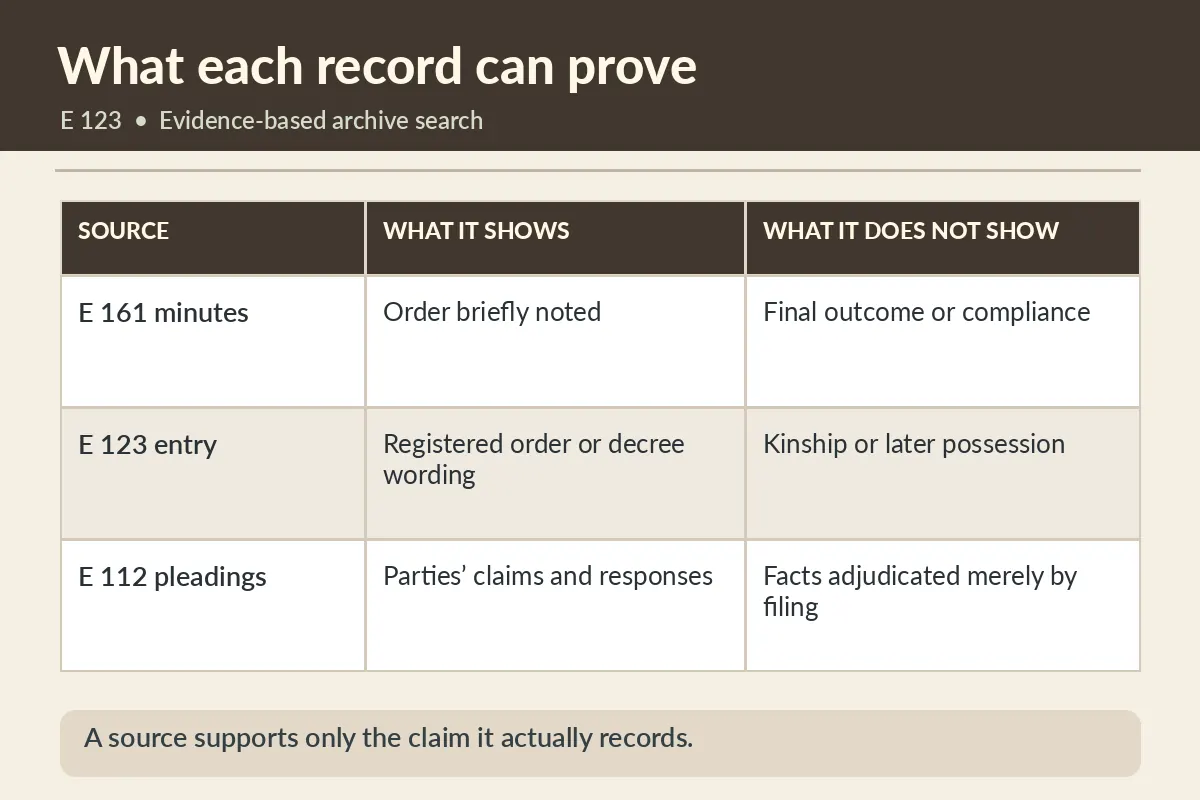
Connect Orders to Minutes and Pleadings
The National Archives identifies E 161 Common Minute Books as a place where orders were first noted, while E 162 Exchequer Chamber Minute Books contain first notices of decrees. E 123 records some of the fuller registered orders and decrees. Those sources document different administrative stages; they are not three independent eyewitnesses to the alleged land claim.
For the substance of the dispute, look for associated bills and answers in the Exchequer equity records, especially the E 112 system where it fits the period. A pleading states what a litigant alleged and is often selective. A deposition or inquiry can report testimony, but the testimony still needs assessment. Record statements as arguments until they are independently verified or adopted by the court in a decision.
Build a chronological case sequence: bill filed, response, interim order, commission if any, hearing note and final decree if one can be located. Leave a blank rather than inserting an imagined step. A court’s order for an inquiry cannot establish that the inquiry’s allegations were substantiated, and the absence of a decree in one volume does not prove the lawsuit never ended.
Use Land and Enclosure Claims Carefully
Exchequer equity disputes could concern land, debt, revenue and contractual questions. The National Archives enclosure guide notes that some sixteenth-century enclosure agreements were enrolled through equity courts and that entry books E 123–E 131 can preserve related decrees. The existence of a decree may show a legal disposition, not necessarily the full modern boundary or continuous private ownership afterward.
If a record names a manor, parish or field, identify the historical jurisdiction and compare the names with dated estate records, surveys, tithe material or later deeds. A court recital may cite an old grant without proving that the described parcel is identical to a current address. Separate the place mentioned in litigation from a particular family’s residence.
An enrolled decree can be strong evidence for the terms it states. Still, execution and enforcement may generate later records. Avoid writing “the plaintiff received the estate and lived there” solely because an order set out a transfer. Confirm the later possession or occupancy independently and preserve any dispute over whether the order was fulfilled.

Record a Judgment Without Inventing Kinship
Write a source table with columns for document type, participants, action stated and limit. For a routine order the limit may be “no final finding.” For an enrolled decree, the limit may be “later compliance unproven.” When parties share a surname, investigate whether the document explicitly calls them relatives rather than inferring a family relationship from an adversarial proceeding.
Cite E 123 by piece, folio or page where available, date and role of the relevant party. Add the E 161 or E 162 citation when using a minute-book cross-check, and cite any pleadings separately. Mark copied text and inferred interpretation distinctly. The name of a case is not a substitute for an exact archive reference.
Conclude with a precise proposition such as “E 123 records an order authorizing a commission” or, where warranted, “an enrolled decree directs a stated legal remedy.” Avoid saying the court proved an ancestral lineage or that a claimant permanently acquired property unless another source supplies that evidence. A restrained conclusion is easier to audit and more useful for later research.
More Records and Archives Guides
How We Research and Verify the Archival Record
For this guide we checked the official series and research descriptions for E 123 against the document categories, chronological boundaries and access limitations specified by the custodians. We separate series-wide statements from claims about a particular piece: the former establish a search route, while the latter require the piece itself. Our principal source descriptions are Court Exchequer Enclosure Awards What Can I Use Discovery For. These sources support reference names and evidence limits; they do not certify an uninspected record as proof of an individual event.
Our verification worksheet records the claim, exact E 123 reference, creation date, nature of the entry, names and roles actually written, independent source used for comparison, and any unresolved alternative. The illustrated search routes are teaching reconstructions, not facsimiles of original records. Consult the affiliate disclosure for the site editorial and commercial policy. This article does not depend on an unverified paid provider or a claim of access to closed material.
No. The series records both interim orders and decrees; only an appropriate decree may represent final judicial disposition.
The National Archives describes it as Elizabeth I to the beginning of James I, not as a comprehensive register for every later Exchequer case.
E 161 notes orders; E 162 includes first notices of decrees. Follow exact dates and parties to link records.
Not unless the relationship is explicit and supported by the source; party names and property disputes do not establish kinship.
No. Some finding aids and manuscript indexes are needed, and Discovery searches catalogue descriptions rather than full document text.