
E 134 preserves sworn testimony for some English Exchequer equity disputes. Learn the county-based search limits and follow pleadings to decisions. Begin with the official archive guidance, distinguish a catalogue entry from an original image, and review our affiliate disclosure before choosing paid collections.
Why an Equity Suit May Name People Missing Elsewhere
Exchequer equity records can preserve arguments about property, trusts, accounts and obligations that touched whole communities. Witnesses might mention neighboring land, past occupations or family claims in the course of a suit. The National Archives identifies E 134 as depositions taken by commission, primarily outside London. That makes it an unusually rich but narrow entry point. It is not a list of every English household and not a database of every legal dispute. Start with a county, the approximate time of a conflict and the precise people or places at issue.
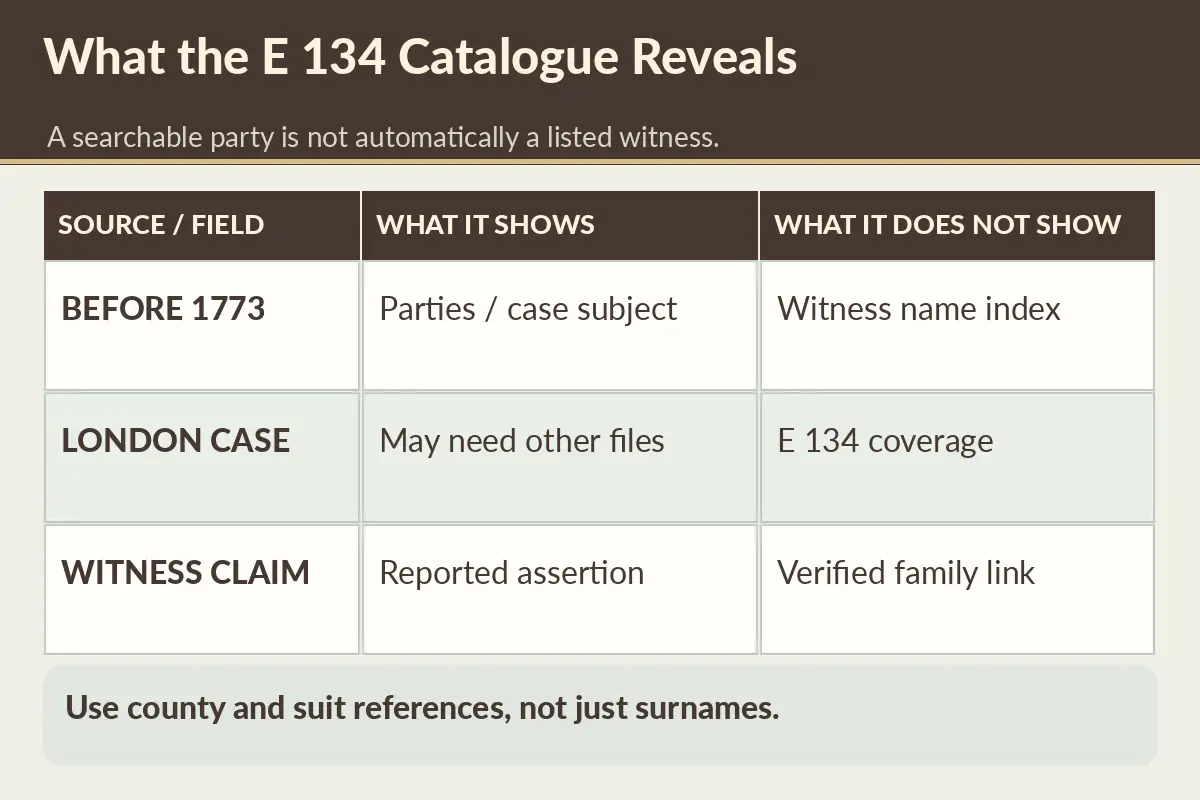
A statement in a deposition is attributed testimony, not automatic truth. A witness might repeat what another person said, misremember a date or describe property from an interested standpoint. Build a research question such as whether a named tenant occupied a particular holding before a transfer. That is more testable than asking whether the file proves the whole family lineage. Collect each location spelling, surname variant and historical county name. Avoid interpreting a witness’s claim to be a ‘kinsman’ as proof of a specific parent-child link without other evidence.
Use the E 134 Catalogue and Understand Its Blind Spots
The Archives recommends an initial E 134 catalogue search for a known equity suit but warns of two structural traps. Descriptive entries before Easter Term 1773 generally name plaintiffs, defendants and the dispute, not the witnesses. E 134 does not cover testimony taken in London. Therefore a missing surname search for a deponent tells very little about the absence of that person in the document. Try known litigants, a manor or parish, a disputed estate and variant place names. Restrict the search to E 134 and read the scope of any result.
The catalogue is considerably less descriptive for much later material, and original calendars and paper finding aids may require a visit to Kew. Record which search interface, county and term dates were covered. A pre-1773 hit is a route to a specific packet, not a verbatim transcript. If you locate a document, check whether its wording is a printed calendar’s summary or the actual signed/recorded examination. Distinguish multiple people with the same name by their stated residence, status and connection to the dispute, not just by name similarity.
Move From Depositions to E 112 Pleadings
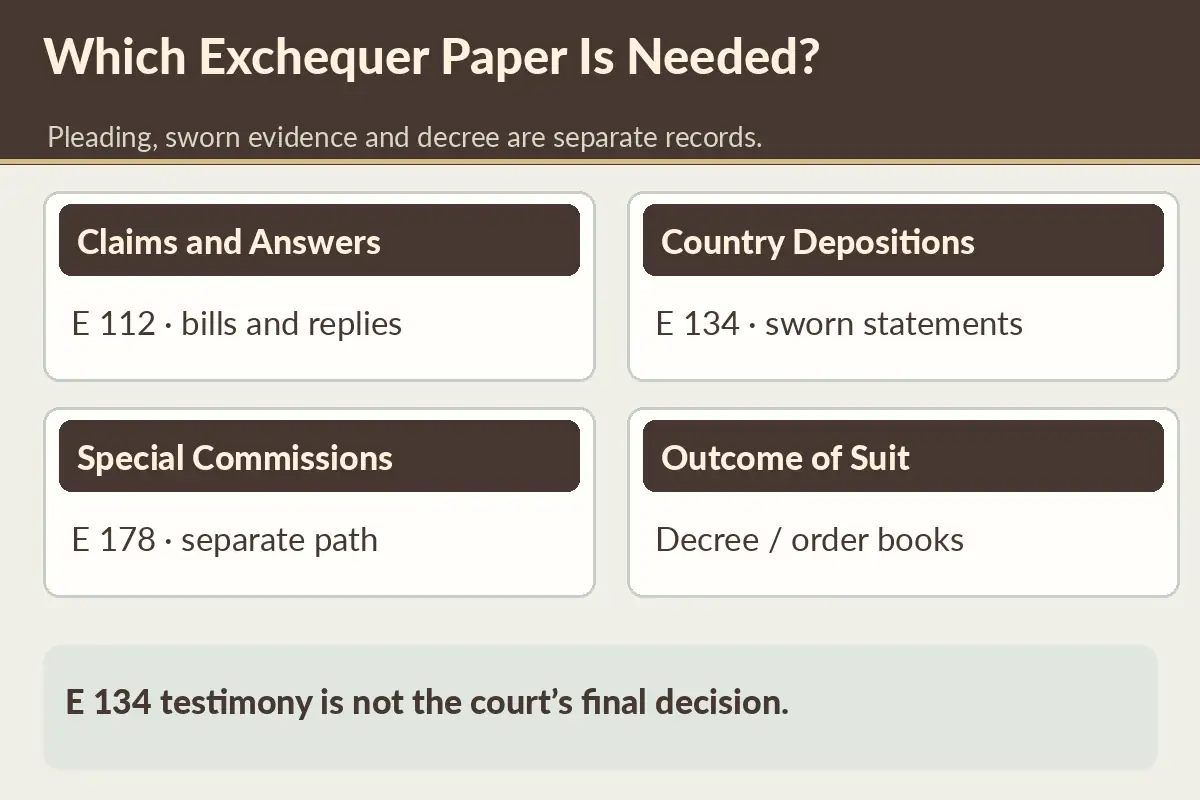
An equity action produces several record kinds, which the Archives groups as pleadings, evidence and court decisions. E 112 contains much of the Exchequer bills and answers from Elizabeth I through Victoria, arranged by reign and county; unlike many E 134 descriptions these papers are not simply name-searchable online. The bill books serve as historical filing registers. Find the county and suit number in the bill book, then use that number to identify the correct E 112 portfolio. Do not assume the E 134 description itself includes all the pleadings.
Transcribe what the bill claims, what the answer admits or denies, and which allegations require supporting evidence. A defendant’s answer can be self-serving, just as a plaintiff’s opening case can be. The same suit may have procedural entries elsewhere, including appearance books E 107, special commissions E 178 or exhibits E 140. These are different branches, not mandatory stages surviving in every case. File references should remain attached to the exact documents: one suit may appear under several series numbers without any of those records being interchangeable.
Identify the Witness Without Confusing Roles
An E 134 witness might be a neighbor, tenant, tradesperson, servant or relative, but a lawsuit’s parties and witnesses occupy legally different positions. First classify every named person as plaintiff, defendant, witness, commissioner or a person discussed by someone else. Then copy the question and the complete answer where available; isolated quotations can erase uncertainty or qualifications. Note the witness’s stated age, parish, occupation or connection if actually recorded. Do not insert a supposed surname, marital status or family role into a missing field based on context alone.
Compare testimony with dated leases, manorial documents, parish register entries and tax lists for the same place. A reported occupation of a cottage needs a different proof path from a claim to own the freehold. A witness who reports that someone was ‘father of’ another person may be providing direct testimony or repeating common knowledge; identify the informant’s opportunity to know. If two witnesses disagree, preserve their separate claims with dates and search for records external to the lawsuit. Repeated assertions copied from one bill are not independent corroboration.
Find a Decree Instead of Calling Evidence a Verdict
The court’s evidence and the court’s conclusion were recorded separately. The National Archives describes decree and order books as another class of equity record; a bundle of depositions may have no corresponding decision within the packet. After identifying a suit, follow its references and finding aids to decrees or orders where surviving. Do not invent a winner when the only surviving text is testimony, a draft order or an unanswered bill. Clarify whether a decision granted relief, merely ordered further proceedings or concerned costs rather than land title.
Chronology also matters. Pleadings can be amended; a dated commission can collect statements about events many years earlier; an order may be followed by later proceedings. Keep the year of the legal document separate from the period described in it. Compare any outcome against actual later property transfer documents. Even a final decree in an equity action does not necessarily show who occupied land after the litigation ended. A convincing family account explains the legal purpose of each source and attributes its claims narrowly.
Document a Negative Search and Decide the Next Route
If E 134 contains no result, the reason may be a London deposition, a suit without surviving depositions, post-1773 cataloguing gaps, or a spelling and county mismatch. The Archives expressly says there is no comprehensive name index across the records. Use the bill books and E 112, inspect the historical indexes at Kew, and consider E 178 for special commissions. Do not report ‘no lawsuit existed’ when the actual research covered only an online descriptive calendar. Record place variants and the exact years consulted.
A reusable case summary should identify the type of action, each party, the deponent’s words, the date and county, related pleadings, any confirmed decree and unknown later consequences. Photograph or transcribe the specific original page where permitted. Note whether the source is in English or an older legal hand and mark unreadable portions rather than guessing a surname. When sharing historical allegations, distinguish them from findings and be mindful that the original may contain severe accusations of wrongdoing. An accurate unresolved suit can still reveal valuable evidence about a family network.

How We Research This Specific Archival Claim
Our review first distinguishes the office that created the records from the later catalogue, digital provider and modern interpretation. We check the repository’s period, surviving extent, original arrangement, access rules and description of each series. Every source is read for exactly what it reports: an original statement may be accurate about one event yet inadequate for a family relationship, legal outcome or residence claim. We test competing namesakes with independent dates, places and record identifiers, keep conflicting claims in separate rows and document precisely which portions of a collection were searched. A negative online search is not a negative archival finding without a documented coverage assessment.
More Records and Archives Guides
Archive Sources and Their Evidentiary Limits
The primary archival guide explains Documents E 134 deposition search limits, pre-1773 descriptions, non-London scope, county bill books, E 112 pleadings and separate decrees.. An additional official research source confirms Explains that Exchequer depositions E 134 may concern administration and disputes of the Civil Wars and Interregnum; a contextual search avenue, not universal name coverage.. These institutional descriptions establish the existence and general scope of records; only the original document can establish what it says about a particular person. Date your retrieval, cite the full piece and page, and keep unresolved namesakes open rather than borrowing unverified details from a published tree.
No. Pre-1773 descriptions generally list parties and subjects, not every deponent.
The National Archives says E 134 excludes depositions taken in London.
It contains Exchequer bills and answers; finding an individual suit may require county bill books at Kew.
No. Testimony and decrees are separate record classes.
No. Survival, county, date and cataloguing all limit what an online search can establish.