
Start With the Payment, Not a Life Story
The Exchequer of Receipt issue rolls in E 403 record payments made through the Crown’s financial administration. The National Archives dates the series broadly from about 1216 to 1834. A payment entry can help establish that an identified person, office or intermediary was recorded in a disbursement. It does not automatically prove that the named person personally collected the money, accepted an appointment, lived at Westminster or performed every service that the payment was intended to support.
The National Archives’ project Friends in High Places: Chaucer at the Exchequer traces many entries relating to Geoffrey Chaucer’s annuity in E 403. That documented individual case illustrates both the research potential of issue rolls and the danger of generalizing: not all named recipients have a similarly rich, indexed series of entries. The project identifies over 150 annuity-related entries, not a universal annual list of Crown employees.
State a testable question before opening the archive: was a particular sum issued to a named official in a defined interval? Record the individual, office, expected date and the associated reason if independently known. A useful citation includes the E 403 piece, internal roll or membrane, date, recipient wording, sum and the exact function of the entry. A later biography can be linked only where its own evidence permits.
Distinguish a Warrant From an Issue
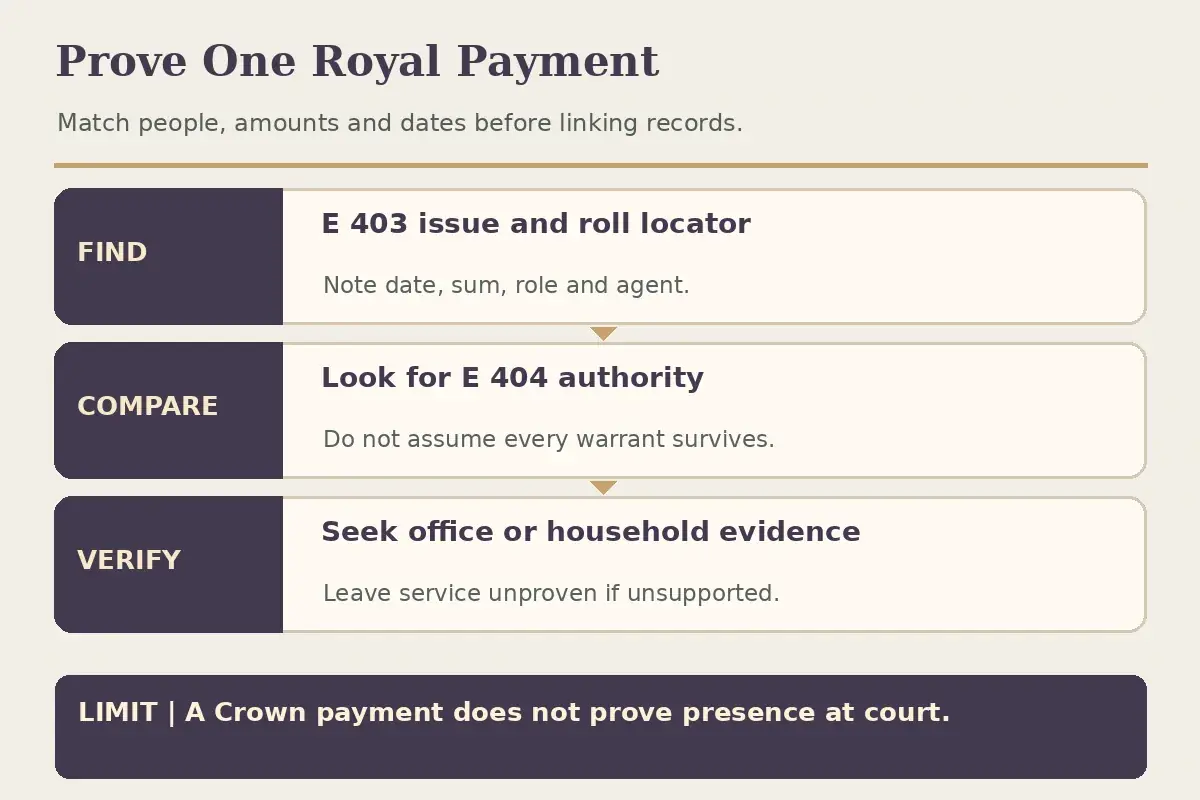
The official royal household and wardrobe guide separates issue rolls in E 403 from warrants for issues and wardrobe debentures in E 404. A warrant is a direction or authority to make a payment; the issue roll records a disbursement through a different administrative step. The two records may support one another if the person, amount, office and date align. Never display a warrant followed by an issue roll as a universal sequence: some supporting papers are lost or may have been created elsewhere.
E 361 summarizes much wardrobe and household expenditure for 1257–1548, while E 101 includes diverse original accounts. Such records can supply different viewpoints and should not be treated as interchangeable copies of E 403. A household official receiving funds is not proof that every person who supplied goods to that office was paid directly by the Exchequer. Distinguish the ultimate beneficiary, the person authorized to receive money and any administrative middleman.
Payments might represent annuities, salaries, provision or other financial obligations. A word such as ‘paid’ needs to be read in the accounting formula and period used by the original. Do not recast a lump-sum issue as a regular monthly wage. If the record uses an old dating convention or a regnal year, write the original form and explain a verified modern equivalent rather than rounding to an unsupported calendar date.

Read the Role of Every Named Person
A single issue entry can name a Crown official, a payee, a creditor or an intermediary. The first question is therefore not ‘Which ancestor received this?’ but ‘Whose role does this name occupy in the sentence?’ Copy titles and offices, and do not drop language indicating someone acted on another person’s behalf. In historical genealogy, institutional roles often explain why a person appears in an account more effectively than a simple surname search.
Our evidence matrix uses three rows. E 404 can support a recorded instruction; E 403 can support a recorded issue; an independent office register, wardrobe account or local receipt can test a claimed appointment or later delivery. The entries may not survive for every case. A name appearing in E 403 could be a useful clue for employment or association with the Crown, but it is not by itself a proof of tenure, length of service or kinship.
Compare possible namesakes cautiously. Medieval names may be rendered in Latin, abbreviated or attached to titles and places that changed over time. A match in occupation, accounting period and official capacity matters more than spelling alone. If a later family pedigree asserts that the person was the same individual, record which independent charter or household document creates the identifying bridge. Without it, leave the pedigree unproven.

Test One Crown Payment in Sequence
First seek the issue-roll entry for a period and department rather than treating keyword search as exhaustive. The National Archives guide notes that medieval maritime personnel and voyages are unevenly indexed across multiple series, including E 403. Where a printed calendar or modern database provides a lead, use it to identify the original reference and inspect the underlying roll when access permits. The index itself is not identical to the full accounting entry.
Second classify the financial act. Record the sum, currency, described purpose, recipient, date and any accounting office, making explicit whether the entry records cash issued to an intermediary. Third find a separate, specific document if you want to establish an appointment, an annuity grant, an actual voyage or household service. If none exists, the conclusion should remain about the issue entry. Adding a guessed job title is not acceptable corroboration.
Finally preserve the negative evidence correctly. A missing E 403 hit can reflect incomplete indexing, variant names, different accounting procedures or a surviving piece not yet checked. It cannot prove that the Crown never paid someone. Keep a search log naming inspected rolls and date spans. Use the contrasting functions of E 403 and E 404 to make any uncertainty visible, not merely tucked into a closing disclaimer.
More Records and Archives Guides
How We Research Exchequer Issue Rolls
Our method follows the financial act through its original administrative context. The contemporary research project about Chaucer supplies a documented example, but our diagrams use generic illustrative entries rather than forged historical facsimiles. We verify the series title and coverage from The National Archives and distinguish mandates from disbursements. We do not translate a roll’s language into a family relationship without a separate record.
Every claim is identified as a recorded instruction, a recorded financial issue or a later independently documented event. For medieval materials we capture source form, office, dating system and any person acting as agent. We do not assume a person visited Westminster merely because the Exchequer of Receipt was based there. Presence in a Crown account and physical attendance are distinct historical questions.
Our affiliate disclosure states the project’s transparency policy. Readers do not need to purchase a speculative family-tree profile to do the core audit. Save the precise E 403 reference and note what further document would change your conclusion. A good finding may be a specific royal disbursement with the claimant’s actual identity and service status still open to investigation.
The Exchequer of Receipt issue rolls and registers, recording Crown payments from roughly 1216 to 1834.
E 403 records issues or disbursements; E 404 includes warrants and other authority documents for expenditure.
Not necessarily. The named person may be an intermediary or beneficiary; service requires independent evidence.
No. It does not necessarily document the payee’s physical presence.
A specific E 403 piece and roll locator, date, exact names and roles, amount and source form consulted.