
Read a Gascon Roll as Crown Administration
The Gascon Rolls, held by The National Archives in C 61, preserve orders and related administrative acts concerning lands in south-west France held by English kings. They are useful when a family-history question touches royal officials, merchants, protections, property or service in medieval Gascony. A name in an order records a particular administrative relationship, not a person’s entire life. It cannot establish kinship, permanent residence in France or an actual journey without additional evidence.
The National Archives guide to French lands of the English kings gives a practical C 61 route: printed editions and calendars for early rolls, followed by later calendaring work to 1468. Search by the medieval location, royal office or named party, with dates and language variants. Do not transfer an English county’s spelling or political boundary to a medieval Gascon place.
Start with a document-specific question. For example, did a royal order protect a merchant at a stated time, or did an appointment authorize an official to collect money? Distinguish the person issuing the instruction, the addressee and the named beneficiary. If the roll records a proposed action, its words need not imply performance. Save the document’s C 61 piece, membrane or item locator and the exact date format.
Choose the Right Calendar for the Period
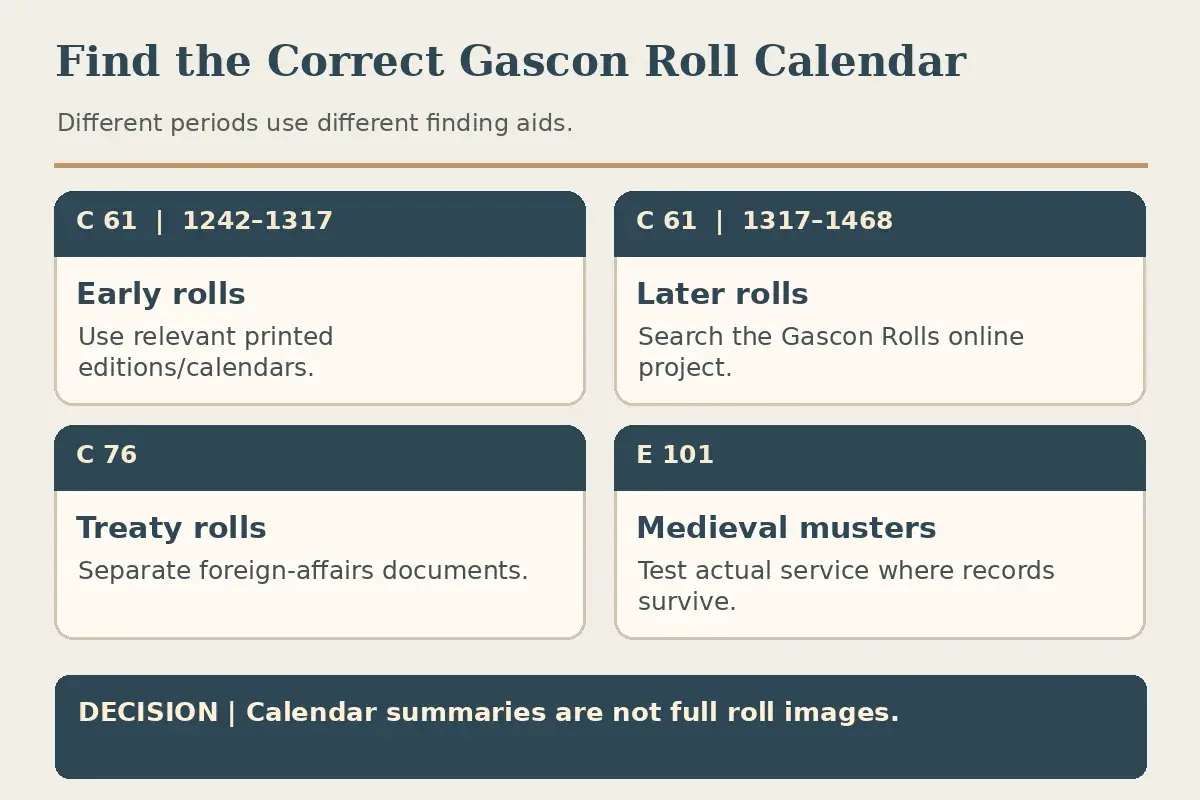
The earliest C 61 documents are covered by different printed and scholarly editions. The National Archives identifies volumes of Rôles Gascons dealing with 1242–1255, 1273–1290 and 1290–1307, together with publications for 1307–1317 and special handling of C 61/3. These are not interchangeable all-period search tools. A research plan should begin with the date and piece rather than assume a single modern name index covers the series.
For the later period, the medieval maritime research guide points to the Gascon Rolls project covering 1317–1468 with free online calendars. Search the accessible calendar for people, maritime trade, ships, officials or places, but inspect the contextual record or original-image material where available. A translated summary is a guide to the original, not necessarily a word-for-word legal transcription.
The date gate matters because a gap in an online project index can simply mean that a particular piece is handled by a printed calendar. Conversely, the appearance of a French place-name does not put it inside Gascony or within the same English administrative jurisdiction in every reign. Check the royal date, geographical context and the original source reference before stating who governed a locality. Preserve the uncertainty of translated proper names.
Classify Grants, Protections and Intended Service
A Gascon Roll can describe an office, protection, order or commercial matter, but the verb used in the record controls what it establishes. Permission for a person or ship to travel is not a passenger list. A protective letter does not prove arrival. An instruction to collect dues is not proof that a debtor paid. A royal grant is not necessarily evidence of possession across generations. These distinctions are especially important where a family story has reduced several steps to a single legendary event.
The National Archives medieval soldiers guide lists C 61 among sources for intended military service in Gascony. It separately identifies muster material in E 101. That distinction is substantive: a royal protection associated with future service and a contemporary muster of men actually enrolled answer different questions. If the specific muster does not survive, do not convert an intention into completed service.
A person can appear as an officer, petitioner, trader, agent or witness. Record each person’s legal or administrative role; namesakes are common across long spans. A surname plus a town in a royal calendar does not demonstrate hereditary descent from a medieval noble family. To test parentage, seek an independent charter, court or family record that names a relationship, and establish that the identity and generation align.

Move From a Calendar Entry to the Surviving Roll
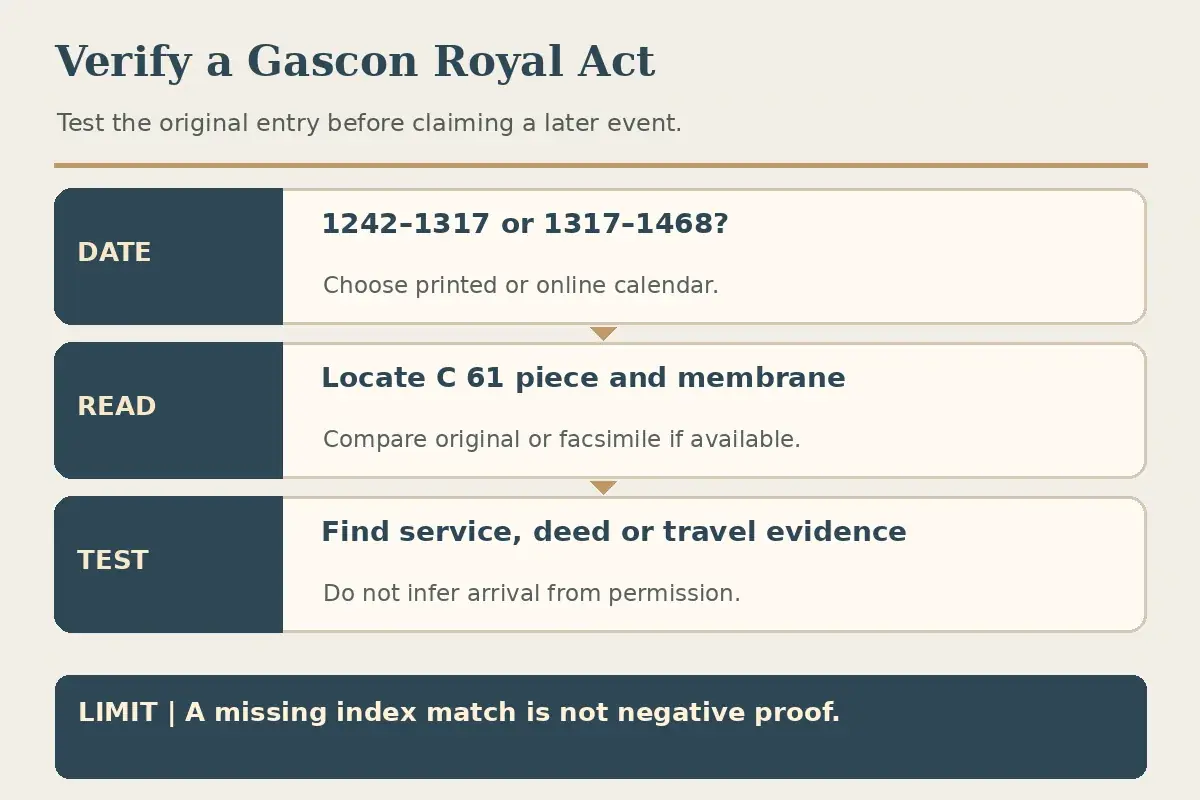
Use a three-stage verification route. First locate the best calendar or edition for the event date and copy the citation it supplies. Second retrieve the corresponding C 61 catalogue entry and, if accessible, the original roll or reliable image. Check the wording, date and any omitted qualifying clauses. Third seek independent evidence of the claimed outcome, such as an actual muster, payment, deed or local record. The third step is conditional, not guaranteed.
Pay attention to membranes and divided parts of rolls. A summary may supply a year but leave an ambiguous entry boundary or omit a person’s title. An official using the same name across two reigns may not be the same person. Keep a separate row for name variants, dates, role, place and document type, and state when the identification is only probable. Translation choices should be documented when they bear on legal status or kinship.
If your research concerns another English-held territory in medieval France, check other Chancery record families rather than assuming all French business belongs in C 61. The official foreign-affairs guide distinguishes C 61 from C 54 Close Rolls, C 66 Patent Rolls and C 76 Treaty Rolls. Subject overlap does not make the series the same archive or create a required sequence. A negative search in one is not proof that no royal act occurred.
More Place and Jurisdiction Guides
How We Research Medieval Gascon Records
We anchor the search to the historical government and its record-keeping geography. Early printed C 61 calendars and later online Gascon Rolls are treated as different finding aids, not one exhaustive database. The visual decision chart identifies the split; a separate evidence matrix distinguishes authorization from completion; the final route shows which independent record could change a conclusion. The artwork is a new interpretation of a medieval archive setting, not a reproduction of a specific grant.
We read archival dates and place names cautiously, preserve regnal-year context and do not infer travel or genealogy from a single translated phrase. Every archive citation retains a C 61 locator and the calendar or image form consulted. Where a name match is uncertain, our working sheet includes rival candidates and the record needed to separate them. Familiar modern family names do not override contemporary documentary roles.
Our affiliate disclosure addresses commercial transparency; our source hierarchy starts with the official archival catalogue and original roll. At the end of the exercise, the result should say exactly what an order granted, requested or protected and when. Later arrival, payment, office holding or kinship must be shown independently or left explicitly unresolved.
The National Archives Gascon Rolls, recording medieval English royal administration connected with Gascony.
No. Earlier pieces rely on several printed calendars; the online project focuses on 1317–1468.
No. It records an intended or authorized status, not necessarily the completed journey.
Compare a protection in C 61 against contemporary muster material such as E 101, where the relevant record survives.
Only if the exact record contains relevant explicit evidence and identities align; a shared surname is insufficient.