
A customs entry may describe taxes due at a port without naming any individual merchant. If the aim is to establish which trade moved through a port during the reign of Henry VII, a crown accounting summary can be useful. If the aim is to prove that an ancestor shipped wool on a particular vessel, a summary is unlikely to be enough. The National Archives’ medieval customs accounts guide identifies E 102 among the Exchequer enrollments of the state of customs accounts from Henry VII’s reign. This wording matters: a state of the accounts is not automatically the same as a port collector’s detailed book.
Define the accounting question before looking for a merchant
Begin a research sheet with three distinct questions: which port and accounting period are relevant; what kind of charge or revenue is being summarized; and whether a person is actually named in a source. Do not transform a total into an itemized list of cargoes. Administrative and commercial activity can be reconstructed at several levels, but each level answers a different question and uses a different archival series.
Match E 102 to the Exchequer account hierarchy
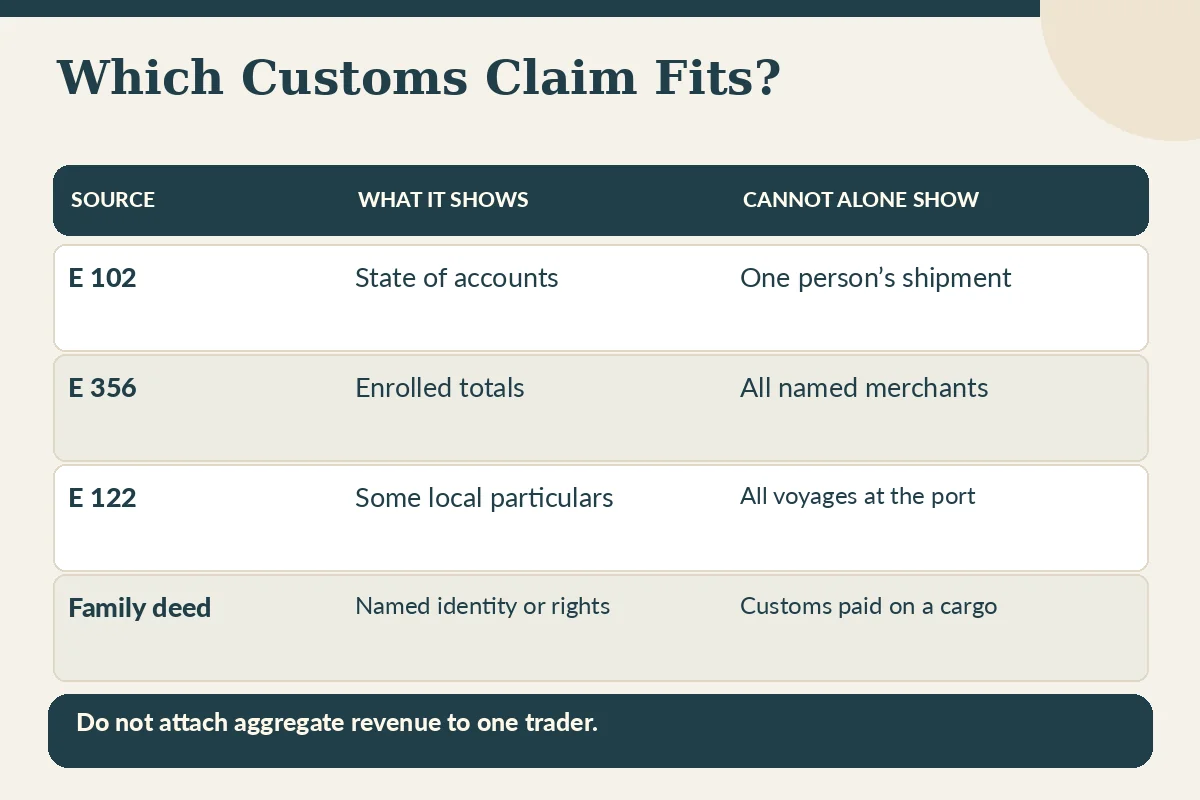
The records follow an accounting process. Local officers collected customs and kept books or rolls of particulars, some surviving in E 122. Final accounts could be audited and enrolled; a major series of enrolled customs accounts is E 356. E 102 provides additional enrollments reflecting the state of customs accounts in the later medieval Exchequer context. These are related sources, but they are neither duplicates nor three compulsory steps that every port and every year will preserve.
The particulars can sometimes name a ship, master, merchant, cargo, date and amount due. The enrolled accounts more often provide quantities and customs totals, with individual merchants usually named only in special circumstances such as exemptions. E 102 should not be treated as a shortcut to a roster of traders. Search a candidate reference in Discovery by series and, where the catalogue allows, place or accounting date. Read the description’s record level before extrapolating from one item. If no piece appears, that may reflect survival or the way the material was arranged rather than proof that a port paid no tax.

Distinguish quantities, monetary values and sums remitted
A customs roll can include different units and values. A figure might be quantity of goods, an assessed value, customs due or a sum formally accounted for to the Crown. Copy the original label and currency or measure as precisely as possible. If a transcription omits units or expands abbreviations, verify against the original or a reliable edition before using the total. The same number in two sources may represent different stages of recording and auditing.
For medieval accounting, collection, audit and enrollment are separate administrative events; the date at the head of a roll may be an accounting year rather than a shipment date. The Exchequer could receive a return long after individual cargoes moved. In comparing E 102 with E 356, confirm matching port, charge and period, then document any mismatch rather than describing it as fraud or missing money. An enrolled total is not a statement that every line of the surviving particulars has been audited identically.
Use port books for names and treat exemptions carefully
When the genealogical question concerns a named merchant, work toward E 122, the particulars of customs accounts, which are arranged by port and date. Even this series represents surviving samples rather than comprehensive traffic records. The National Archives guide cautions that the enrolled customs totals in E 356 normally omit merchant names except in certain cases, including exemptions from payment. The appearance of a merchant in an exemption entry says something about how that account was handled, not that the merchant owned all the goods recorded that year.
Try variants of a medieval place name, merchant name and spelling, but never assume today’s port boundaries map neatly onto the historical customs account. A place of shipment is not necessarily a home address, and the label “merchant” need not identify the ultimate owner of goods. Verify any claimed family connection using independent records, such as deeds, court proceedings or other documents naming the same person with compatible context. Keep ship master and merchant as distinct people unless a source joins those roles.
Build a three-column comparison before calculating anything
A useful worksheet has one row for each original document. Record the archive reference, port, accounting year or span, charge type, original unit, whether names occur, and which proposition the record can actually support. In a second table, contrast E 102 states, E 356 enrollments and E 122 particulars; make a column headed “Cannot alone prove.” This prevents readers from treating Crown revenue as personal profit or an audited roll as a complete ship log.
If a historical account suggests a sudden increase in receipts, resist jumping to a narrative about one named merchant. First test the change in accounting coverage, currency, date and survival. An illustrative example might show an increased aggregate for a port while a surviving particular mentions only one named trader; that cannot establish the trader caused the increase. The evidence can support a pattern of recorded customs activity, but not a personal voyage without a named item. Preserve calculations outside the transcription and explain every assumption.
As an example, a collector’s annual customs statement could show a sum for one port, while a separate roll of particulars names a merchant and a cargo. That does not make the merchant responsible for the whole annual amount. Cite each document’s accounting level, distinguish values from quantities, and align the same accounting period before comparing the two sources.

More Records and Archives Guides
How We Research Crown Customs Accounts
Our archive method starts with the official customs research guide to identify whether an item is a particular account, an audited enrollment or a state of the accounts. We check series-level coverage, cite the exact piece and use original terminology when interpreting values. If a modern catalogue record does not expose the individual names, we do not invent an index that may not exist.
We label examples as illustrations and distinguish the source’s own figures from calculations made afterward. Independent proof of a merchant’s identity and movements is needed before writing biography from Exchequer totals. Information about external references appears in the GenHis affiliate disclosure.
The National Archives identifies E 102 as containing enrollments of states of customs accounts from the reign of Henry VII.
No. It is an Exchequer accounting source; the level of detail and named individuals must be checked in the actual record.
Selected surviving particulars of customs accounts in E 122 can contain ships, masters, merchants and cargo details.
E 356 holds enrolled customs accounts that usually summarize quantities and revenue rather than naming every merchant.
No. You need person-level and ownership evidence, ideally with matching dates and independent identifiers.