
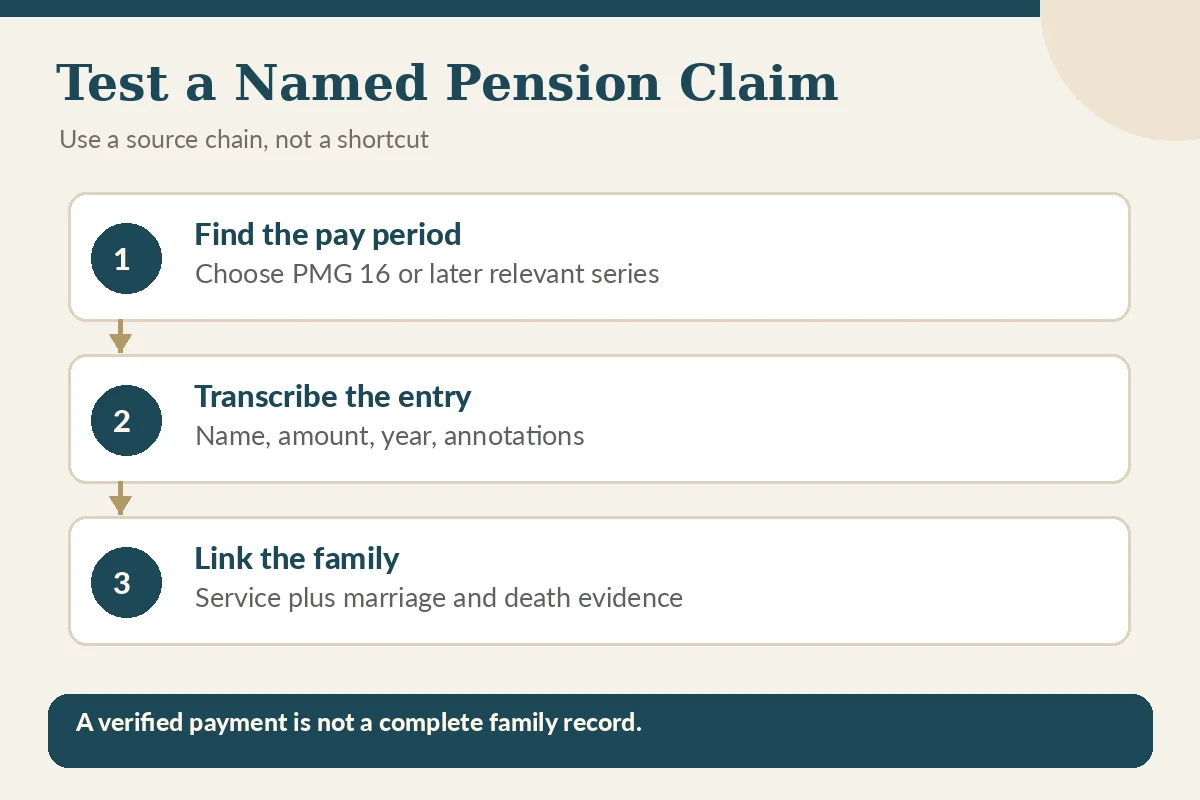
A family story may say that a Royal Marine officer’s widow received a pension after his death. The first task is not to calculate what she “must have been owed” or to assume that every widow was paid. Find a name, plausible year and rank or appointment for the officer, and separately record the widow’s name as actually stated in the source. The National Archives identifies PMG 16 records of pensions paid to widows of Royal Marines officers for 1836–1870. That is a route to an administrative payment, not a universal database of Marine marriages.
Identify the claimant rather than beginning with a pension myth
The official Royal Marines officers guide distinguishes records for different periods and categories of beneficiary. PMG 16 also holds wider miscellaneous pensions and services, so do not classify every PMG 16 entry as a Marine widow claim. A pay entry can preserve a name, an amount and a date without proving the full life story of either spouse. Start a two-person identity worksheet even when the index mentions only one.
Use the right series for the right pension period
For the Royal Marines officer-widow question, the archives guide points to PMG 16 during 1836–1870, PMG 20 for widows and relatives from 1870–1919, and PMG 72 for 1921–1926. It also identifies ADM 165 for pensions paid to officers from 1871 and to officers’ widows and children in a later date range, and earlier material in ADM 96/523. These references are not a simple personal account automatically transferred from one record series to the next. Select by the claimed payment date and recipient category.
A payment dated 1868 should not be searched only in a series covering later years because a family history mentions a husband’s retirement in the 1880s. Verify the date in the actual item. In Discovery, browse the candidate PMG 16 pieces and their descriptions rather than guessing a name-level catalogue index exists. If an entry is missing, try a different spellings and year but do not change the historical category merely to find a result. Write down whether the search covered the whole relevant series or only digital catalogue descriptions.

Read payment, entitlement and family relationship separately
A pension record may establish that the government recorded or made an allowance to a named payee in a specified period. It need not state the original reason for the award, confirm the exact date of death, name all dependents or preserve a marriage certificate. It is especially important not to infer that the officer died on the first date of a payment: administrative decisions and disbursements can be later. Nor is a single payment proof that the allowance continued every year until the recipient died.
The Royal Navy officers’ pensions guide describes categories such as full pay, half pay, wounds, disability and widows’ pensions; the distinctions matter. Full pay is evidence about employment and compensation. Half pay was a retainer, not the same as a widow’s award. An application could be rejected, and a register of applications would be a different evidence type from an actual pay book. Label each item by its historical function, not by a modern summary.

Prove a marriage and distinguish two similarly named families
To identify the officer as the claimant’s husband, look for a contemporary marriage entry, service record or commission, and independent evidence of the officer’s death. A matching surname alone is rarely sufficient: families might share names, a woman may have remarried, and the records can use initials or titles. Make a second pass through the officer’s documented rank, unit and dates. The Royal Marines guide also points to other service and appointment sources that may give the officer an independently established identity.
Keep an explicit “relationship proved by” column. If it contains only “pension paid to Mrs. Smith,” the claim that Mrs. Smith was a particular ancestor must remain provisional. A later civil registration or a parish marriage can support a connection, but only when names, dates and locations align. For an officer’s child, consult the period-appropriate child allowance records rather than automatically treating the widow’s payment as a child’s record.
Record gaps in payment and an illustrative family file
Imagine finding an entry for a widow in 1863 and a second apparent entry in 1865. Even if the names match, the intervening year may simply be missing from the volumes or may reflect a change in entitlement. Before concluding a continuous three-year award, verify whether the documents are pay registers, decision books or annual summaries. Capture currency, the accounting period and any annotations about termination, transfer or arrears. Do not calculate lifetime income by multiplying a single figure.
For a useful family research table, enter the PMG piece and folio, exact payee spelling, payment year, type of allowance, the named officer (if given) and the evidence connecting them. Record separately the date on which an event occurred and the date on which a record was generated. When the source is silent, say “not stated” rather than filling the blank from an unsourced family tree. This also helps relatives reconstruct and independently check your conclusions.
Consider a pension entry paid to an officer’s widow in 1863. A name, amount and period could demonstrate an administrative payment, but would not alone prove the spouse’s maiden name or the exact death date of the officer. Link the officer’s service identity to marriage and death records, and keep any gaps in the pension sequence visible rather than assuming payments continued uninterrupted.
More Records and Archives Guides
How We Research Royal Marines Pension Evidence
We consult The National Archives’ officer guide and pension-specific instructions before deciding which range is relevant to a claimed payment. We record the actual archival reference and separate administrative evidence from civil or church evidence of a relationship. We also distinguish an applicant from a recipient and an officer’s pension from a dependent’s pension.
If only a catalogue description is available, we call it a lead rather than claim that the underlying pay book has been read. The GenHis affiliate disclosure describes our editorial approach to external references and relationships. The purpose is a traceable claim, not a story created to fill an archival gap.
The National Archives identifies PMG 16 as a source for Royal Marines officers widows pensions paid in 1836–1870; it is not limited exclusively to this category.
The Royal Marines officers guide identifies PMG 20 for 1870–1919 and PMG 72 for 1921–1926; check beneficiary and date scope.
No. A payment or accounting date should be kept distinct from an independently documented date of death.
That is unsafe. Compare the original payee name with marriage, death, rank, service and residence evidence wherever available.
No. An application records a request; a payment entry records a different administrative event and may not prove every asserted relationship.