
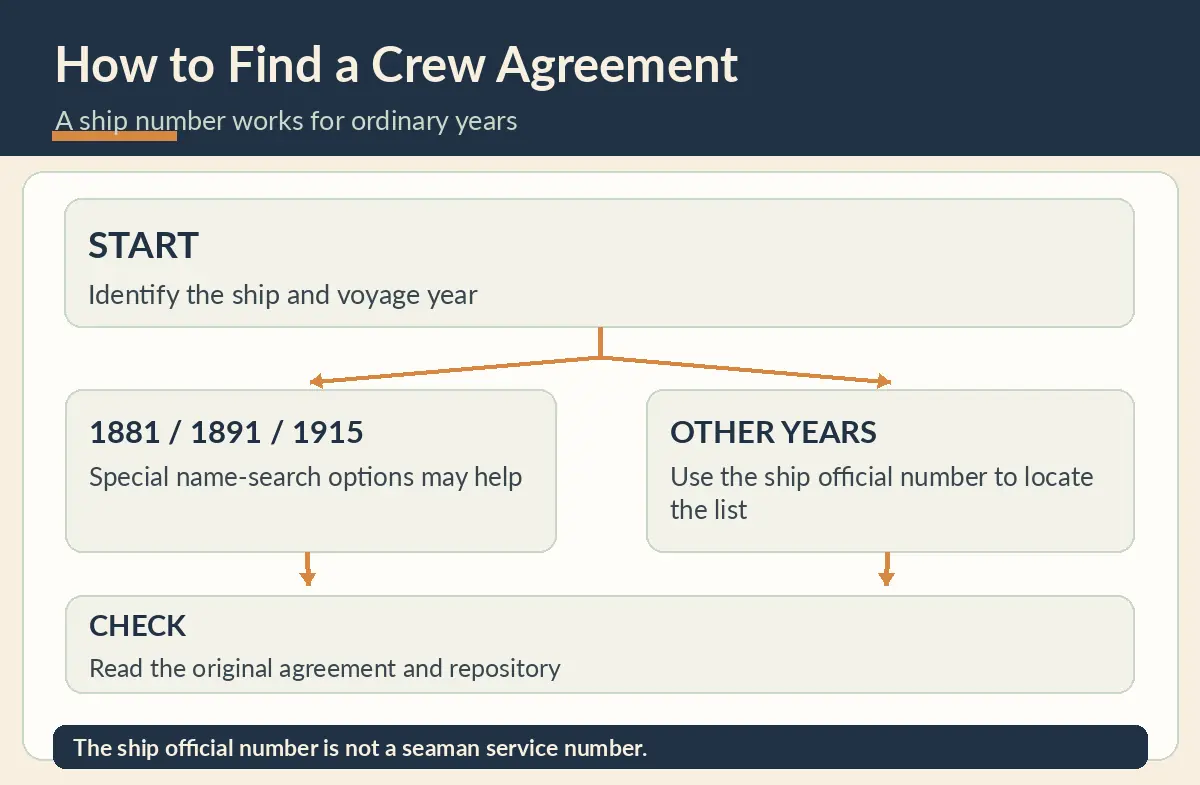
To locate a British merchant seaman in nineteenth- or early twentieth-century crew agreements, begin with the ship’s official number and the voyage year. The National Archives keeps a sample of the agreements in BT 99; this is not a universal alphabetical index of seamen. The official crew-list research guide explains both the ship-number arrangement and the alternative custodians that prevent a missing Kew catalogue result from becoming evidence of nonservice.
Know What an Agreement Can Establish
A crew agreement records the relationship of a master and crew members to a particular vessel and voyage or period of service. Depending on the form and date it may give a person’s name, age, birthplace, role or “quality,” previous vessel, signing-on place and date, and how and where the person left. These are unusually useful identifying fields, but the form is not a life history. Ages and birthplaces can be approximate or self-reported.
Treat the agreement and crew list as different names for the same document, not two independent confirmations. A seaman appearing on an agreement is tied to an administrative ship assignment; the departure column is needed to assess the ending. Neither presence on a list nor a ship’s destination proves an individual stepped ashore at every port on the ship’s route.
Find a Vessel's Permanent Official Number
Since central ship registration began in 1855, an official number identifies a British-registered vessel across name changes. Search the National Archives guide for recommended identification tools such as the Crew List Index Project and historical shipping registers. Record the exact number, vessel name as recorded, registration port and approximate dates. This protects against a common error: identifying the wrong ship simply because it shares a familiar name.
The ship’s official number is not a crewman’s service number. Keep both concepts separate in notes and illustrations. If a later index shows a similarly named ship but a different official number, treat it as another vessel until documentary evidence links the identity. Avoid using a modern registration number or a guessed ship spelling to navigate nineteenth-century BT 99 pieces.
Route 1861–1938 Requests to BT 99 Carefully
For 1861–1938 the National Archives holds about ten percent of the surviving crew lists and agreements in BT 99. That percentage describes a repository share, not a probability that every ten-year interval or trade has identical coverage. Begin with the official number and year, find the relevant catalogue range and identify whether images can be viewed remotely or a physical copy is required. A catalogue description may cover multiple vessels’ numbers.
The main pre-1914 seamen guide notes special name-based searching for 1881 and 1891, while the First World War guide describes a 1915 name-search project. These are exceptions to the ship-number rule and should not be generalized to 1905, 1910 or every other year. Log exactly which name index and original agreement, if any, you actually examined.
Follow Other Archives When Kew Has No List
The National Maritime Museum has substantial designated year groups, including many agreements for 1861, 1862, 1865 and later years ending in five. The Maritime History Archive in Newfoundland holds another major portion of surviving agreements for the relevant era. These are alternative custodians, not identical searchable copies of the same complete database. Follow their own arrangements, ordering policies and indexes before concluding the source has been lost.
Write a three-column custody note: year and vessel number, institutions checked, and surviving item or explicit gap. Do not stop after BT 99 returns nothing. Conversely, do not assume a large percentage of surviving agreements means a particular ship must be held somewhere. Preservation and descriptive coverage are uneven, and not every list is available online.

Read Joining and Leaving Information as a Sequence
A crew member might sign articles, transfer, be discharged, desert, die or be recorded as leaving for another reason. Transcribe the actual wording in the disposal or discharge field. A reason such as “discharged” is an administrative outcome for the voyage; it says little about later residence unless corroborated. If the name of a previous vessel is supplied, use it to find an earlier agreement, checking that ages and places remain compatible.
Build a chronological ledger of documented ship assignments rather than a continuous claim of employment. Do not automatically fill the months between agreements or infer that a listed port was a long-term home. The official instructions caution that agreements are brief personnel and voyage records, not detailed ship diaries or passenger lists.
Resolve Two Similar Seamen Without Overclaiming
Suppose two hypothetical sailors named James Brown appear on vessels sailing from Liverpool. One agreement records a Belfast birthplace and an early-30s age, another a Bristol birthplace and a different previous ship. A marriage certificate with a sailor occupation may support a search, but cannot by itself reconcile conflicting birthplace reports. Compare age, last ship, role, sign-on date, and signatures where genuinely present before joining the records into one career.
A single matching ship name can be seductive, particularly where relatives repeated first names. Rank each proposed connection as directly supported, plausible or unverified. Keep an alternative-candidate table and search other independent civil or maritime records for disambiguating addresses and family details. Similar jobs and shared ports are not genealogical proof.
Distinguish Crew Lists, Service Cards, and Ship Registration
BT 99 agreements document crews; ship registration and ownership series such as BT 107–111 concern vessels and owners; seamen’s card registers for other eras have separate record systems. These sources often complement one another but answer different questions. An official number can connect them without converting an owner into a crew member. Before citing an image, verify its header, date, source series and whether the list covers the voyage of interest.
For a negative result, record the vessel number, date range, custodian, indexing method and any known sampling issue. Then decide whether to broaden to nearby voyage years, alternate locations, or a different repository. A surname search without vessel identification is usually too weak to establish absence from the Merchant Navy.

More Records and Archives Guides
How We Research BT 99 Agreements
Our method starts with the National Archives’ distribution table, independently identifies the ship’s official number, checks BT 99 for a dated agreement, and searches the appropriate alternative custodian when Kew does not hold the list. We test crew identity using several form fields and the movement from previous ship to next voyage. This avoids three recurring mistakes: treating a sample as a complete roll, conflating ship and seaman identifiers, and equating a ship’s itinerary with an individual’s migration.
A complete citation names the repository, BT 99 or another actual series, piece, ship official number, agreement date, page or image and person as written. Keep a link to the custodian’s finding instructions, and review our affiliate disclosure before using any commercial maritime database mentioned in outside research.
No. The main arrangement is by ship official number; special name searches exist for selected years, including 1881, 1891 and 1915.
The National Archives retains a sample, and many surviving lists are held by other archival custodians.
Not always. Use the permanent official number to distinguish vessels with reused or similar names.
No. Read joining and leaving dates and reasons, and check later lists for discharge or transfer.
The National Maritime Museum and Maritime History Archive in Newfoundland hold important portions of surviving agreements.