
The 1831 England and Wales census was not a nationwide register of named families. It counted households and population, but the names and individual details familiar from 1841 onward were not collected centrally. Some local enumerators retained returns or made their own lists, and a few of those documents survive. The best starting point is therefore a specific parish, township, or street—not a national surname search. Find the original locality, establish whether its archive has a named document, and distinguish any surviving household name from a statistical summary. A blank commercial search screen cannot establish that your ancestor was absent from the district.
Why 1831 does not work like the 1841 census
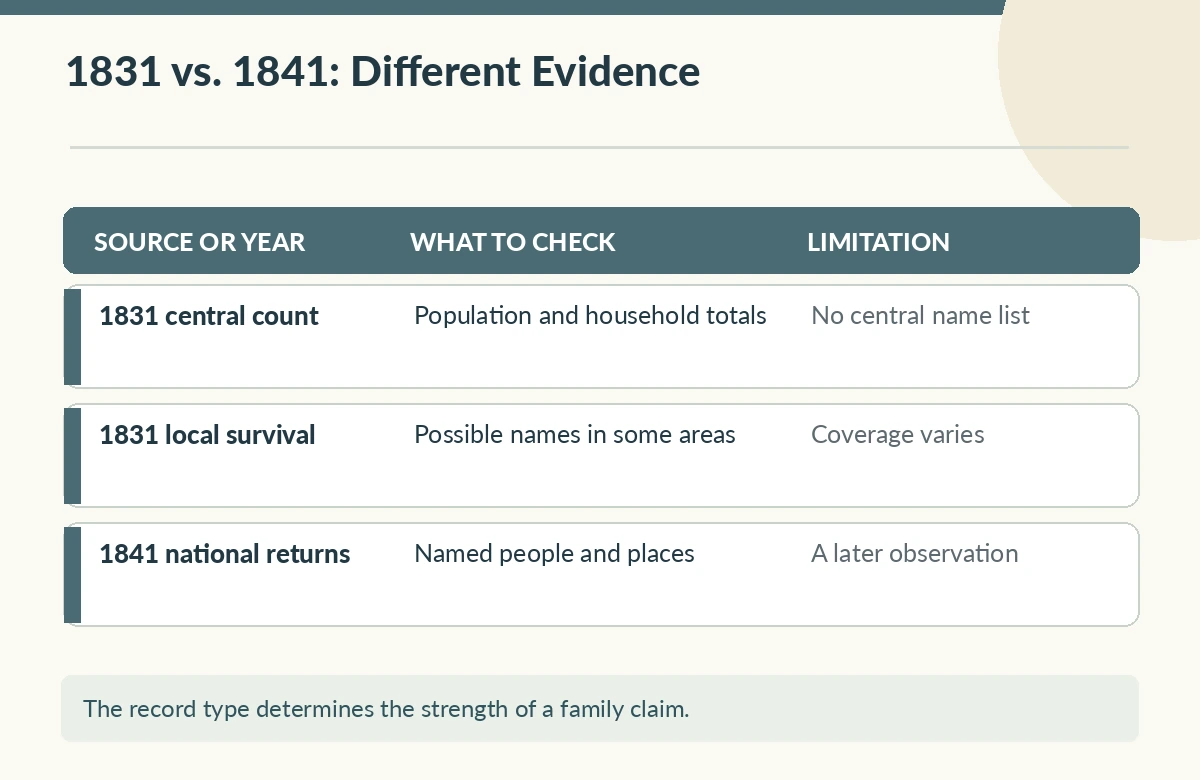
The National Archives explains that census-taking began in 1801, but the 1801, 1811, 1821 and 1831 returns did not generate centrally collected name lists. The 1841 enumeration is the first of the routinely available household-by-household national records used in England and Wales genealogy. A county-wide demographic table published from the 1831 totals is a statistical source, not a roster of residents. Before entering an ancestor in a timeline as “seen in 1831,” ask whether the thing examined is an actual named local manuscript, a later transcription, or a population count. These are different records with different evidentiary reach.
Build a parish-level search key from an earlier source
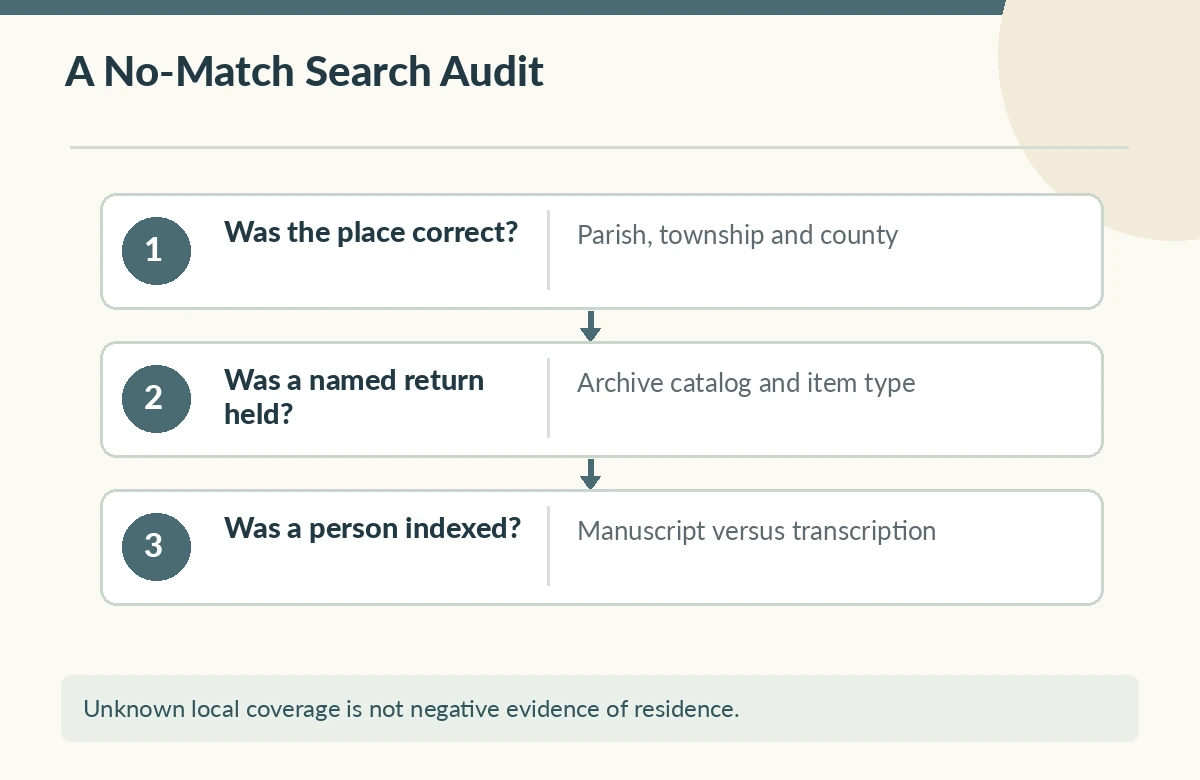
Start with a known residence in the late 1820s or early 1830s: a baptism, marriage, burial, land tax roll, trade directory, or settlement examination. Note the historic parish and any chapelry, township, borough, or county boundaries. A modern postal town may not be the unit an enumerator used. Write down all plausible spelling variants, including a shortened given name, but avoid searching England as one undifferentiated place. Locate the parish or township first; the archive catalog can describe surviving returns without indexing a single personal name. This geographic key keeps the search reproducible even when the person is not listed.

Check local archives and the Early British Census Project
Search the appropriate county record office catalog using combinations such as “1831 census,” “population return,” “enumerator,” and the parish name. The Early British Census Project at Brigham Young University brings together references to scattered pre-1841 local materials; its presence does not mean every parish has a surviving return. Read the project’s description and then identify the custodian and catalog reference for a useful record. Commercial databases may hold a few transcriptions or images. State whether your actual evidence is an image of the manuscript, a modern extract, or a catalog entry naming a collection that has not yet been examined.
Decide whether a local list names heads or individuals
Local survivals vary dramatically. One manuscript might list house or family heads; another may contain household totals but no names; a substitute assembled by a local official could record ratepayers rather than everyone resident. Transcribe the document’s own column headings. If it names only a householder, the existence of a spouse and children in that house remains an independent question. Do not turn a one-name entry and four anonymous persons into five named relatives. Record whether the listed unit is house, household, family, farm, building, or taxpayer; different denominators cannot be compared casually.
Use 1821 and 1841 sources as bounds, not interchangeable proof
A person present on an 1821 parish list and in the 1841 national census may be a plausible 1831 resident, yet the ten- and twenty-year intervals contain births, deaths, marriages and migrations. Build a two-column comparison of confirmed records around 1831, marking direct residence statements separately from retrospective claims. The 1841 census lists names, ages and birthplace-county status, but its limitations also need to be remembered. Do not project a later wife, child or property backward without a dated source. A dated directory or poor-law document from 1830–1832 can narrow the gap more effectively than a surname coincidence a decade later. Our guide “Dorset Parish Registers” covers a related question.
Evaluate totals without translating them into named families
Population counts can still describe the district your family inhabited. A parish total might support the historical scale of a settlement or changes in industrial or agricultural activity across decades. It cannot prove the count includes a particular ancestor unless a named local source is also available. Keep aggregate figures under a locality-history heading in your notes instead of attaching them as direct evidence to a person profile. If your software asks for a personal census event, refrain from importing the total as an individual residence. Explain the distinction explicitly when publishing a family narrative.
Differentiate a true local return from a substitute list
Parish rate books, poll books, militia rolls and poor-law documents are valuable 1831 substitutes, but each covers an eligible subset. A poll book omits many nonvoters; a ratepayer list may identify owner or assessed occupier rather than all residents; a poor-relief account records specific administrative activity. Label each record by its real creator, date and purpose. If a genealogy site markets a mixed collection under “early census,” inspect the item title and original heading. A substitute can narrow a hypothesis, but its selection rules must be stated before drawing any negative inference. For a comparable plan elsewhere, our guide “Newfoundland Censuses, 1921–1945” shows how to find families by community and verify originals.
| Research question | Record-level test | Claim not yet established |
|---|---|---|
| Correct person? | Compare locality, dates and associates | Same surname means same identity |
| Record coverage? | Check year and exact archival series | No index hit means no event |
| Dates or status? | Preserve original fields and informant | One date explains every process |
| Family links? | Seek another independent source | Adjacent names prove kinship |
Separate competing same-name householders in one township
Suppose a local list includes two adults called William Brown. Compare street or property description, occupation if available, and neighboring householders with a deed, directory or church record from nearby years. Record clues that conflict as well as those that agree. A person appearing in the 1841 census beside one of those neighbors may strengthen an identification, but it does not establish a 1831 parent-child relationship. Build candidate A and B rows rather than merging them. The point of the exercise is not to force a match but to identify the next dated record most capable of discriminating.
Cite a rare 1831 manuscript so another reader can recover it
Capture archive, manuscript collection, catalog identifier, parish or township, year, volume or sheet, and image or folio if provided. Add whether a volunteer project supplied only an index or full text. If the named document is accessible only onsite, cite the archive catalog honestly and do not imply you inspected the manuscript. Log every negative search with the exact locality, search terms and collections examined; another archive may later describe new survivals. The defensible research result can be that the surviving local coverage for a target parish is still unknown.
More Records and Archives Guides
How We Research 1831 England Census
We compared The National Archives census research guide with the Early British Census Project description and an English local authority’s explanation of early returns. We have not treated generic pre-1841 online search results as evidence of nationwide named coverage. Our method requires the original record type and archival custodian to be identified before making family claims. Direct research references: Archival research guide. Record coverage and access. Additional official instructions.
The archives and collection links here are research references, not sponsored endorsements. No paid service or unconfirmed affiliate arrangement is recommended. See our affiliate disclosure for site-wide details.
No. The 1831 returns did not produce a centrally collected national name series; surviving named records are local exceptions.
Some local lists survive, but the fields and people included vary by place and original manuscript.
Search the county archive catalog and the Early British Census Project for that parish and check the record description.
No. Aggregate headcounts describe a place and cannot establish the identity of a particular resident.
Use adjacent dated parish, tax, directory, poor-law or other local records and state their separate coverage limits.