
Alberta historical death records are located through indexes but are not generally available as freely browsable registration images. The Provincial Archives of Alberta describes death registrations from 1870 through 1976, with different indexes for different eras and special record groups. Under the current historical-access rule, records of deaths at least 50 years old may be requested through the archives. Start with the surname, year and place, but learn how the handwritten vowel-group indexes differ from later searchable annual indexes. When a candidate appears, capture its registration number and request the actual archival registration rather than treating a name in the index as the full record.
Separate historical eligibility from index year coverage
Alberta says historical death records reach the Provincial Archives when they are 50 years old or older from the death date. That is a moving threshold: do not hardcode “before 1976” as an access right for every day of a year. The archive lists historical death registrations dating from 1870 through 1976, but the visible index sections vary by period and may not cover every individual equally. A record may be held yet difficult to locate in an index; another may fall outside the historic access boundary and require the ordinary registry process. Note the actual death date and current eligibility before requesting. Our guide “Nova Scotia Death Registrations, 1864–1974” covers a related question.
Choose the handwritten or OCR death index intentionally
The Provincial Archives lists handwritten death indexes for 1877–1950 and 1973–1975, and a 1925–1972 series that is arranged by year and surname and supports text searching. These overlap for part of 1925–1950, offering a useful independent search route when one indexing method fails. Do not assume a negative OCR search proves no registration: scanned text can misrecognize surnames and characters. Write down which series was searched and whether it used manual browsing or OCR. Switching index type is a deliberate research action, not a duplicate search in the same database.

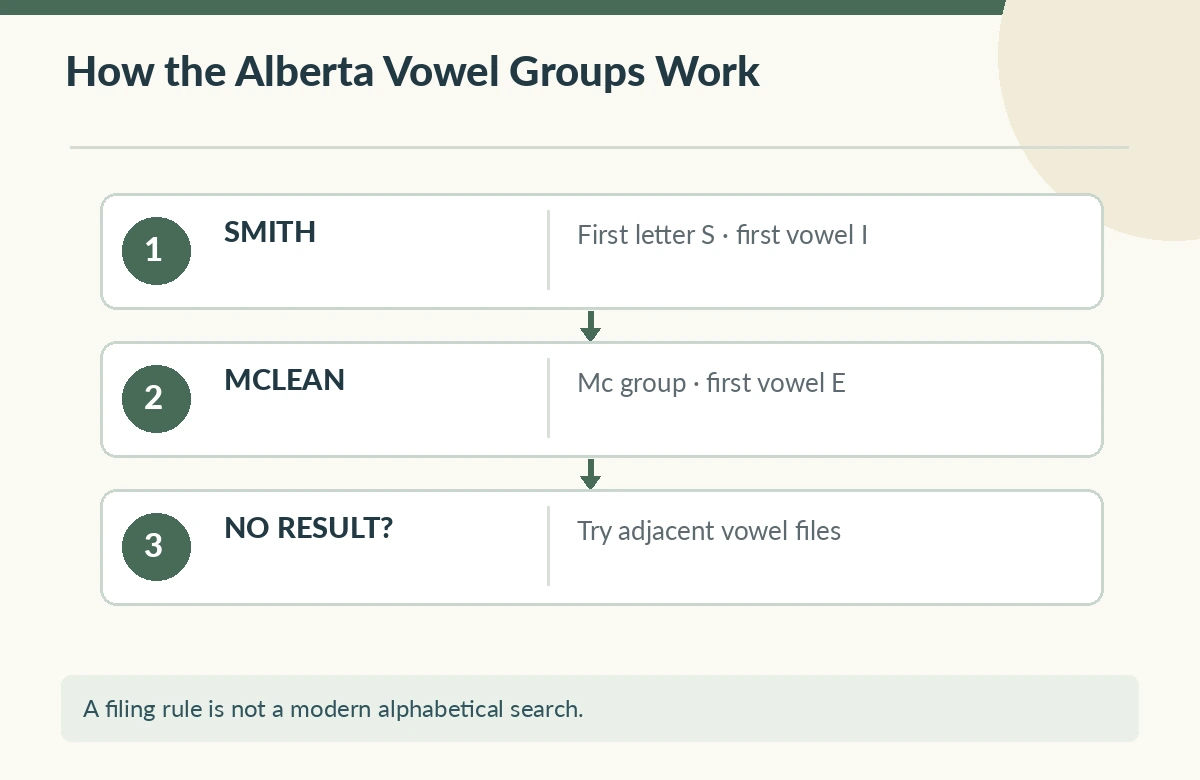
Decode the first-vowel filing system in older lists
The handwritten lists divide surnames by first letter and by the first vowel appearing after it; the archive offers an example in which Smith files under Si rather than Sm. Mac and Mc spelling may be grouped together, and the letter Y is not treated as a vowel in the filing scheme. Begin with the expected vowel combination, then inspect adjacent vowels if the surname is absent or the indexer made a mistake. A surname that changed from McLeod to MacLeod can cross the groups a reader first expected. Capture the page itself, not simply the category label, as evidence of the exact candidate entry.
Check overseas and separately indexed deaths
The Provincial Archives lists overseas deaths from 1940–1948 and a separate historical index labeled for Indigenous deaths from 1923–1945. Its guide advises checking other death indexes if a name is missing. These are archival administrative groupings, not a framework for inferring any modern person’s identity or community membership. A service member who died overseas can have a different record path from a death reported in an Alberta municipality. Record the original category as an index label and treat the date, place and registration number as the information to be corroborated. Avoid assuming a person is in a separate category simply from surname or family tradition. For a related choice, see our guide “New Zealand Historical Death Records”.
Capture a registration number before requesting the copy
The archive instructs researchers to search for a person’s name, location, year and registration number and then use its online Vital Statistics request and payment system. These original records are not handed out for browsing in the Sandra Thomson Reading Room. Keep a small request sheet with the exact index spelling, event year, registration number, locality, source index and an alternate identification if uncertain. If two same-name candidates exist, obtain and assess the detailed originals separately rather than choosing one based only on an approximate birth year. Fees and fulfilment methods should be confirmed on the live archive page. Our guide “Alberta Historical Birth Records” shows how to find the index and request the registration.
Understand what a death registration can establish
A registration is an official report of a death, yet a named informant may know the death date firsthand while relying on memory for parents, age or birthplace. Examine the original form, any amendments and the difference between the recorded event and later filing. For the genealogical question “Who were the parents?” identify who supplied the information and look for a marriage, baptism, census or family document independent of that informant. Do not elevate every field in a government record to unquestionable truth. Record contradictory statements before writing a lineage conclusion. For a related choice, see our guide “1831 England and Wales Census”.
Use the correct service for nonhistorical records
Alberta’s government explicitly distinguishes historical copies managed by the Provincial Archives from newer registrations handled through registry agents or Registry Connect, where eligibility requirements may apply. A researcher who cannot show the death is at least 50 years old should not bypass those rules or treat the archive index as authorization for a modern record. The government also distinguishes archival copies of registrations from official certificates requested for legal use. Clarify the intended purpose before ordering: genealogy normally needs full record details, whereas another process may require a legally recognized certificate. Our guide “Newfoundland Censuses, 1921–1945” covers a related question.
| Research question | Record-level test | Claim not yet established |
|---|---|---|
| Correct person? | Compare locality, dates and associates | Same surname means same identity |
| Record coverage? | Check year and exact archival series | No index hit means no event |
| Dates or status? | Preserve original fields and informant | One date explains every process |
| Family links? | Seek another independent source | Adjacent names prove kinship |
Resolve an apparent no-match with two independent routes
For a likely death in 1940, try the alphabetical handwritten index and the overlapping later OCR-searchable list, then check any genuinely relevant specialized register rather than selecting one based on assumptions. Vary surname spellings and the possible year, compare a known cemetery or newspaper notice, and inspect neighboring entries in a handwritten file. Record which alternative was tested and whether the index genuinely covered the event. If the death occurred elsewhere, Alberta’s indexes may be the wrong jurisdiction; adjust the question rather than declaring that the person did not die.

Log the original record and protect unresolved identities
Cite the Provincial Archives of Alberta, index series and year, exact displayed spelling, registration number and image or index page, then add the details of the requested copy once received. Mark the index and the registration as distinct sources. A public family tree should not combine two same-name deaths before independent relationship checks have been done. For an unfilled request, write “index candidate only,” never “certificate verified.” The next action might be a cemetery plot search, marriage register check or investigation of a neighboring Alberta community based on the claimant’s known residence.
More Records and Archives Guides
How We Research Alberta Historical Death Records
We used the Provincial Archives of Alberta’s death index directory and handwritten-list guide alongside Alberta’s historical vital-statistics access explanation. We distinguish the 50-year access rule from specific indexed year bands and treat special administrative indexes as search routes, not identity proofs. All examples are illustrative rather than claimed discoveries. Direct research references: Archival research guide. Record coverage and access. Additional official instructions. Detailed holdings.
The archives and collection links here are research references, not sponsored endorsements. No paid service or unconfirmed affiliate arrangement is recommended. See our affiliate disclosure for site-wide details.
The provincial historical-access rule is 50 years or more from the date of death.
The archives direct researchers to order copies; original registrations are not openly browsed in its reading room.
The first-vowel filing system places it under Si; consult the archive’s group instructions and check variants.
Yes. The handwritten 1877–1950 and searchable 1925–1972 series overlap for those years.
No. Obtain the registration and corroborate family details with independent records.