
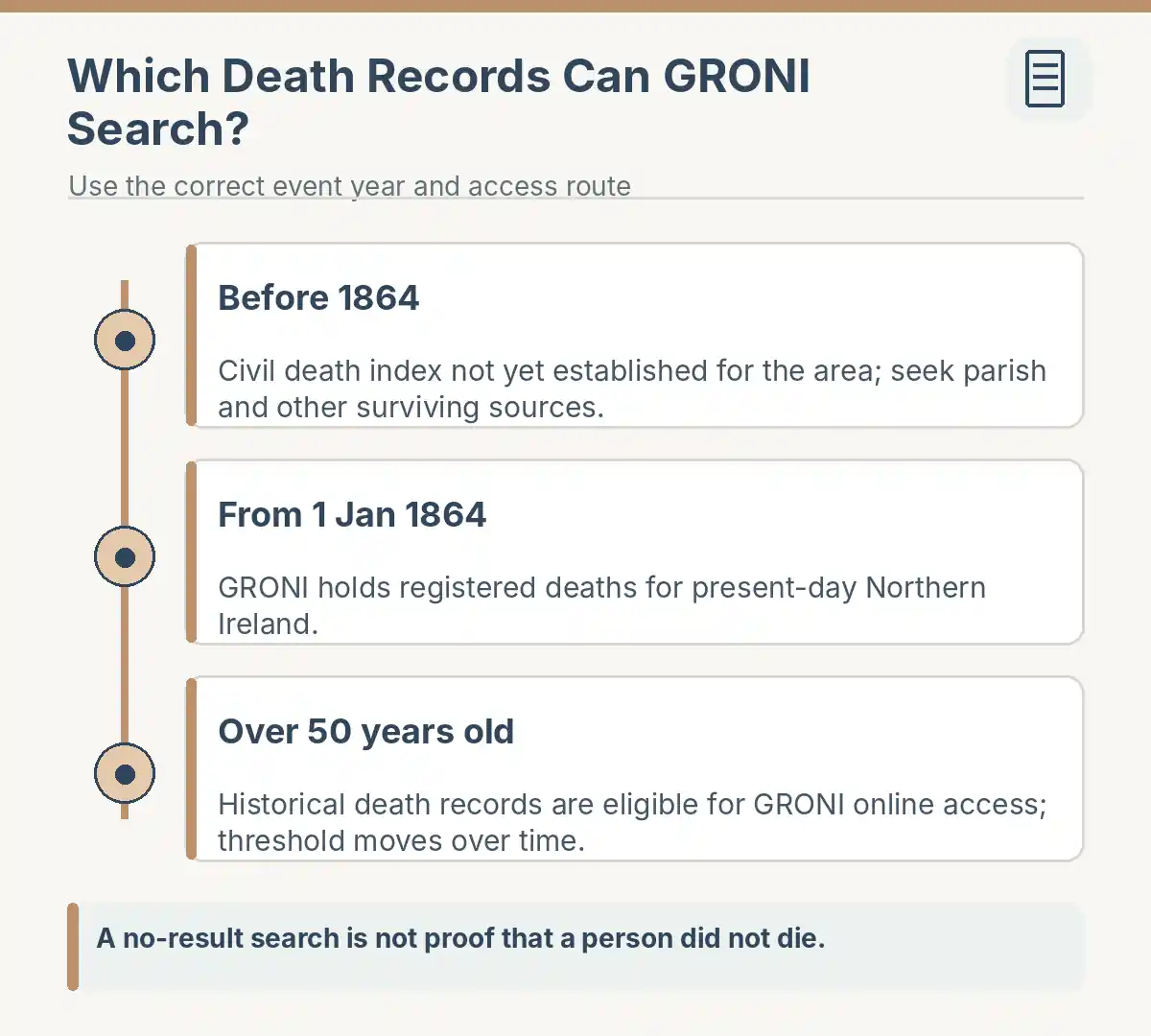
For a death registered in what is now Northern Ireland, start with the General Register Office Northern Ireland (GRONI) rather than a surname-only memorial search. Its civil death indexes begin on 1 January 1864. Historical deaths more than 50 years old can be accessed through GRONI’s online genealogy service; more recent records require a different access route. A name match is a candidate, not yet proof you found the right person. The useful first question is: where was the death registered, roughly when, and which independent evidence can identify the person?
Fix the registration jurisdiction before searching
Northern Ireland did not exist as a separate state when many nineteenth-century deaths were recorded. GRONI covers deaths registered in the area that is now Northern Ireland, not every place bearing an old Ulster county or parish name. Write down the historical townland or street, county, likely registration district, and approximate year. If the person died in a county outside the present six-county jurisdiction, do not treat an empty GRONI search as evidence of no death. Locate the appropriate civil register elsewhere on the island. The registration place can differ from a family’s residence or burial place, so keep all three localities in different columns. A newspaper’s county of publication is particularly weak evidence of the death-registration district. Use GRONI’s records description to confirm the class and place covered before entering a name.
Use the free name count and five-year interval correctly
GRONI offers a public free name search that reports the number of matches in the registration categories. For detailed searches its guidance says to enter at least a surname and a date: exact date, year, or a range of no more than five years. Test the spelling actually used by contemporary relatives, then retry an initial, an alternative spelling or a wider plausible range. Log exactly what you searched, including sex and any date-of-birth filter you chose. Do not combine a very narrow district, one uncommon spelling and an assumed age at the first attempt: any one of those hypotheses could be wrong. The publicly free count is not a scanned civil document. To review detailed results, the online service has account and credit conditions, explained by the official access page.
Distinguish basic index, enhanced information, and the entry
A basic death result may provide a registration number, date of death, age or birth date, names, sex, and district. Enhanced results and a full view are different stages of evidence, with different access costs. Copy every identifying field along with which level you actually saw. When the full registration image is offered, transcribe its wording; do not silently substitute an indexed date for a handwritten one. Check the recorded death date against the date of registration, burial and obituary publication; they need not be identical. Compare the reported age against an independently documented baptism or birth, allowing for approximate ages. A certificate or contemporary entry documents a registered event, while an informant’s knowledge of relationships may vary. Use GRONI’s result-level guide when deciding whether the index is enough for a particular claim.
Check the 50-year online threshold and wartime series
The public online historical limit is a rolling rule: deaths must be over 50 years old to be searchable through the genealogy interface. Do not convert it into a permanent last calendar year, because it changes with time. For a more recent death, official routes include the Belfast public search room or applying for a certificate when appropriate; protect information about living people in linked files. GRONI also describes a separate World War II death index, covering wartime-related deaths, with a range that extends beyond the conflict for deaths from injuries. Do not assume an ordinary search and a war-death result refer to different people, or that inclusion proves military service. Examine registration category, dates and identity evidence for each candidate. Never use the war index to infer a cause of death that is not stated in the record. For a related choice, see our guide “OK2Explore Oklahoma Death Records”.

Separate two same-name death candidates
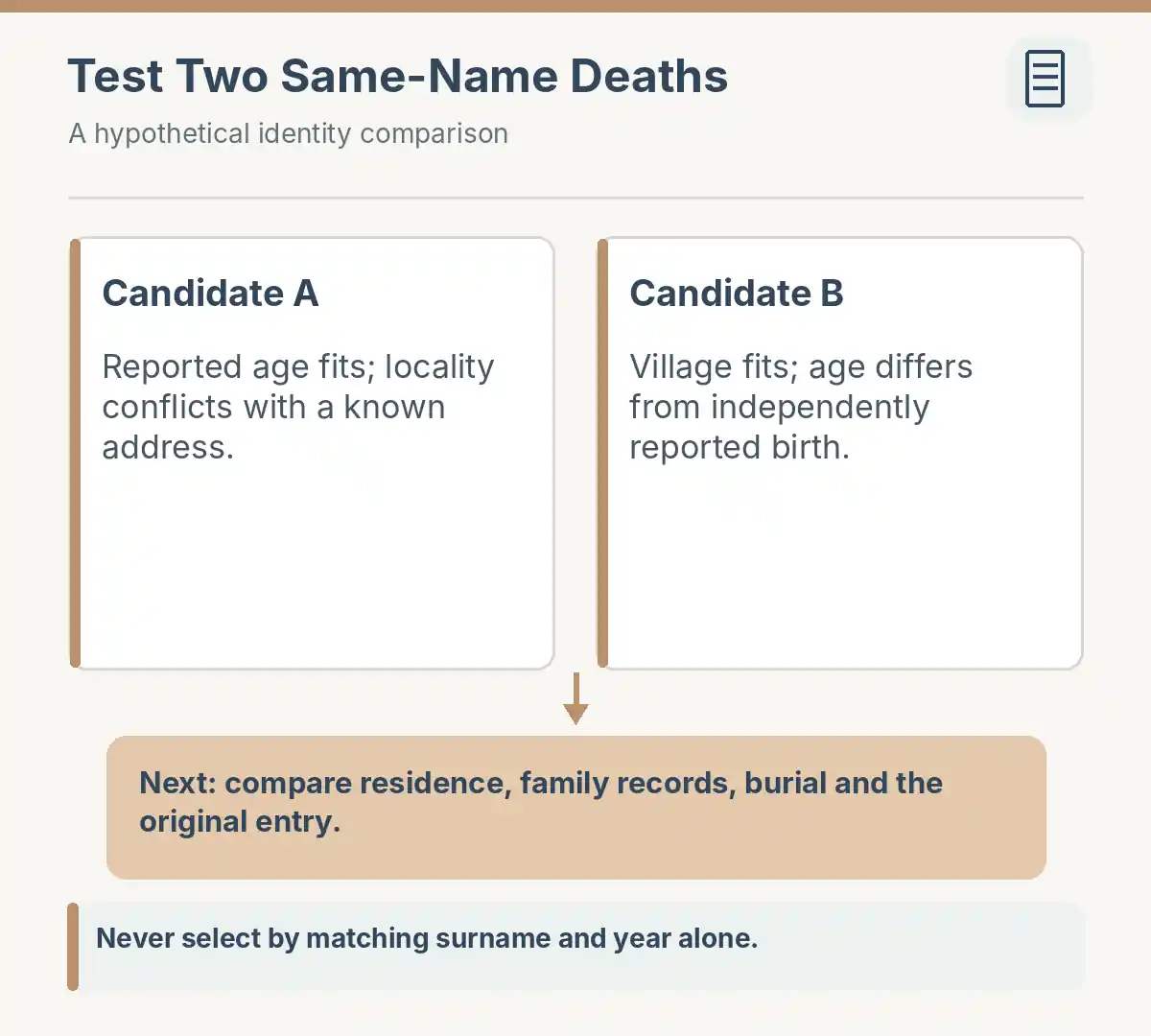
Imagine two men named Thomas Martin found within a five-year interval. One matches a reported age, but another matches the family’s village. Neither match alone is decisive. Prepare parallel candidate rows: full indexed name, date of death, reported age, district, reference, source level, proposed family connection and conflicts. Obtain independent evidence such as a will, civil marriage, household record, contemporary notice or parish burial; identify the actual information connecting a spouse, trade, address or parent. An unusually common surname is not sufficient reason to pick the closest death date. If an independent record clearly contradicts your favored candidate, retain both and write down which observation would distinguish them. A blank result under a strict spelling says only that this particular search returned none. Our guide “Irish Civil Death Records” covers a related question.
Make a copy request and citation reproducible
Save the GRONI registration number, record type, displayed date, district and image or certificate details in your research log. If the historical image is unavailable for your request, follow the formal certificate or search-room route rather than assuming there is no registered death. For every eventual claim, cite the custodian, registered event, registration number or volume/page where provided, image or certificate and consultation date. Add a brief note explaining whether the age or address was supplied by an informant or independently verified. Keep a linked chronology of death, registration, funeral and probate actions. This audit prevents a family tree from acquiring a precise death date simply because the surname looked promising. It also makes it possible for another researcher to retry the search without knowing your private guesses.
One efficient method is to first bracket an unknown death year using two independently dated appearances of the person, such as an earlier directory and a later probate record, without assuming the events occur in the same locality. Search GRONI in overlapping allowed five-year windows and retain the details of every near match. For each candidate, draw a line from the civil-registration date to the earliest known burial notice, then identify any discrepancy. The objective is not to force a single answer from the first index hit: it is to make a specific record-request decision with clearly documented alternatives. Our guide “Northern Ireland Marriage Records” covers how to use GRONI and the 1845–1864 divide.
More Records and Archives Guides
How We Research GRONI Death Entries
Our method follows three GRONI explanations separately: the record coverage, the search fields and the result levels. We check date, present-day jurisdiction, index-versus-image status and identity links before calling a claim supported. Examples here are hypothetical: no named individual has been searched and no family relationship is asserted. Commercial relationships, if any, are explained in our affiliate disclosure.
GRONI indexes deaths registered from 1 January 1864 in the area that is now Northern Ireland. An earlier death needs parish, cemetery or other surviving evidence.
No. There is a free public name-count search, while detailed records require an account and the credit rules described by GRONI.
The historical genealogy search is limited to deaths over 50 years old. Other official access and certificate routes may apply.
No. It is a record-category clue; wartime death and military service are different historical claims.
Keep both candidates and use an independently documented address, age, spouse, occupation or linked record before identifying either as your relative.