
OK2Explore death records are free index entries maintained by Oklahoma Vital Records, not downloadable death certificates. The official service generally exposes deaths that occurred more than five years ago; records become legally open after 50 years. Those are distinct thresholds. Begin with a broad surname and plausible death period, preserve the exact result, and determine whether a certificate or a substitute record is the best next source.
Separate index visibility, open-record status and certificate access
OK2Explore reports whether an Oklahoma vital record is on file and supplies limited searchable fields. For death entries, the public index includes events more than five years old. This does not mean the certificate itself is freely displayed, nor does it make a recent death record unrestricted. Oklahoma explains that death records become open records after fifty years, while requests for more recent restricted documents require eligibility. Check the actual event date and the current state instructions before planning a request; do not extrapolate from the index interface.
The index is regularly updated with additions and corrections. Therefore a hit may appear after an earlier unsuccessful search, and an old screenshot may not represent the current database. Use an evidence ledger with columns for event, index observation, access status, ordered copy and independent corroboration. This makes it possible to distinguish what the public search reports from the personal information, informant details or medical particulars that might be present in a legally accessible certificate.
Search Oklahoma names with exact matching and controlled wildcards
The state search guidance says that supplied terms are matched exactly, with an asterisk accepted as a wildcard. An overly specific full name, year and county combination can therefore suppress a relevant result. Begin with a documented surname and a limited date range. When no hit appears, try a first-name abbreviation, a wildcard after the stable name stem, or a wider year range without changing every field at once. Save the precise query, including punctuation and the chosen window, so the search can be reproduced.
If a search returns too many candidates, the interface may require refinement instead of displaying every record. Narrow by event county only when that county is independently documented; a last residence is not necessarily the county of death. Test nearby county possibilities when a family lived near a border or a person died in a hospital elsewhere. Do not silently select an entry because its name and approximate year match; establish a second identity marker before treating it as your ancestor.

Read early Oklahoma registration dates without false negatives
Oklahoma began collecting death records in October 1908, but registration was not mandatory until 1917 and filing was uneven in earlier decades. The earliest indexed date is not a guarantee that a certificate survives for every person or county. A pre-1908 death cannot be excluded from the historical record merely because it is absent from the state index; it belongs in local newspaper, cemetery, probate, church or other contemporaneous searches. Even after 1908, reporting failures and spelling mistakes can explain a blank result. If you want the full process, read how to find historical U.S. death records, notices, and dates.
For a missing early death, identify the historical county and likely community, then consult the Oklahoma Historical Society collections. City death registers, funeral-home material, obituary indexes and cemetery records answer different questions. Record each repository and its actual coverage rather than creating one combined list of supposed certificate substitutes. A funeral notice can establish the date of an announcement; a burial register records an interment; neither automatically supplies a certified date and cause of death. For a related choice, see our guide “Utah Death Certificates”.
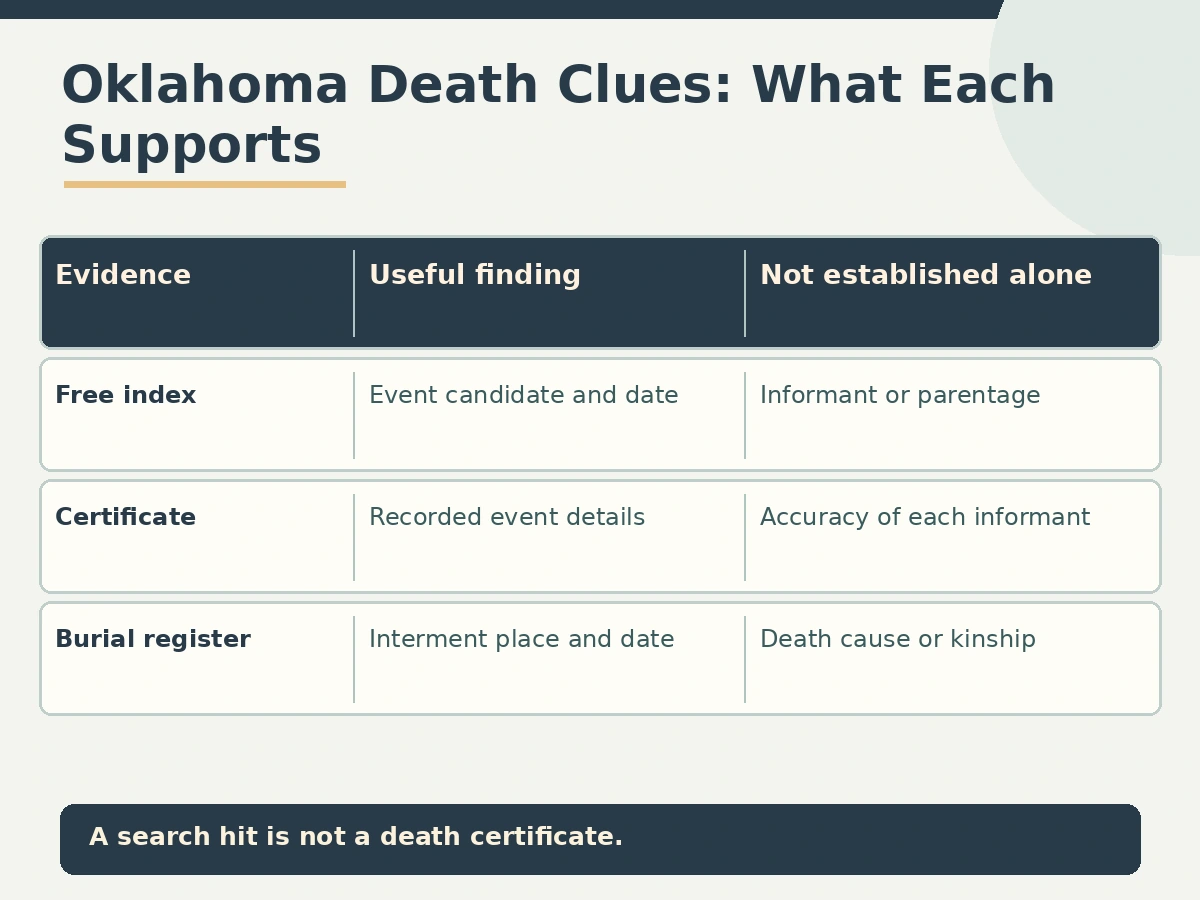
| Source | What it can show | What it cannot prove alone |
|---|---|---|
| Free index | Candidate death date and county | Certificate details |
| Certificate | Recorded event and informant | Accuracy of every statement |
| Cemetery register | Burial place and date | Cause of death or kinship |
Order the certificate only after identifying the correct candidate
The Oklahoma Department of Health provides official methods for ordering a birth or death certificate, including restricted-record eligibility and identity requirements. Begin by copying the indexed full name, date and county exactly as shown. Check the state application requirements and fees when you order, because services and prices can change. The index itself costs nothing to search; a record-copy request is a separate transaction. Avoid paying an unrelated intermediary simply because its website appears above the government site. For a related choice, see our guide “Minnesota Death Index, 1904–2001”.
When the certificate arrives, transcribe the event date, place and the informant information into separate fields. A registrar may have recorded an event near the time it occurred, but birthplaces, parents and even marital details can depend on an informant who had limited knowledge. Preserve the original wording and cite the record number if supplied. If the file cannot be released, note the eligibility restriction rather than calling the historical death unverified or nonexistent.

Test the death identity against two independent records
Imagine two people named Sarah E. Wilson appearing in nearby Oklahoma counties within three years. Use census ages, spouse names, an obituary address or a burial entry to build a candidate comparison. The search index can separate dates and counties but may not contain enough family details to prove either identity. Do not use an obituary that merely copied the same state index as an independent source; independence concerns where the information came from, not which website displays it.
A compact conclusion should identify the record actually viewed, the matching anchors, contradictions and remaining unknowns. If only an index is available, say “an Oklahoma death-index entry for a candidate,” not “the certificate proves the parents.” Preserve a source URL, query, retrieval date and the relevant event locator. A later certificate or probate document can then strengthen, revise or reject the identification without obscuring the original research trail. Our guide “Social Security Death Index” covers a related question.
More Records and Archives Guides
How We Research Oklahoma Death Index
We checked the Oklahoma Vital Records index, its search help and the official certificate-request page, then compared their scope with the Oklahoma Historical Society’s death-related collections. Our examples are hypothetical; we did not identify or publish any living person’s restricted information. We do not recommend paid intermediaries. Read our affiliate disclosure for site policy.
No. OK2Explore is a free index; a certificate requires a separate official application and any applicable eligibility requirements.
The official service describes index visibility for Oklahoma deaths more than five years old, distinct from the fifty-year open-record rule.
The search uses exact matching for supplied terms. Try controlled spelling or wildcard variants, broaden dates, and check another county.
No. Filing began in 1908 and did not become mandatory until 1917; early registration was incomplete.
Cite Oklahoma Vital Records, the OK2Explore result, searchable fields and retrieval date, and label the original certificate as not yet viewed.