
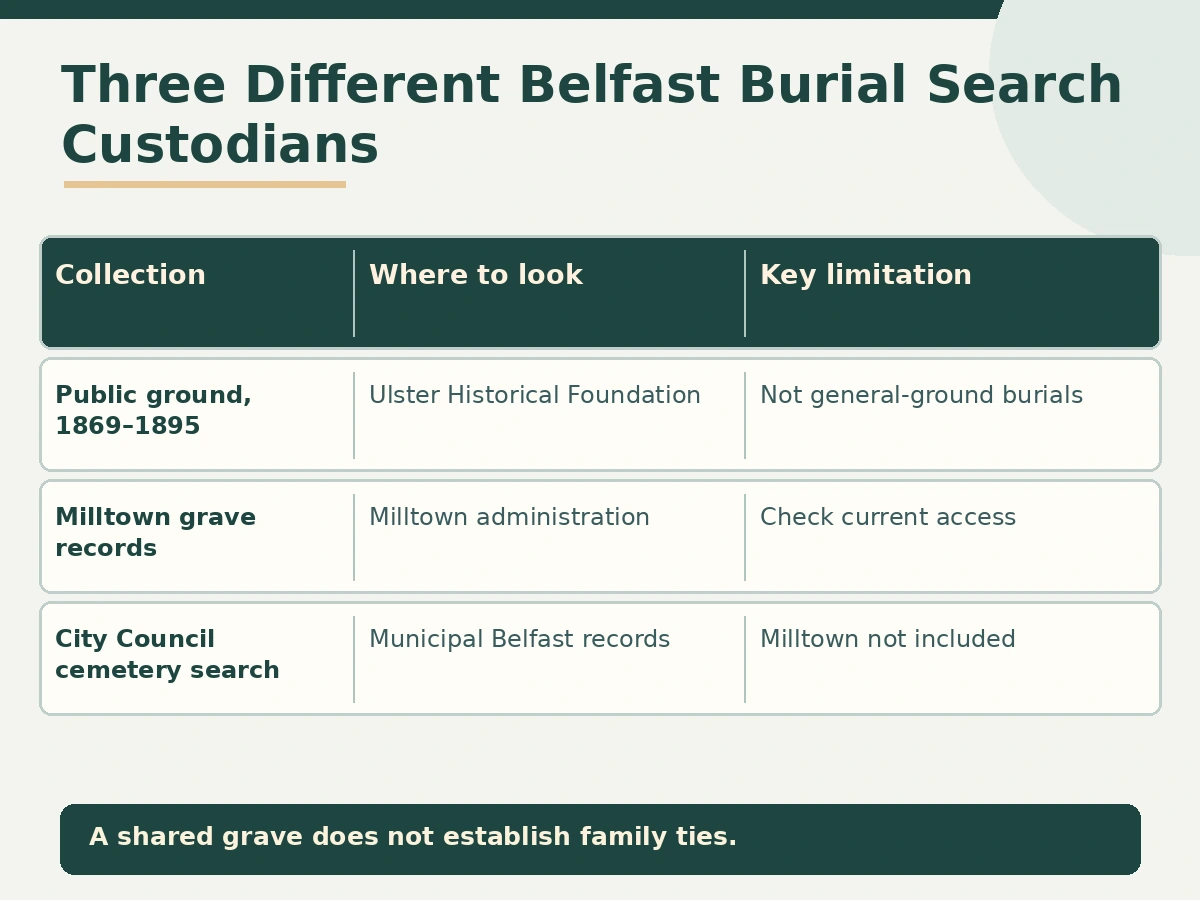
Milltown Cemetery burial records require a different search route from Belfast City Cemetery. Belfast City Council explicitly says it does not hold Milltown’s records. The Ulster Historical Foundation offers a named index of public-ground burials for 1869–1895, but that is not a complete all-graves index. Search it as one defined collection, then contact Milltown’s administration for questions about later years, other registers or a particular grave.
Understand Milltown, public ground and administrative custody
Milltown Cemetery opened in 1869 on Belfast’s Falls Road and has strong associations with the city’s Catholic community. The phrase “public ground” on the historical index is a record category, not an interchangeable label for every named plot in the cemetery. Ulster Historical Foundation states that its database includes more than 27,000 names and covers public-ground burials from 1869 through 1895; it explicitly excludes the general-ground register. Start by defining whether you seek an indexed public-ground entry, a named grave, or a later burial. For a related choice, see our guide “Norwich Historic Burial Records”.
One of the most common dead ends is searching the Belfast City Council burial website for a Milltown ancestor. That council search serves municipal cemeteries and warns that Milltown is administered separately. Treat this as a custody distinction, not a database malfunction. The Diocese of Down and Connor announced a separate Milltown digitization effort in 2024 covering a much wider set of burial records and graves. An announcement of digitization is not proof that every item can be freely searched online today; check current cemetery access arrangements. Our guide “Belfast City Cemetery Records” goes into more detail.
Search the 1869–1895 transcription by name and context
The Ulster Historical Foundation public-ground interface supports first name, surname, different matching modes and free-text searching. Begin with the best-documented surname and a broad match; use given-name variants such as Mary, Maria or abbreviated initials before rejecting a candidate. Because names recur in Belfast families, the same-name result list should be treated as a group of possibilities. Note the period and public-ground scope on every screenshot or exported note so that other researchers do not mistake it for Milltown’s entire burial history.
The transcription describes fields including name, age, address and burial date. Capture their exact printed forms, along with the database title and any result identifier. An address may help distinguish contemporaries and point toward a later census, directory or newspaper notice. It does not necessarily state the residence at the exact time of death; the entry records what the original clerk or later transcriber preserved. Compare original images or cemetery information if available before silently correcting a surprising age.
Know what a burial date and grave reference do not prove
A burial date usually follows a death, but the interval varies. Without a separate death record, avoid converting it into a precise date of death. Similarly, a burial record can establish an interment in the cemetery without proving the deceased’s parents, spouse or kinship with everyone in a shared grave. Milltown historical inscriptions and modern grave-finding services may add names that are commemorated rather than interred. Use a three-column worksheet: recorded interment, plotted grave location and memorial inscription. For a related choice, see our guide “Guildford Stoke Cemetery Records”.
Where a name is associated with a plot, note the exact grave reference, whether the source was a cemetery office reply or an index and whether the plot’s location has been confirmed. Do not guess an internal coordinate or claim a particular monument from an approximate map pin. For an unmarked burial, administrative records may be more reliable than headstone databases. Treat the absence of a visible stone as a field observation, not proof that an entry has disappeared. Our guide “Linthorpe Cemetery Burial Records” covers a related question.
| Source | What it can show | What it cannot prove alone |
|---|---|---|
| Public-ground index | 1869–1895 burial candidates | All Milltown burials |
| Cemetery office | Grave and administrative search | Biological relationships |
| City Council index | Council-run Belfast burials | Milltown holdings |
Request a burial search for dates outside the public-ground index
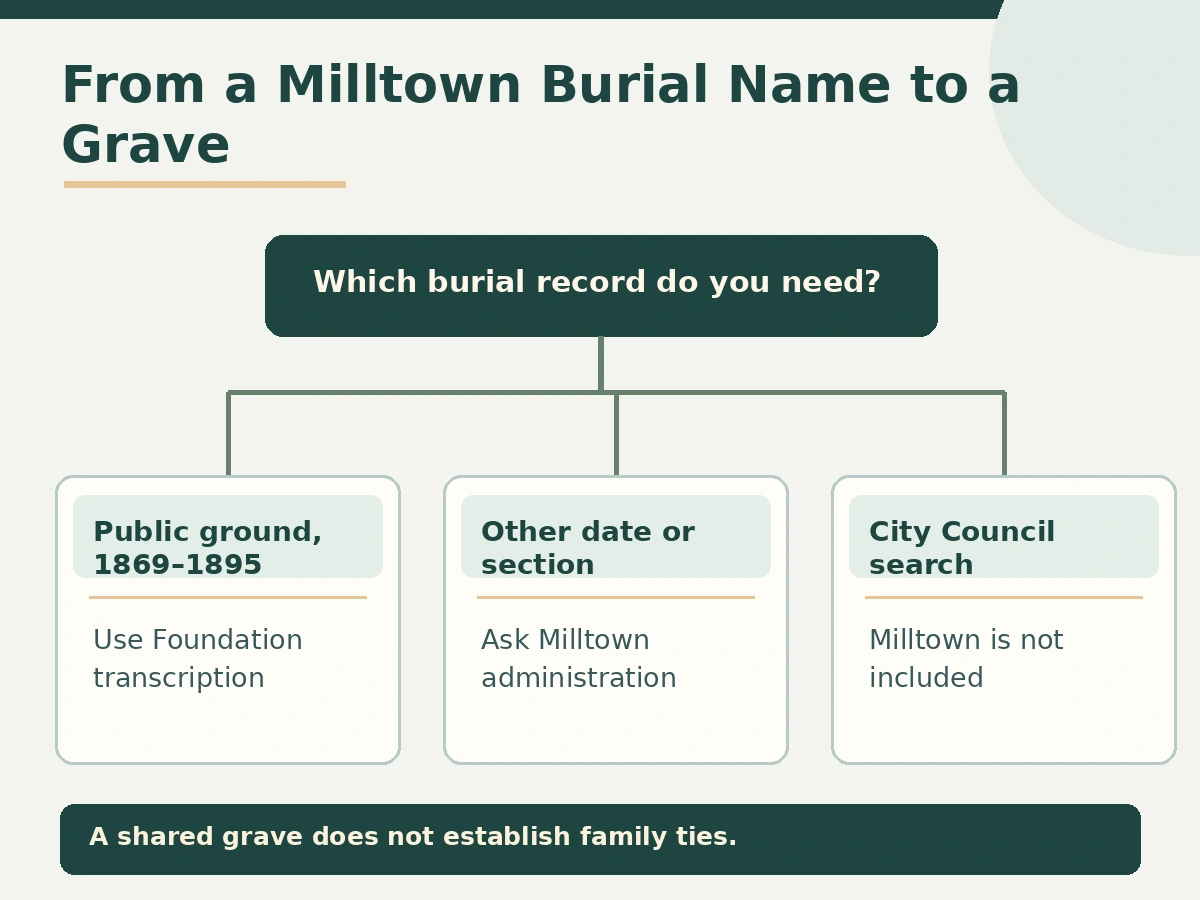
For a candidate who died after 1895, who may lie in another part of Milltown or whose name appears nowhere in the Foundation transcription, identify the appropriate cemetery administration. Prepare a concise enquiry with the name, possible date interval, last known Belfast address and any independent obituary or civil-registration evidence. Ask which series was searched and whether a record extract, plot number or location information can be supplied under current procedures. Do not assume that a historic digitization press release guarantees immediate remote copies.
Keep every negative response narrowly worded: “no match reported in the named series for the supplied details” is different from “the person was not buried at Milltown.” If the cemetery cannot locate a candidate, consider alternate spelling, church funeral books, civil death registration and local newspapers. Because Milltown is not managed by Belfast City Council, contacting the council repeatedly about the same missing Milltown result is unlikely to resolve a custody problem.
Compare the burial with civil and parish evidence
A workable example uses a hypothetical Patrick Murphy buried in the 1880s, with two same-name candidates living near the Falls Road. Build parallel entries listing burial age and address, civil death date and registered district, spouse or family address in a directory and newspaper funeral information. Mark discrepancies instead of choosing the candidate with the most familiar family name. The public-ground transcription is a discovery source; if it derives from a register, identify that relationship in the citation.
The strongest conclusion names the original source consulted, its cemetery section and the evidence connecting this burial to the family. If only a modern transcription has been inspected, say so. Preserve the precise collection title “Burials in Milltown Cemetery Public Ground, Belfast, 1869–1895,” because dropping “Public Ground” produces a falsely comprehensive citation. If a cemetery office later supplies a different register, cite the second document independently rather than replacing the first observation. Our guide “Dundonald Cemetery Records” covers a related question.

More Records and Archives Guides
How We Research Milltown Cemetery Records
We checked the Foundation’s scope note, Belfast City Council’s express exclusion of Milltown and the Diocese’s digitization announcement. Our suggested searches do not claim access to non-public records or prove that all announced material is live. Milltown details are treated respectfully, with no speculative family assignment. No affiliate booking or cemetery service is promoted; see affiliate disclosure.
No. The council states that it does not hold Milltown Cemetery records; use Milltown-specific records or its administration.
It indexes public-ground burials for 1869–1895, not all cemetery plots or the general-ground register.
It gives a burial date and other transcribed details; establish an exact death date in a separate contemporary record.
Check Milltown’s own burial records and current enquiries rather than treating the historical public-ground index as comprehensive.
No. They may have a connection worth testing, but kinship requires independent civil, parish or household evidence.