
Norwich has more than one historic cemetery and the surviving documents are not identical. Norwich City Council’s published guide gives Earlham cemetery indexes from 1856 to January 1998 and burial registers from December 30, 1885 to December 31, 1970. Rosary cemetery has indexes from 1821 to 1997 and a burial register from November 1821 through October 1991. A researcher who searches only Earlham for an 1830 burial is following the wrong date range. First decide which cemetery is plausible from a newspaper notice, family paper, death record or memorial photograph. Then select the index or register that actually covers the date. Treat the council’s range descriptions as archival holdings, not a promise of a complete public online name database.
Separate index ranges from actual burial-register coverage
The Earlham index starts in 1856, but the published burial-register span begins later, in December 1885. That gap in types of surviving records matters when you need to verify an index claim against an original registration. Do not assume an original burial-register page for 1860 exists merely because the index covers that year. Conversely, Rosary’s register begins in November 1821 and extends into 1991. Record exactly which type of book supports the result, who maintains it and which years it includes. If a date lies outside one register’s range, ask whether an alternative index, older burial document or other source is available rather than inventing a missing page.
Route a historical lookup to Norfolk Record Office
Norwich City Council directs historical researchers to the Norfolk Record Office for detailed archival holdings and to the Norfolk Heritage Centre for selected records. Start with the council’s own published dates, then contact the appropriate custodian for availability, catalog references, image permissions and research arrangements. A library’s selected microfilm or index is not necessarily identical to the record-office original. Prepare a concise request: name, proposed cemetery, approximate burial date, alternate names and the specific entry or original you want checked. Fees or access procedures can change, so confirm them rather than representing a public catalog as an unconditional free image service.

Distinguish burial from the date of death
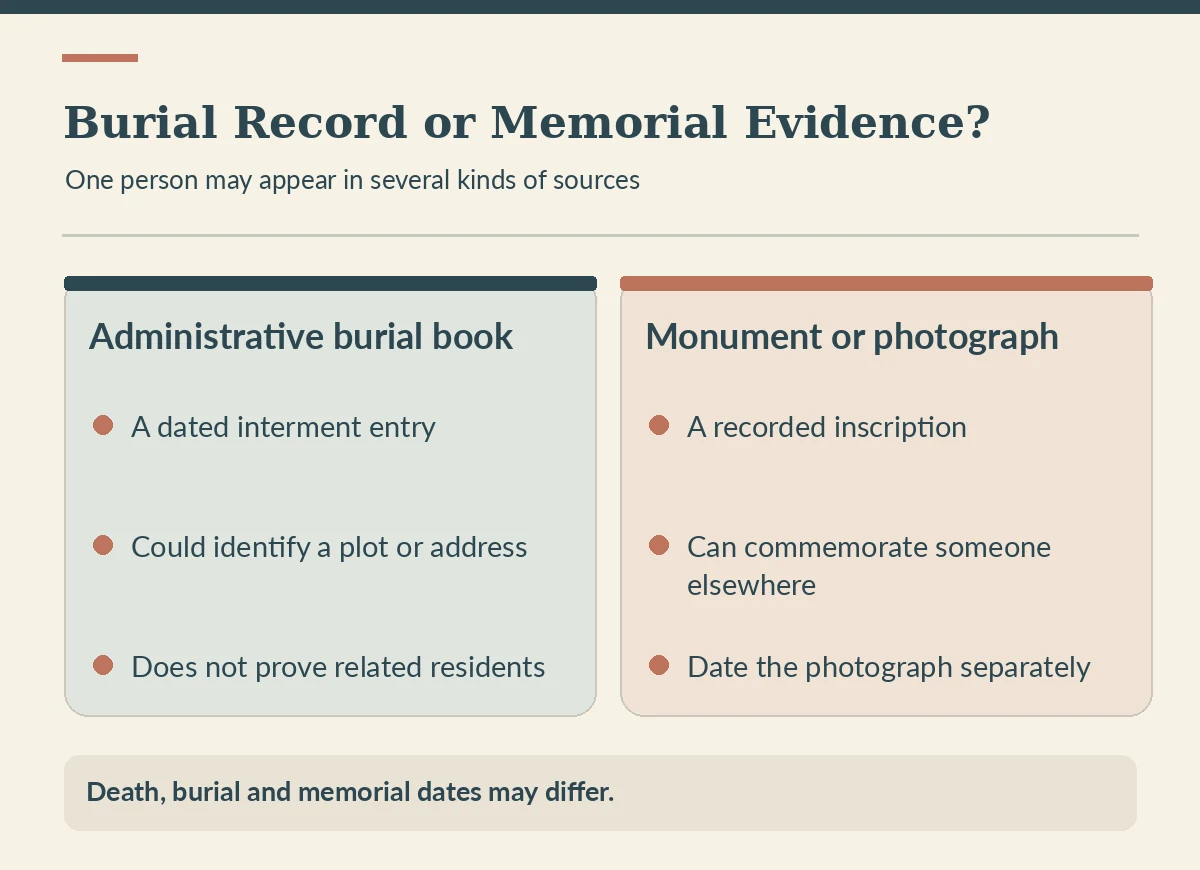
A cemetery register documents the administrative handling of a burial; it may show a burial date that differs from the death date. If a newspaper describes a funeral on Friday and a death on Tuesday, keep both dates distinct and cite each source. A cemetery index transcription can also omit fields found in an original register, including an address, age or plot designation where the historic book provides one. Do not backfill missing index details from assumptions. When the death date matters for proving identity, compare an appropriate civil death record and a contemporary notice. Where ages conflict, preserve the conflict and investigate namesakes before assigning the burial to a family tree.
Read grave references without inferring kinship
A plot code or grave number locates a cemetery administration record, not a family relationship. People sharing a grave may be relatives, unrelated individuals or people connected through rights of burial rather than blood. A memorial can refer to someone whose remains are elsewhere. Record cemetery, section, grave reference, service date and any recorded names in separate fields. If an inscription gives a spouse or parent, cite the literal text and date of the memorial observation. Then seek independent records proving that relationship. Do not treat ownership or an exclusive right of burial as proof that the holder owned the ground itself; Norwich City Council explicitly distinguishes those rights.
Handle stillborn registers and sensitive details carefully
The council’s archival guide lists an Earlham stillborn register from 1928 to 1997, while the Rosary entry does not list a corresponding stillborn-register range. These records can be emotionally sensitive and may be subject to particular access conditions. A dash or omitted range in a public summary is not proof that an event did not occur. Ask the repository about what records were created, what survives and what may lawfully be accessed. Do not publish identifying details about living relatives or speculate about unnamed infants from a shared grave. A respectful search can document the repository and event without reproducing restricted or private information.
Check whether the cemetery or a churchyard was responsible
Not every historic Norwich burial belongs in the two cemetery collections. A death occurring near Norwich may have led to burial in a parish churchyard or a cemetery administered by another organization. Confirm the locality and approximate date from a contemporary source. If the event falls outside both cemetery ranges, search Norfolk parish burial registers and identify which ecclesiastical parish served the settlement. If a family later erected a memorial at Earlham, it might commemorate someone buried elsewhere. An index search limited to the city-managed cemetery cannot establish that a person was never buried within Norfolk.
Build an Earlham–Rosary comparison before merging candidates
When two similar names appear, make a side-by-side table: index spelling, cemetery, burial date, age if given, listed address, register reference and independent evidence. One candidate may fit the family’s parish while another matches a different occupation or address. Retain both unless the documentary correlation is decisive. Earlier family histories can contain an incorrectly attached burial; verifying the original register may reveal which detail was misread. Note especially whether the date was taken from a modern memorial transcription or a contemporary cemetery book. They are not equally close to the event and can report different kinds of information.
Cite the council’s holdings guide and the actual entry separately
The Norwich City Council page is a guide to what the institutions hold; it is not itself the burial entry of a named person. Cite the guide when supporting a statement about year ranges or repositories. When the Norfolk Record Office supplies a register image, cite the cemetery, register title, relevant dates, folio or entry number and archive catalog identifier. If a heritage-center transcript was used, identify the derivative transcription and date accessed. A photographed headstone receives its own citation with photographer and capture date. Keeping these objects separate lets the reader distinguish a published holdings description from evidence that a specific individual was interred.

Select the next source that would resolve your question
If you need to locate a grave, seek the index reference and an appropriate plan or staff confirmation. If you need to prove the date of death, use a civil death record rather than substituting a burial date. If you need to connect two buried people, prioritize documents naming their relationship. If a record is missing for the year, check the council’s dates and ask about other Norfolk repositories before concluding the person was absent. A careful final statement might be that the Rosary register records a burial on a particular day while family identity remains a hypothesis. That level of accuracy protects later family research from false matches.
More Records and Archives Guides
How We Research Norwich City Cemetery Burial Records
We checked the stated time periods, location boundaries, holdings scope and likely error modes in repository guide; archive research guidance; original collection notes. Editorial illustrations are conceptual, not photographs of particular historical documents. No affiliate relationship is claimed for these official resources. See the affiliate disclosure for site policy.
Rosary cemetery: Norwich City Council lists indexes from 1821 and a burial register starting in November 1821.
The council lists Earlham indexes from 1856 but a narrower burial-register span from December 1885 to December 1970.
Norwich City Council directs researchers to Norfolk Record Office for detailed holdings and Norfolk Heritage Centre for selected records.
No. A plot is an administrative locator; relationships need independent documentary evidence.
Check the other cemetery, parish churchyard registers and the custodian’s catalog for alternative surviving material.