
Somerset birth research divides at July 1, 1837, when civil registration began in England and Wales. For later events, begin with the General Register Office birth index or an appropriate local registration-office index, then obtain an actual certificate where needed. For an earlier ancestor, prioritize a documented Somerset parish baptism register or a surviving substitute. Somerset Heritage Centre holds Diocese of Bath and Wells parish material under D/P references; these are church ceremonies, not modern birth certificates. A baptism recorded in 1820 may show the child and parents but not a precise birth day. This article’s objective is to route a known place and approximate date to the correct record without merging a registration district with a parish or a baptism with a birth.
Understand why a GRO district is not the parish name
Somerset’s civil-registration guide explains that early registration districts followed Poor Law Union boundaries and could contain many parishes. An index entry for a named registration district may therefore refer to an event in one of several communities. Do not open every parish book in that district blindly. First capture the index district, registration year and quarter, then use an independently known address, later census or sibling’s baptism to narrow the parish. Administrative boundaries also changed, so record the district as printed in the contemporary index. A family living near a county line might appear in a registration district whose name differs from its everyday town or village.
Record the quarter, volume and page from the index
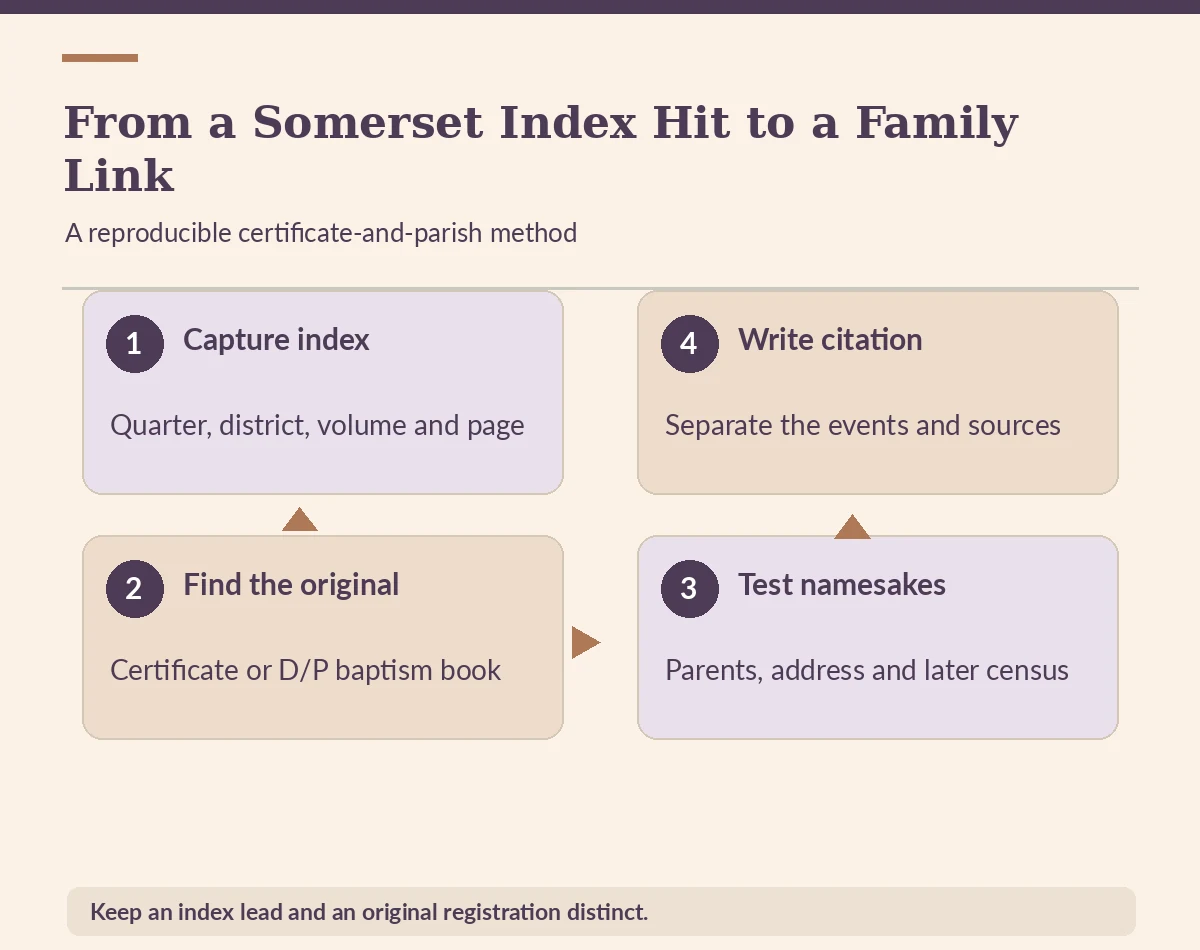
The GRO’s guide explains that historical civil indexes are grouped in March, June, September and December quarters and identify the registration district, volume and page or equivalent reference. Record these details exactly for every plausible candidate. A March-quarter entry is a period of registration, not automatically a January or March birthday. A child born late in one quarter may have been registered in the next. Use the index as a finding aid; it is not a full certificate with all parent information. When several babies share the same given name, the registration reference makes candidate searches reproducible without pretending to know which one is yours.

Check the mother’s maiden-name clue cautiously
Modern GRO historical birth-index searches can show a mother’s maiden name where that field is available. This is a strong candidate discriminator but it is not a substitute for checking the complete registration or independent family evidence. Spelling variations, transcription problems and unusual family circumstances can produce conflicts. A blank field or unexpected surname should not trigger an automatic change to a family-tree parent. Compare the reported mother with a marriage certificate, baptism, census and other children’s registrations. Record whether a surname is printed in the index or inferred by you from another source. When two candidates remain, order or consult the relevant full record instead of selecting the first plausible one.
Request the correct certificate from GRO or Somerset services
Somerset Heritage Centre’s civil-registration guidance gives the General Register Office and Somerset local registration services as routes for copies of events held in their registers. Establish the exact record sought before paying: name, year, quarter, district, and where possible volume and page. Current prices and delivery formats can change, so verify them at the provider rather than repeating old figures. Check whether the request is for a certified certificate or a permitted digital historic copy; these are not necessarily identical products. Do not assume a family-history website’s indexed result includes the official document. Save the certificate’s own registration details when received. For the next step, our guide “Denbighshire Death Records” explains how to find the local index and correct register office.
Use D/P parish registers for earlier Somerset children
Somerset Heritage Centre describes parish baptism, marriage and burial books in the D/P collection. The parish guide notes that many registers began in the seventeenth century even though keeping registers was ordered from 1538; coverage varies between places. Select the historical parish and approximate year, then inspect the baptism register and any relevant index or image. Copy the child’s name, recorded parents, stated residence, occupation if present, and baptism date as written. A baptism could occur days, months or sometimes years after birth. When the entry does not provide a birth date, do not create an exact one from the ceremony alone. Our guide “Scottish Birth Registers from 1855” shows how to find parents and check original entries.

Compare surviving bishop’s transcripts when a book has gaps
Somerset Heritage Centre also describes bishops’ transcripts, annual copies sent to diocesan officials, under D/D/rr and related references. They can sometimes supplement missing or damaged parish-register entries, but a transcript is neither universally available nor guaranteed to reproduce every detail accurately. Compare the copied entry with the register when both survive, especially where a parent’s surname or date differs. Cite each manuscript as its own source and identify the transcriber’s potential role. If both are missing, consult nonconformist church materials, nearby parishes or other locality records appropriate to the ancestor’s denomination, rather than assuming a baptism never occurred.
Build a proof table for two Somerset children with one name
Suppose two babies named Mary Taylor appear in a registration district in neighboring quarters. Create a table listing full name, quarter, district, volume/page, mother’s maiden name if shown, subsequent residence and the parish baptism evidence. Do not merge them because one matches the family’s general county. A later census may supply birthplace and an estimated age, while a marriage record can name the father; compare those claims with each registration. Keep the two candidate profiles separate until the evidence distinguishes them. This controlled comparison is especially important in large districts with repeated names or families moving between market towns and villages.
Cite birth and baptism records as different events
For a civil birth registration, cite the GRO index separately from the certificate and specify the district, year, quarter and reference. For a Somerset parish baptism, include Somerset Heritage Centre, the D/P collection and exact parish-volume or image reference, and the written ceremony date. If you used bishops’ transcripts, identify their copy series instead of substituting a generic parish-book label. A complete evidence note contains reported fact, source context, confidence and an unresolved-conflict column. For example, a baptism’s father’s occupation is a reported detail of that particular entry, not automatic verification of every later person with the same name. For a related choice, see our guide “Gloucestershire BMD Index”.
Use the missing fact to choose a next Somerset source
When the index gives a candidate but no proof of parents, the next step is a certificate or a contemporaneous church record. When the birth predates 1837, find the correct historical parish and inspect the baptism or bishops’ transcript. If the location is uncertain, build a dated map from census places, directories or marriage records before ordering multiple certificates. If no result appears, distinguish wrong quarter, changed district, spelling variation and genuinely absent surviving material. A sound conclusion may establish a Somerset registration in a specific quarter while leaving the exact birth day or parentage unconfirmed until the original record has been checked. If you want the full process, read how to find England birth records.
More Records and Archives Guides
How We Research Somerset England Birth Records
We checked the stated time periods, location boundaries, holdings scope and likely error modes in repository guide; archive research guidance; original collection notes. Editorial illustrations are conceptual, not photographs of particular historical documents. No affiliate relationship is claimed for these official resources. See the affiliate disclosure for site policy.
Civil registration began across England and Wales on July 1, 1837; earlier family events need church or other records.
No. It identifies the quarter in which the birth was registered, which may differ from the birth month.
The index lists civil registration districts, which often encompassed several historical parishes.
Only if that date is explicitly recorded and reliable. The baptism date is a different event.
Somerset Heritage Centre describes D/P parish series and related bishops’ transcripts; verify parish-specific coverage.