
The Gloucestershire local BMD search changed on February 11, 2026. The current Gloucestershire Registration Service Index (GRSI) replaced the former public interface, and the Gloucestershire Family History Society reports that several previously useful fields are no longer displayed. Search the new portal for the event, retain the index locator, and use the General Register Office (GRO) or the appropriate local registrar for supplementary details and a certificate. A missing mother’s maiden name in the new search result is not proof that the original birth registration omitted it.
Use the current GRSI portal rather than old bookmarked pages
The Gloucestershire Family History Society announced that the old county BMD website was relaunched as the Gloucestershire Registration Service Index on February 11, 2026. Older guides may still send readers to the former /bmd/ address or describe its older search results. Go to the live /grsi/ main menu and select the birth, marriage or death index rather than relying on screenshots. Save the date you searched, the exact query and whatever identifiers are now displayed; avoid assuming the old interface’s filters and fields remain available.
Know which birth-index field is no longer displayed
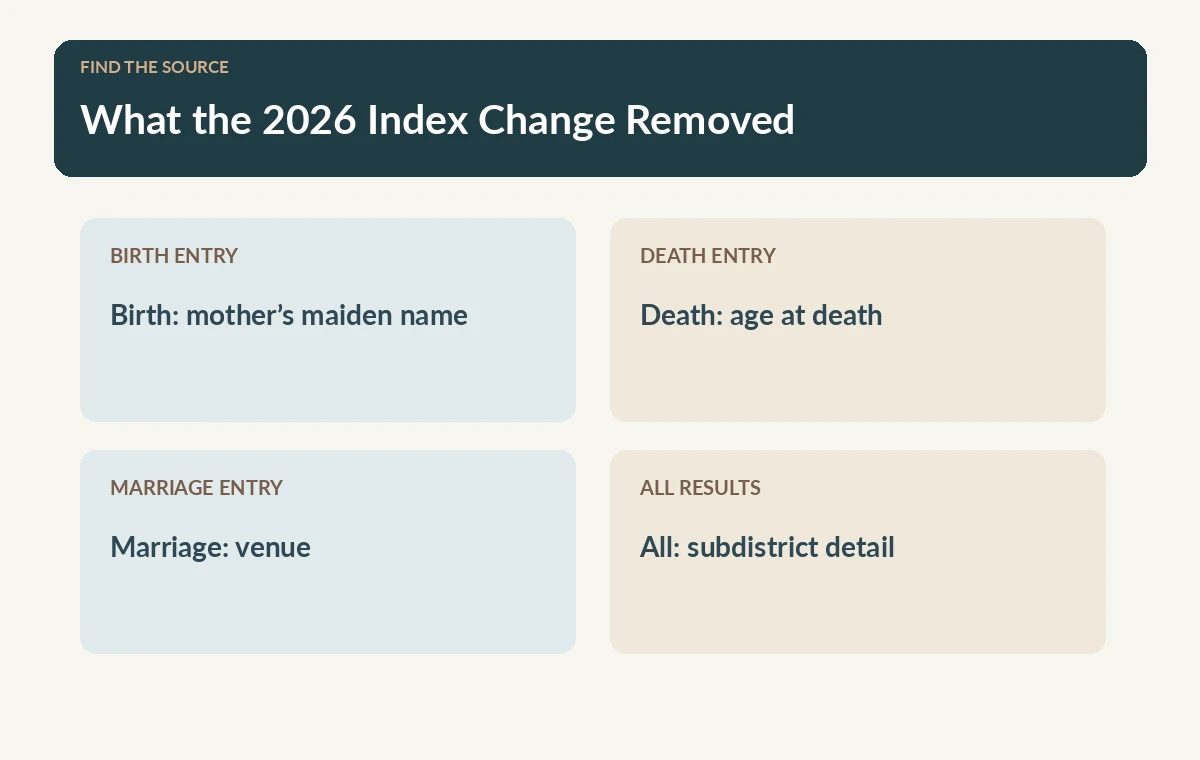
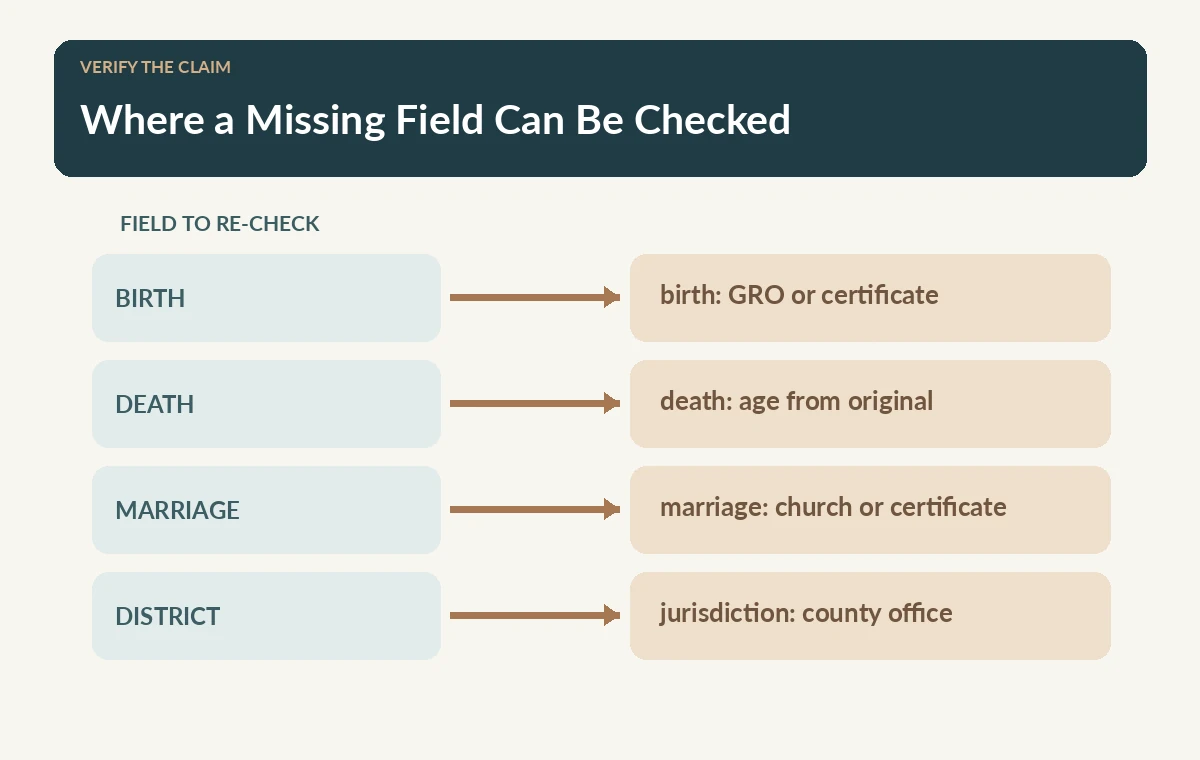
According to the Family History Society’s March 2026 notice, the relaunched GRSI no longer shows the mother’s maiden name in birth results. That is a change to the online display, not evidence that a mother was unnamed on the legal register. The society advises that the GRO’s historical birth index can supply the former surname for many older entries. Search the GRO against name, quarter, year and district. Do not assume that a blank online field equals an unknown mother or that a surname match alone proves parentage.
Understand the hidden death ages and marriage venues
The same local notice says the new results omit ages on deaths and places of marriage; subdistrict names have also disappeared from the online display. These omissions weaken quick discrimination between same-name candidates. Recover age from a national death index when available, a certificate, burial register or a contemporaneous obituary; seek the marriage venue from the original certificate or church register. Keep the record type straight: a marriage registration is evidence of a civilly recorded event, whereas a banns entry only indicates an intended wedding.
Compare Gloucestershire’s local index with the national GRO index
The local index and the GRO index are related finding aids but use different reference systems and can expose different details. The GRO indexes are organized by registration district, quarter, year, volume and page for older records. The local entry may reflect the registrar’s physical volumes and a different indexing scheme. Copy each reference in its native form; do not substitute a local number into a GRO order form unless that service specifically accepts it. If both indexes disagree on spelling, check a certificate before choosing one as authoritative.
Check the historical district before requesting a certificate
A Gloucestershire postal address does not necessarily mean the civil registration took place in the county’s current administrative district. Gloucestershire County Council explicitly warns that not all GL postcodes are within its registration jurisdiction. Its official certificate guidance also specifies that Berkeley registrations in certain historical periods fall under different modern authorities. Test the event’s period and historical registration district, not only a modern street address. An unsuccessful local certificate request can be caused by jurisdiction rather than an incorrect family date.

Look past the current result to the original act
Once you find a candidate, identify whether the required proof is the full registration entry, a civil certificate or a parish entry before ordering. Birth certificates can report parents and informant; a death certificate records information attributed to a reporter and may be mistaken about birth year; a marriage certificate describes the parties and witnesses under the form rules of its date. A transcript of any one is a starting point rather than a substitute for the document. Preserve the indexes even after you obtain a copy so others can reproduce the search. For a related choice, see our guide “Denbighshire Death Records”.
| Event | Not shown in GRSI | Possible next record |
|---|---|---|
| Birth | Mother’s maiden name | GRO index or birth certificate |
| Marriage | Marriage place | Marriage certificate or parish book |
| Death | Age at death | Death certificate or other index |
| All events | Subdistrict on results | Historical district and registrar |
Handle name variants and 500-result searches systematically
Broad surname searches can generate many matches in common Gloucestershire names, especially when four distinguishing fields have vanished. Use a narrower year range, given name variant, event type, or historical district when available. Make a shortlist rather than accepting the first result in alphabetical order. Then cross-check companions: a child’s later marriage for a mother’s family name, a spouse’s burial for a death age, or witnesses for a marriage venue. The correct use of an index is to locate records for testing, not to declare identities from matching names alone. For a related choice, see our guide “Somerset Birth Records”.
Treat coverage summaries as dated, not permanent promises
Earlier guidance about the former local index discussed indexed years and coverage, but its field layout predates the 2026 redesign. Do not copy its old field layout or imply that every local record is now equally accessible in GRSI. Consult current county notices for coverage and use the national GRO index as a separate route when a local name search has no result. Registration began on July 1, 1837 in England and Wales; earlier baptisms, marriages and burials are normally sought in parish holdings. For a step-by-step method, see how to find England birth records.
Keep a field-by-field record of index differences
For each candidate, create two columns labelled Local GRSI and National GRO, followed by a certificate column. Enter only fields actually visible in that source. If a local marriage result does not display a venue, mark it “not shown in this interface,” not “unknown church.” Similarly, do not fill a missing death age by reverse-calculating from an assumed birth year. This discipline prevents old screenshots from becoming untraceable claims and makes source conflicts easy to revisit if the county changes its interface again.
More Records and Archives Guides
How We Research Gloucestershire index changes
We checked the live GRSI site, the Gloucestershire Family History Society’s dated March 2026 notice, county certificate guidance, and the GRO family-history page. We distinguish a field removed from a public display from a field absent in the historical registration itself. Links here are not paid endorsements; see our affiliate disclosure.
Yes. The Gloucestershire Family History Society dates the launch of the new GRSI to February 11, 2026.
The new local index no longer displays it; that is not proof the original birth registration lacks the information.
The new local search omits death ages. Check other indexes or obtain the relevant record where available.
Not always. Use the historical registration district and the county council’s guidance for changing jurisdictions.
Do not assume so. Preserve each index’s own locator and use the reference accepted by the issuing authority.