
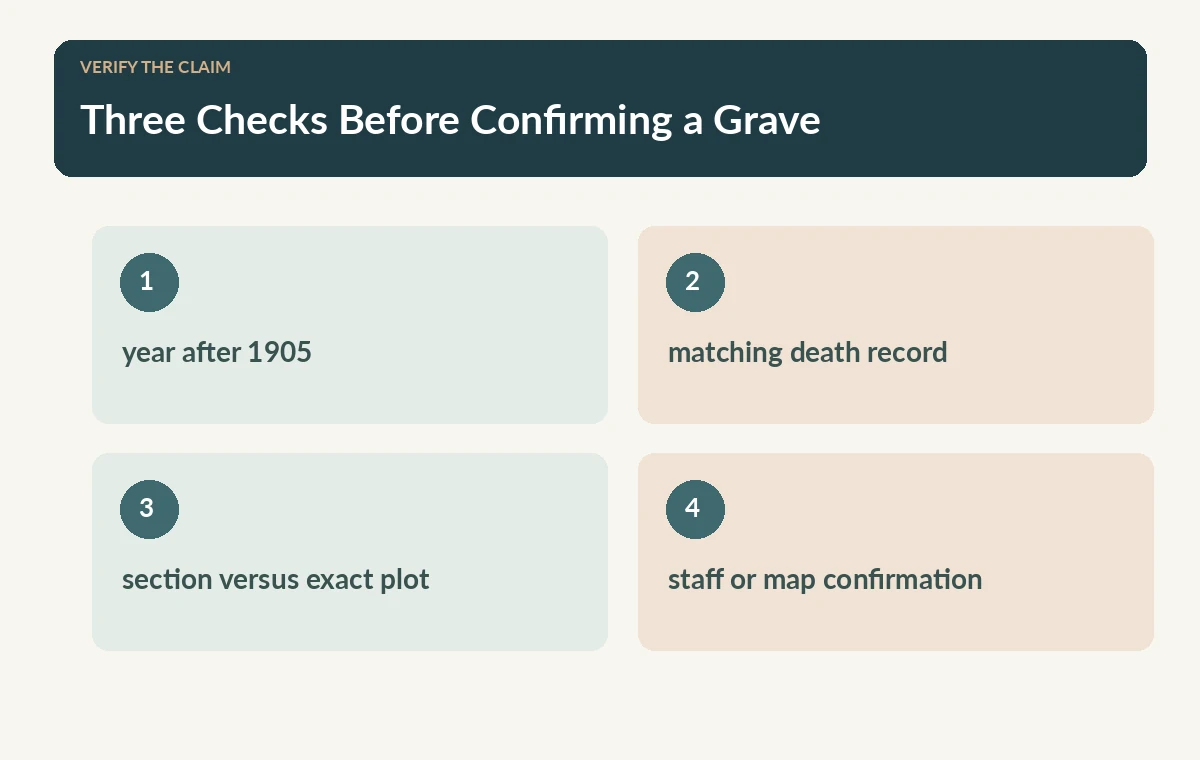
Use the City of Launceston’s Carr Villa burial search to look for a named person at Carr Villa Memorial Park in Tasmania. The city says the park’s first burial was in 1905, which is an immediate date check: a supposed burial before then needs another cemetery or a corrected family date. Copy the exact entry and locate the relevant section through the official visitor maps. A database match can be evidence of an indexed interment, but it does not by itself confirm a headstone, family connection, ownership of a burial right, or precise on-ground position.
Check the 1905 start date before trusting a family story
The City of Launceston’s Carr Villa FAQs say the first burial was in 1905. That provides a simple falsification test for a claimed nineteenth-century Carr Villa grave. A family story may use the cemetery’s modern name for an older Launceston burial elsewhere. Record the reported death and burial years separately; newspaper funeral notices can help reveal the correct burial ground. Do not force an earlier death into a later memorial-park result because the surname and suburb look plausible. For the fuller picture, see our guide “Woronora Memorial Park”.
Search the official burial records using flexible names
Use the city’s burial-record search, starting with a surname and adding given names only as needed. People may appear under initials, alternative names or a married surname; an index often reflects the administrative spelling at the time. For every likely result, transcribe the actual name, associated dates, burial or memorial details, and any section or location field shown. Keep a separate list of rejected hits. The city’s public page provides the entry point to a search tool, but an iframe or temporary interface change may mean its fields differ from a saved screenshot.
Separate a burial from ashes placement or memorialization
Carr Villa supports conventional burials and cremation-related memorial areas. An entry linked to an ashes placement need not indicate a coffin grave, and a memorial does not necessarily identify where a person’s remains are located. Read the label supplied by the source rather than interpreting every result as a headstone-bearing grave. The relevant cemetery office can clarify the category when the public record is abbreviated. A search result never proves that two people listed within one broader section were spouses or related. Our guide “Pinnaroo Lawn Cemetery Brisbane” covers a related question.
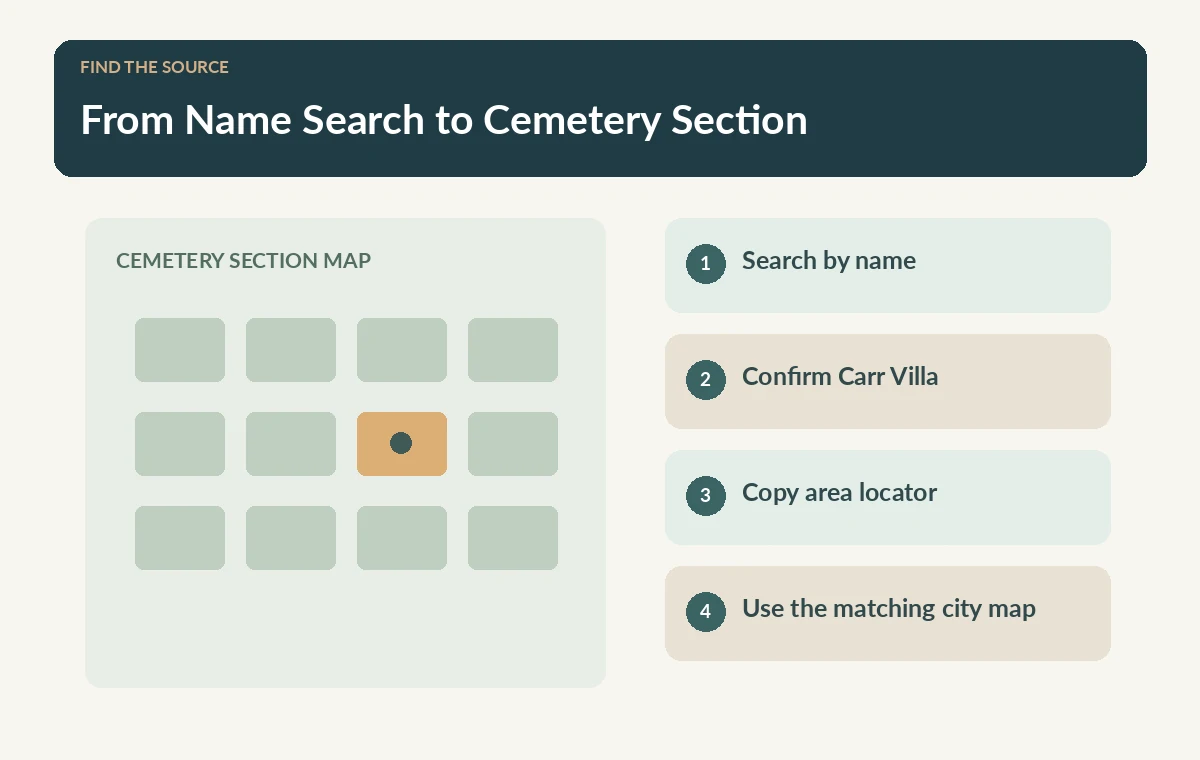
Choose the correct site map before traveling to a grave
The official visiting page includes maps for different Carr Villa areas, including lawn and monumental sections and cremation gardens. Match the wording in the search result to the corresponding map. Do not confuse the park’s overall footprint with the numbered section or with the grave within it. A marked section on the printed map may still require office confirmation of an individual plot. Photograph the map legend for reference and respect access restrictions on site.
Treat approximate coordinates as a guide, not a guarantee
In describing the cemetery’s mapping work, the City of Launceston explained that a historical online name lookup returned an approximate location and staff used further paper records to establish exact positions. More mapping work may have changed the interface since that announcement; verify the current result rather than assuming a GPS pin is provided. If precise placement matters, contact the memorial park using the full reference. Never attempt to lift a marker, probe the soil, or disturb a plot to settle a family-history question. Our guide “Abney Park Cemetery Records” goes into more detail.

Verify a name match using an independent death source
Search Tasmanian civil death indexes, contemporary newspaper notices or surviving funeral records for the proposed person. Compare age at death, death and burial dates, address and known relatives. A gap of several days between death and burial is normal and should not be silently merged into one event. Consider whether a person of the same name was also buried in Launceston. Create a candidate table with two columns for what each record literally says and what you infer from the combination.
| Item | What it tells you | What remains open |
|---|---|---|
| Burial-search result | An indexed cemetery or ashes entry | Exact physical location |
| Site map | Which area or section to approach | Individual burial identity |
| Headstone observation | Visible inscription on a marker | Correctness of the inscription |
| Civil death record | Reported death facts | Where remains were placed |
Avoid inventing a family connection from adjacent plots
Two people with the same surname in the same memorial park may be relatives, but cemetery placement alone does not define their relationship. Even a shared family plot can involve later reuse, changes in burial rights, and non-relatives. If the entry contains a section or plot reference, use it to find administrative records rather than asserting kinship. A funeral notice naming a spouse or child, a civil registration or a probate entry is a better way to test the relationship. Preserve both identity uncertainty and plot-location uncertainty as separate questions. To go further, our guide “Fawkner Memorial Park Burial Records” shows how to find a grave and test identity.
Contact Carr Villa with a complete evidence request
For unresolved mapping and historic entry questions, use the official contact information at the foot of the city’s visiting page. Supply the recorded name, relevant date, cemetery area, any grave or ashes location code, and a precise question such as whether a scanned interment register or map is held. Ask first whether staff can verify the site from surviving documentation and whether a retrieval fee applies. Do not send details of living family members that the office does not need to answer an archival query.
Write a traceable burial citation and location note
Your citation should give City of Launceston, the specific Carr Villa online search, name as entered, record description, location code if any, access date and any follow-up register details supplied by staff. Keep site maps and monument photographs as distinct sources. If a marker is weathered or missing, record what you observed without upgrading an administrative result to a physical monument. A dated photograph should include its viewpoint and an indication of whether the grave location was verified independently.
More Records and Archives Guides
How We Research Carr Villa burial information
We compared the official burial search, the city’s park FAQs, its visiting maps and the public explanation of grave mapping. Our evidence test distinguishes the name index, cemetery section and exact resting place. We do not treat neighboring plots as family relationships. There are no paid cemetery referrals here; see our affiliate disclosure for site policy.
According to the City of Launceston, the first burial was in 1905.
It may return location details, but the park advises using its maps and staff records for unresolved precise locations.
No. Ashes and memorial areas have different forms of placement; follow the record’s exact category.
No. Section proximity is not evidence of a family relationship; verify through civil, probate or funeral records.
The City of Launceston Visiting Carr Villa page links to maps of the memorial park and its major burial and memorial areas.