
For a death in historical Denbighshire, Wales, begin with the registration year and locality, not simply the present-day county name. Civil death registration in England and Wales began in July 1837. North Wales BMD offers searchable local death indexes with subdistrict and present register-office information, but its coverage depends on the specific locality and year. A local index hit is a route to a certificate, not a certified account of the death and not evidence of a family relationship. The essential task is to preserve the local reference separately from any General Register Office (GRO) reference.
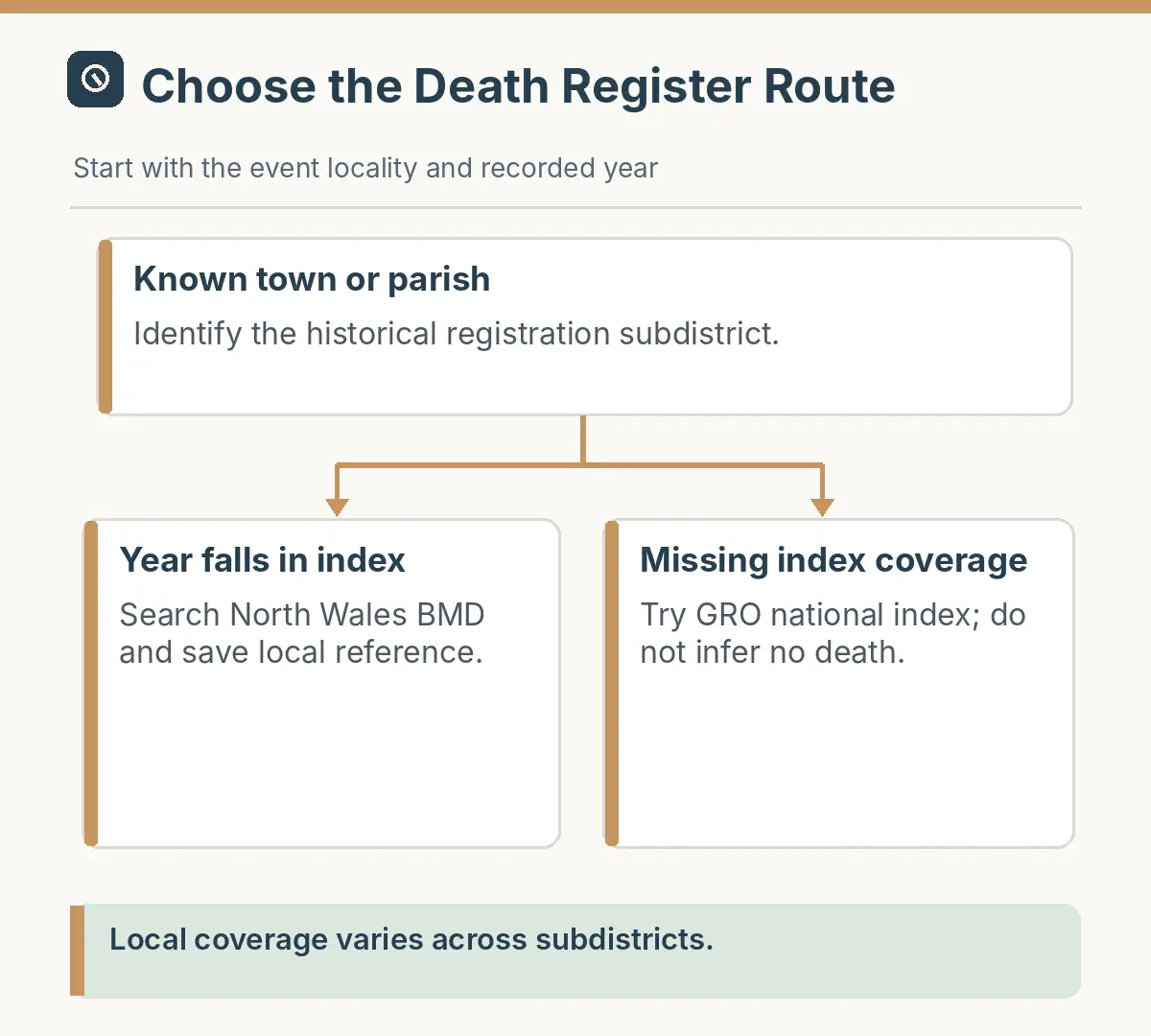
Choose the historical subdistrict before searching a surname
Identify the village, street, or parish associated with the death from an obituary, census, family document, or burial notice. The present map of Denbighshire does not reproduce every Victorian registration district. The North Wales BMD subdistrict guide identifies which localities each historical area served and where the surviving registers are now held. For example, the guide places records of the Ruthin subdistrict with Denbighshire South (Ruthin), while Rhyl-related records can belong to St. Asaph or the later Rhyl subdistrict depending on the year. Record the precise parish or town first, then test whether its subdistrict was active on the date. A modern district name alone is an unreliable filter for a nineteenth-century event.
Check indexed years instead of assuming complete coverage
Consult the death coverage table for the particular subdistrict and compare the years indexed with the years the subdistrict operated. The service aims to index a large span beginning in 1837, but coverage differs between places. An empty name search can mean that the correct year has not been indexed, that a name was transcribed unexpectedly, or that the death was registered elsewhere. Search one adjacent year when the family date is approximate. Do not interpret an absent local online result as proof that no registration exists. For a missing local period, use the national GRO indexes or contact the appropriate register office after checking the historical district.
Read each local result as a retrieval instruction
The local death index can provide the registered name, registration year, subdistrict, present custodian, and a reference number used by that office. The local users’ guide expressly notes that the registration year may differ from the actual date of death, and that the local reference is not a GRO number. Save an exact screenshot or transcription of each candidate result, including the subdistrict and local code. When two people share a common Welsh name, retain both candidates until an age, address, occupation, spouse, or burial record distinguishes them. The index alone does not disclose all the details on a certificate, and its name may reflect the registrar’s spelling rather than family usage.
Do not exchange a local reference for a GRO reference
The General Register Office has a different citation system: historical quarterly indexes use a registration district, volume and page, while local index references are designed for the specific register office holding the local book. The GOV.UK certificate ordering service directs national orders to the GRO. If ordering locally, follow the procedure associated with the current office named in the North Wales BMD result; if ordering nationally, collect the appropriate GRO reference from the national index. Never paste a code from one system into the other and treat a failed lookup as a missing death. Keep two reference columns in your research log, each labeled with its repository and method of retrieval.

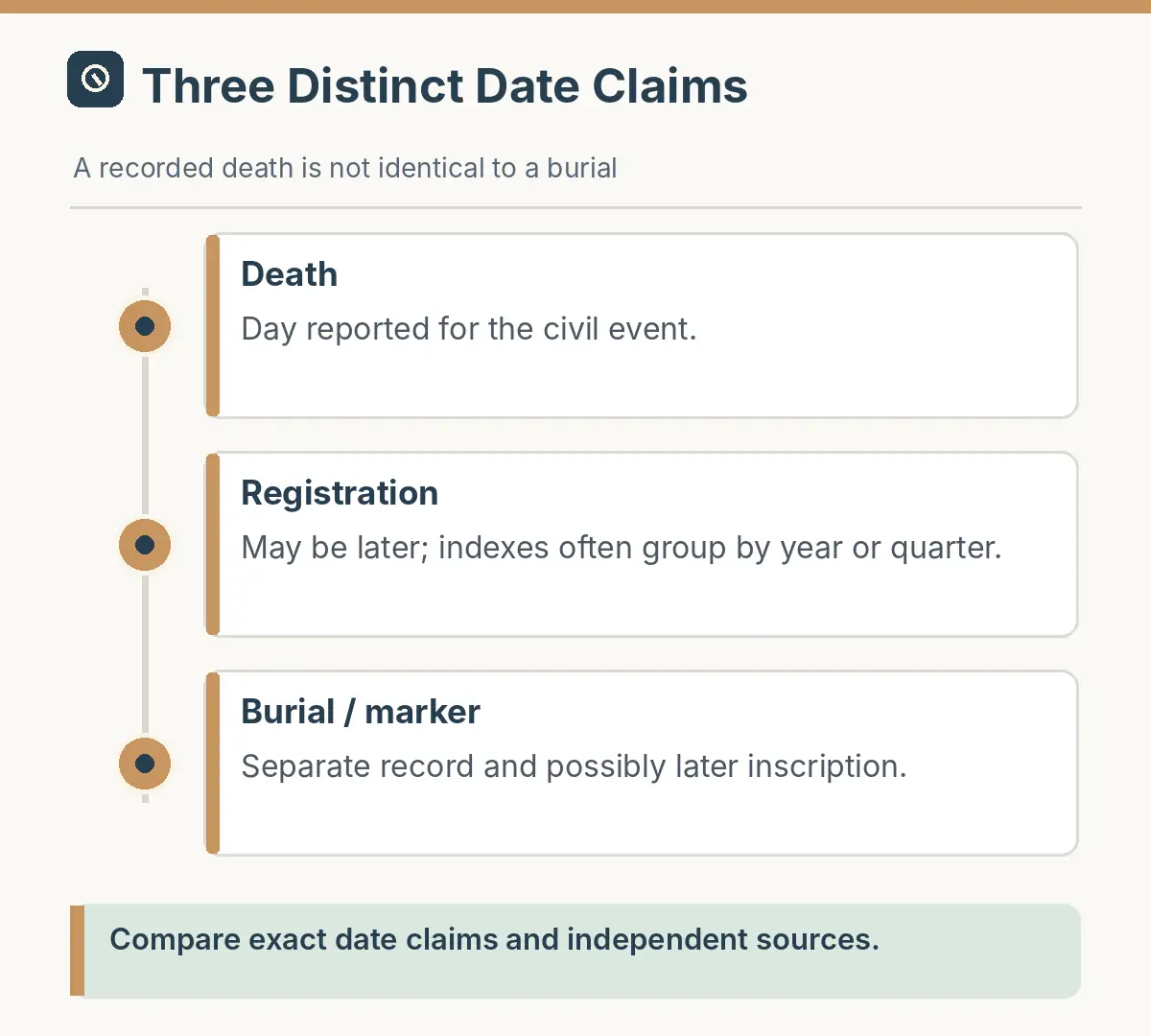
Compare death, registration, burial, and inscription dates
A death certificate records a civil event; a burial register records a separate religious or cemetery procedure; a headstone may be erected much later. Build a date ledger with independent fields for death, civil registration, funeral, burial, and memorial inscription. For older burials, church registers or cemetery office material can supply a plausible event window before a certificate is located. Remember that an index is normally arranged by registration period, not necessarily the calendar day of death. A gravestone shared by multiple surnames is not adequate evidence that everyone engraved there is interred in the same plot. If an informant appears on a certificate, preserve the wording of their stated qualification instead of automatically naming them as a child or spouse.
Use nearby households to distinguish repeated Welsh names
Welsh patronymic history, common surnames, name changes, and multiple adults of the same name can make a district-wide index ambiguous. List candidate names side by side rather than choosing the first match. Check ages or estimated birth years where the index offers them; compare earlier census addresses, occupation, spouse, and independently documented children. If the record concerns Ruthin or St. Asaph, do not assume a similarly named death elsewhere in North Wales belongs to the same family. Separating documented facts from a working hypothesis is especially important when a candidate’s age conflicts with household returns. Resolve a conflict through an independent record rather than rewriting the year to fit an attractive match. Our walkthrough on how to find England birth records sets out each step.
Prepare a registrar enquiry that can be answered
If you need a certificate from a local register office, send a concise enquiry naming the deceased exactly as indexed, the registration year, the local subdistrict and its reference. Include a date range when evidence is approximate, but distinguish an index reference from an inferred family story. For an older event, state the known town or parish rather than assuming a modern county is the complete address. If the office directs you to GRO instead, do not treat the referral as proof of a lost volume. Save the reply, requested reference and any stated search limitation in a research log. This creates a reproducible route for another researcher and avoids repeated unproductive requests to the wrong custodian. For the next step, our guide “Gloucestershire BMD Index” explains how to use the New 2026 registration service search.
More Records and Archives Guides
How We Research Denbighshire Registration Districts
Our source route starts with the local coverage by subdistrict, checks the place-to-office guide, and uses GRO information for the separate national certificate path. We treat 1837 as the start of civil registration, not the start date of every local online subindex. We do not infer that a person on a burial notice is the same person in the local database without an identity comparison. The affiliate disclosure explains our commercial policies; government and local-index sources take precedence here.
No. It is an index entry used to locate the local civil registration; original local registers are not openly browsable.
No. Use the subdistrict coverage table to determine whether the place and year have been indexed.
No. The local office reference and GRO quarterly volume-and-page reference are separate systems.
The registration date can follow the actual death, sometimes crossing a calendar year.
It supports a burial event, but the civil record is an independent source to identify and assess.