
Historical Edinburgh census records for 1841 through 1921 are searchable through Scotland’s People. These are digitized enumerators’ books of Scottish households, not surviving original household schedules. Begin with a census year, known name, and Edinburgh place or district filter; then open the image to establish the address, household members, and precise enumeration context. The published 100-year closure rule means later person-level returns generally are not yet available. An Edinburgh street address is a stronger lead when paired with a district and record reference than when treated as a modern geocoded address alone.
Begin with the year that matches a documented life event
The National Records of Scotland confirms access to indexed Scottish census images from 1841 through 1921. Start with the census nearest a documented marriage, birth, work address, or death and search backward or forward in decade steps. The enumerator recorded a snapshot on the census night, so a person can be absent due to travel, employment, institution admission, or migration even when another record places them in Edinburgh that year. Do not assume a later adult and the earlier child of the same name are identical merely because their birth years are close. Keep one line in your ledger for every census-year candidate and label uncertain identity matches before attaching them to the tree.
Use the City of Edinburgh and district selectors
The Scotland’s People place-search guide describes filtering census results by county or city, followed by district. Select Edinburgh where appropriate and inspect the listed districts; a parish label used in older documents may differ from a later civic area or familiar neighborhood. Search the person’s surname alone first if given names vary. When results are too numerous, narrow with an approximate age, a second household person, or a known occupational clue from independent evidence. Restricting too tightly at the outset can hide a family enumerated on the other side of a city boundary. Write down exactly which fields and variants were used so an unsuccessful search can be repeated.

Understand what the indexed Scottish image actually is
Scotland’s People explains that enumerators copied information from household schedules into books; the original household forms are not what researchers see in the historic searchable set. The transcription into an official book can contain spelling or age errors, and a modern name index is another layer of interpretation. Inspect the image rather than relying only on a search snippet. Read adjacent entries, address headers, and relationships exactly as recorded. A household head designation describes the enumerator’s household relationship framework, not necessarily legal ownership or biological parentage. A boarder, visitor, servant, and relative each have different evidentiary implications. Cite census year, district, enumeration book and page details visible on the image; preserve the site reference for later retrieval. Our guide “Orkney Census Records, 1841–1921” covers a related question.
Link a census address to Edinburgh valuation rolls
A household’s address gives evidence of presence on census night, while a valuation roll concerns property-related administrative assessments and may name an occupier, owner, or other party. Use the two in parallel: record the exact address spelling and house number from the census, then see whether a roll in a nearby year includes the property. Small changes in numbering, subdivision, stair or flat descriptions, and street names can create apparent moves that require a historical directory or map check. Do not equate a roll’s proprietor with a census resident. A reported business premises, rented room, institution, or home can have different users and ownership arrangements.

Handle children, absences, and institutions cautiously
Scotland’s People describes the census as a snapshot including visitors and people in institutions. If a child appears with another household, the relationship entry may identify their place in that household but does not automatically prove all of their parents’ names. Institutions can have their own books and naming patterns; check whether the enumerator listed occupants under a collective establishment address. For a missing adult, compare birth and death registrations, marriage entries, city directories, or a previous census before proposing emigration. The younger a reported age, the more a difference of one census year can change the interpretation. Record uncertain ages as estimates, not fabricated exact dates of birth; write the name as found before normalizing spelling for searching. For a related choice, see our guide “Isle of Skye Census Records, 1841–1921”.
Work backward from 1921 without importing later returns
The official Scottish census guide lists the historical enumeration nights, including 19 June 1921 and 2 April 1911. Those dates are not interchangeable with the equivalent England and Wales census timing. Scottish person-level returns are closed for 100 years, so a later population total or an electoral register is a different kind of record rather than a freely open 1931 household census. For Edinburgh research after 1921, consider dated statutory records, valuation rolls or directories that actually survive for the target district. Build a person-by-year table with an explicit ‘not searchable yet’ category to prevent the wrong negative claim from later closed material.
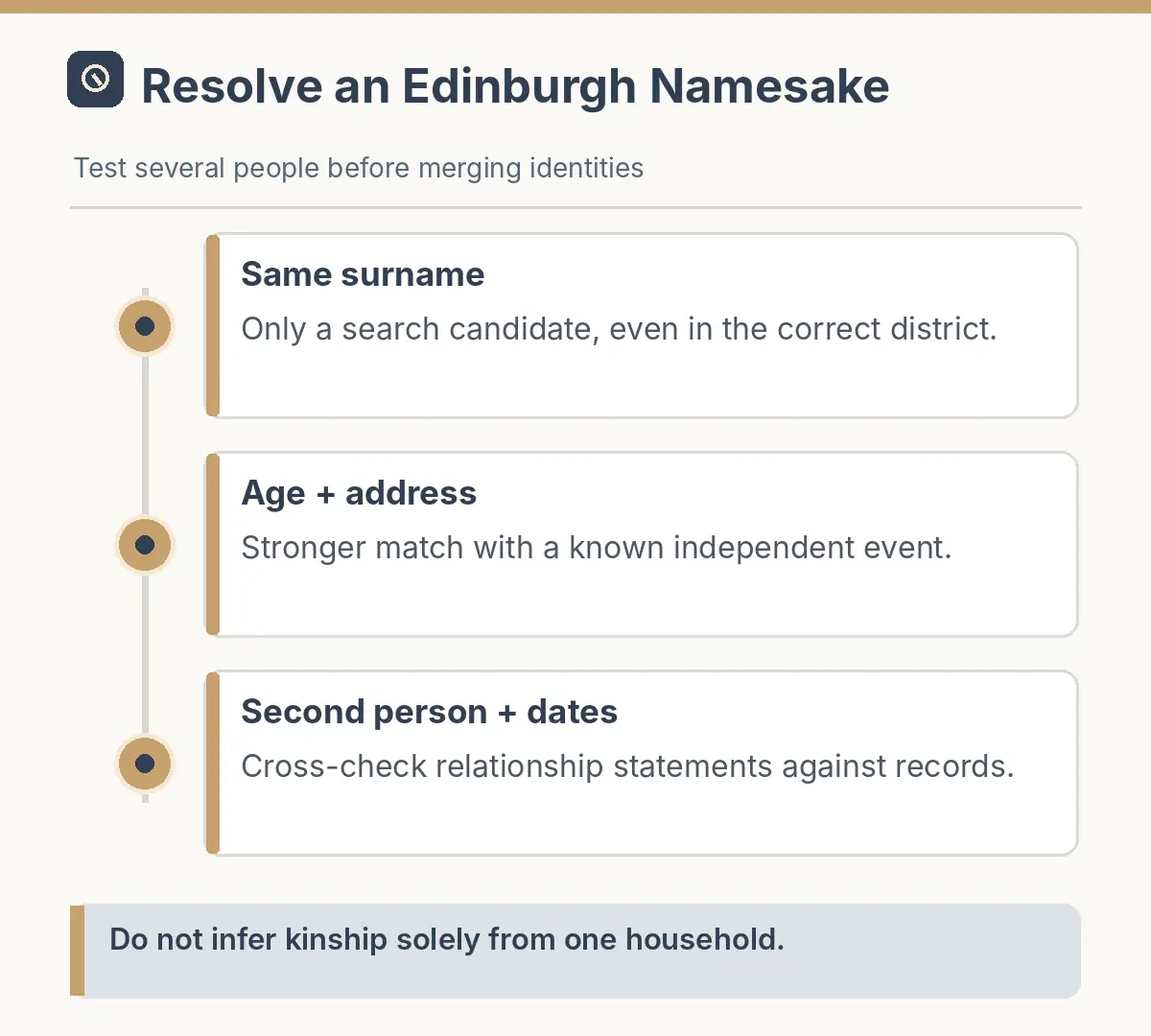
Build a household comparison across three Edinburgh decades
A useful three-census worksheet lists each known individual as a separate row and columns for their reported age, birthplace, occupation, relationship label and street address in each year. Note that a person may have a different relationship to the household head after a marriage or widowhood. A daughter-in-law in one home may be the head of another by the next enumeration; the two roles do not conflict. When a birthplace differs, look at the actual image and the person’s own statutory record before rewriting a family narrative. Cite the book references for each household independently, including a negative search only when its place and spelling range are documented. This is especially useful for Edinburgh tenement addresses containing multiple households. Our guide “Aberdeen Census Records, 1841–1921” goes into more detail.
More Records and Archives Guides
How We Research Edinburgh Census Sources
We use the official Scottish census search to define the access route, the National Records of Scotland guide for the surviving book type and open years, and Scotland’s People’s district-filter instructions for repeatable searches. This methodology avoids inventing Edinburgh households or pretending we have reviewed a particular person’s original image. We distinguish a named enumerated resident from a proven legal owner or a proven ancestor. Our affiliate disclosure applies; access arrangements are determined by the source provider, not by an imagined partnership.
Scotland’s People provides index-linked census images for 1841–1921; later records remain subject to closure.
No. Researchers normally see enumerators’ transcript books compiled from household schedules.
Yes. Scotland’s People provides city or county and district options for Scottish census returns.
No. The census records presence; use valuation rolls or title evidence separately.
Use surviving statutory records, valuation rolls, directories, and other properly dated sources.