
Search the 1841 NSW census by historical district and surviving form, not as an every-person name list. Start with the official NRS 1281 and NRS 1282 descriptions: one preserves limited householder returns, while the other contains district abstracts. A named establishment plus household tallies is evidence of an enumerated unit, not proof of every family member inside it.
Begin with the surviving forms, not a modern name index
The practical answer is to search the 1841 New South Wales census as a partially surviving collection of household-head returns and abstracts, not as an every-name population list. Museums of History NSW identifies two essential series: NRS 1281, the relatively scarce householders’ returns and affidavit forms, and NRS 1282, abstracts arranged by district. A hit in one series is not automatically an image of the other. Write down the exact series before transcribing anything. Our guide “1828 NSW Census” adds more detail on this.
For 1841, decide the historic district where your target household belonged. A modern suburb, postal address or present-day state boundary can send you to the wrong section. Start with the place named in independent evidence closest to the enumeration and keep alternative districts on a small list. If you have only a surname, gather a parish, land, court or occupational clue first so an indexed householder can be distinguished from a namesake.
Identify the few surviving original householder affidavits
The official Census & Musters Guide lists NRS 1281 householder returns and affidavit forms for Illawarra and Port Phillip; it does not present them as an intact statewide run. Those are particularly important because a form closer to the original householder statement may show details that a later district summary compresses. Look up the original item or reel, and record whether you are examining a return, an affidavit or a catalog description. Our guide “Tasmania Colonial Census, 1837–1857” shows how to find the householder and read the return.
Do not silently turn Port Phillip into a modern Victorian census series: its 1841 administrative position and the present-day custody labels need separate attention. Similarly, a family known to be in Bathurst, Sydney or another district should not be treated as absent simply because it is outside the listed original-form survival. Instead ask which abstract or substitute record is available for that district.
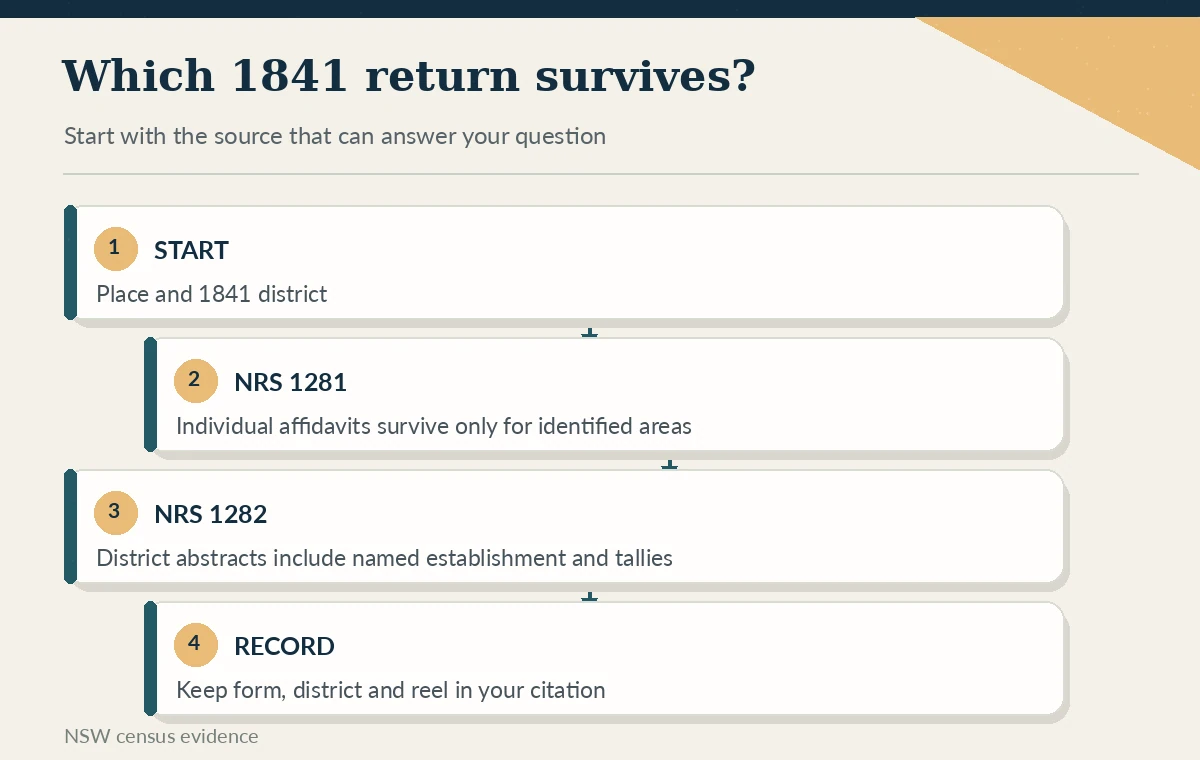
Search NRS 1282 by historical district and establishment
NRS 1282 consists of 1841 abstracts of returns. The Museums of History NSW guide provides district spans and reels, including Berrima through Port Phillip on one reel group and Queanbeyan through Yass on another. The older descriptive guide explains that Form C summarizes information from individual householders’ returns. Find the relevant district, inspect the heading and note the form or page identifiers rather than relying only on an alphabetical card reference.
The recorded establishment may name a householder, a business or another reporting unit. Its spelling may differ from that used in church registers or deeds. Record the name as written, including titles, initials and any place annotations. Check the preceding and following returns for context, and keep the order of entries; adjacent units can help locate a person but proximity alone establishes neither kinship nor a shared property.

Interpret counted residents without inventing a pedigree
The 1841 abstract includes columns grouping males and females by age, civil condition, religion and types of employment, together with building information. They are census categories, not a verified list of family relationships. If an establishment contains one woman aged 21 to under 45 and two young children, you cannot identify them as the wife and children of its named head from those tallies alone. Staff, lodgers and unrelated people may have been counted in the same establishment.
Transcribe the exact column label and number. The age brackets are broad, with divisions such as under two, two to under seven, and seven to under fourteen; use the headings on the particular image rather than a remembered modern conversion. Do not calculate exact birthdays from them. A status tally similarly records a classification made for enumeration purposes; it does not substitute for a legal freedom record or full biographical account.
Build a district evidence worksheet before claiming a match
Use a four-field worksheet: historical district; named establishment; observed age, sex and status totals; independent evidence that could test the identity. Add a separate column for negative searches with series, coverage and inspection date. This keeps a genuine zero result distinguishable from the absence of a surviving return or a failed surname lookup.
Imagine the fictional George Bell who appears as a householder in the Goulburn district. A later baptism mentions a George Bell with two children in that area. The census numbers may be consistent with a household of that size, but they do not name the children and do not establish that the two Georges are the same man. Compare a land transaction, parish record and occupation before making the connection. If those records disagree, leave the identity open. Our guide “1901 NSW Census Collectors’ Books” adds more detail on this.
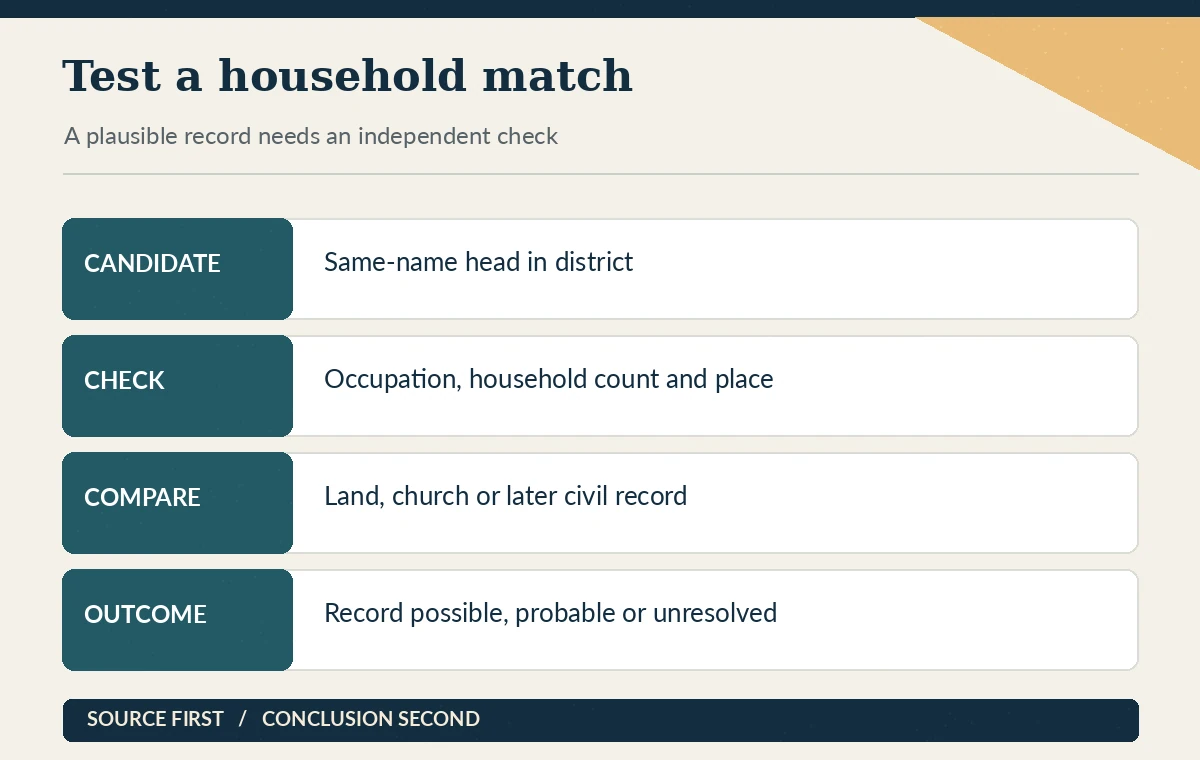
| Evidence checkpoint | Record the observation | Do not infer |
|---|---|---|
| CANDIDATE | Same-name head in district | Identity without a second source |
| CHECK | Occupation, household count and place | A precise date not given by the record |
| COMPARE | Land, church or later civil record | An undocumented relationship or event |
| OUTCOME | Record possible, probable or unresolved | Certainty beyond surviving evidence |
Use alternate records when the name or district is missing
If the right household cannot be identified, first determine whether the relevant forms survive and have been indexed. Re-read the enumerated district boundaries and try spelling variants only after checking coverage. A transcription may put an initial or establishment name where the expected surname would appear. Browsing the district can work better than another broad name search.
For a missing family, contemporary land grants or leases, church baptismal and marriage registers, colonial correspondence and newspapers may be more informative than a destroyed or aggregate census return. State and later Commonwealth electoral rolls belong to different periods and eligibility rules, so they cannot simply replace 1841 counts. Present each alternate record with its own evidentiary limits and time gap.
Record the precise source and your remaining uncertainty
A reproducible citation identifies Museums of History NSW as the repository, NRS 1281 or NRS 1282, the district, household or establishment heading, page or item, and the published reel or archive reference used. Cite an online transcript as the access layer if it provided your starting point, and cite the original image separately when you actually reviewed one. Avoid claiming to have seen a page if you only saw its finding aid.
The strongest conclusion may be narrow: a named householder headed an establishment counted in a particular district in 1841, with specified numbers in particular age categories. Write later family identifications as hypotheses supported by separately cited documents. That distinction makes a census fragment valuable without overstating what it proves. Our guide “1891 NSW Census Collectors’ Books” covers how to find a household without inventing names.
How We Research The 1841 NSW Census
For this guide we examined the current official repository descriptions and related research guidance listed below. We separated catalog coverage from image-level evidence and used deliberately fictional examples for matching exercises. Search interfaces, restrictions and individual item survival can change; check the repository before requesting records. The method tests only the types of claims these documented sources can support, and it does not assert that any fictional person or sample transaction is an actual archival entry.
More Records and Archives Guides
Archive Catalogs and Primary-Source Finding Aids for The 1841 NSW Census
Museums of History NSW: NRS 1281 surviving Illawarra and Port Phillip returns; NRS 1282 district abstracts; access reels (mhnsw.au).
Historical series description: forms A and C, household-head limitation and 1841 age/status columns (concise.mhnsw.au).
National Library of Australia: historically separate enrolment records as a later substitute, not an equivalent census (library.gov.au).
Editorial disclosure: This article contains no paid recommendation or approved affiliate placement. The site-wide policy is available at GenHis affiliate disclosure. Historical records may include inaccurate or discriminatory wording; reproduce it only as needed for a sourced analysis and avoid identifying or speculating about living people.
No. The surviving abstracts primarily identify the head or establishment and use counts for others; do not attach identities to those counts without another source.
NRS 1281 contains a small surviving set of original householder returns and affidavits; NRS 1282 contains district abstract returns compiled from householder information.
Start with the district and surviving series, then check the archive catalog and the limits of its index. A missing name is not proof the person lived elsewhere.
No. A tally within a broad age group produces only a rough range, and the counted individual is not named.
Record the series, district, household or establishment, return or folio, reel or item identifier, repository and the specific field consulted.