
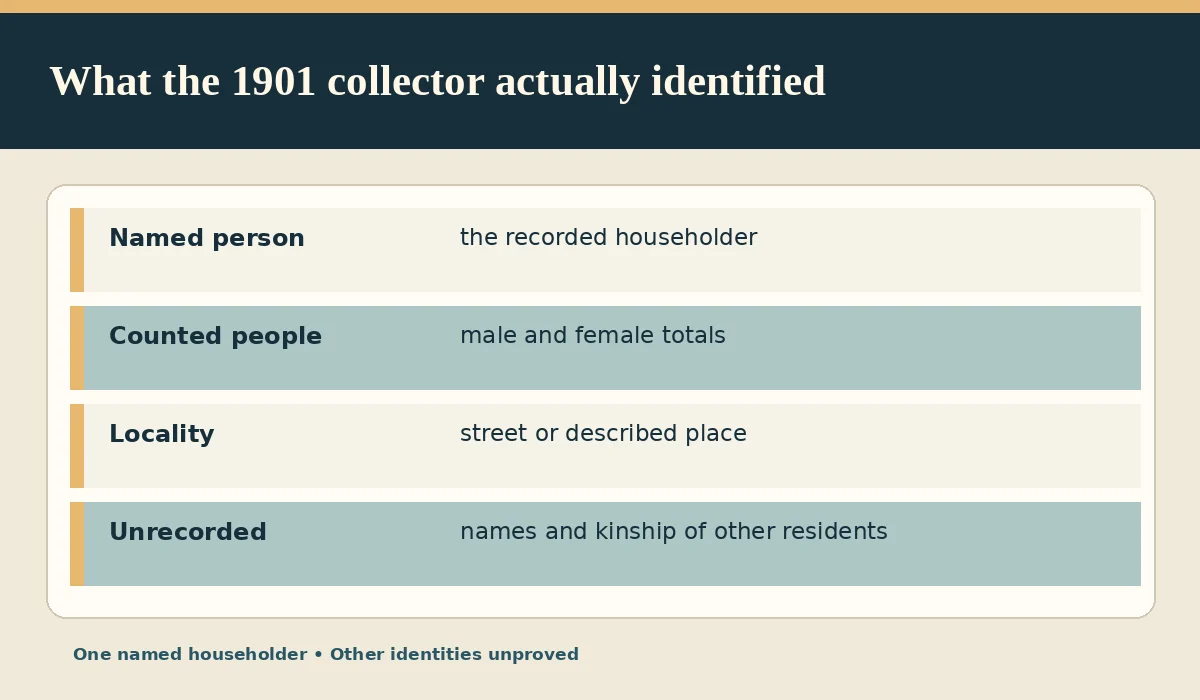
The only original household-enumeration records surviving from the 1901 New South Wales census are the collectors’ books, series NRS 685. They name the householder but not the other people counted at the address. The census date was March 31, 1901. Search by historical census district and subdistrict first; copy the householder’s name, locality, female and male counts, and archival page reference, then use independent records to test a possible family. NSW districts 8, 47 and 65 are missing. A seven-person total can document a household size, but it cannot supply seven names or prove parent-child relationships.
Start with March 31, 1901, and the surviving book type
Museums of History NSW calls these documents Census Collectors’ Books or notebooks, not the original schedules filled out by each family. A surviving notebook generally gives a location and named householder; it can also contain a dwelling description, total men and women, and historical administrative categories. It does not preserve the full named household roster. The census act may describe information intended for the enumeration, but that is not proof the corresponding individual household schedules survive in the archive. If that is your next decision, our guide “1891 NSW Census Collectors’ Books” explains how to find a household without inventing names.
Open a worksheet with columns for the original wording, your reading of it, and a conclusion requiring corroboration. Copy the enumerator’s count exactly rather than adjusting it to match people in a family tree. Historical ethnic labels and administrative classifications should be transcribed contextually, not used as authoritative descriptions of a living person’s identity or community affiliation. State whether you viewed the original page or only an index entry.
Find the census district and subdistrict before searching names
The official NSW guide lists district holdings alphabetically and breaks many districts into subdistricts marked with numbers or letters. Some have a boundary description or small map. Begin with a place established near 1901 from a directory, dated letter, electoral roll or birth registration. Search its historic district rather than assuming the current suburb or postal label matches the old collector’s administrative unit. Record the enumerator’s district and the surrounding localities when the name is ambiguous.
The official guide identifies NRS 685, fiche numbers and original item references for district volumes. Make a reusable locator: district, subdistrict, fiche, archival item, page or image and date seen. This is more useful than a bare surname hit when multiple householders have similar names. Check districts 8, 47 and 65 before recording a negative result: their missing records cannot be searched merely by trying another website. If that is your next decision, our guide “NSW Railway Employee Records” explains how to find service cards and registers.

Read the line as a householder entry, not a family group sheet
Transcribe the locality as written, including roads, gullies and occasional house numbers. Note the named householder, the total males and females and any comments or dwelling type. Some collector books separately counted people under historical racial categories, but these columns reflect the enumerator’s classification, not independent evidence about a person’s self-identity. When the count is five people, the book does not identify who they are or how they relate.
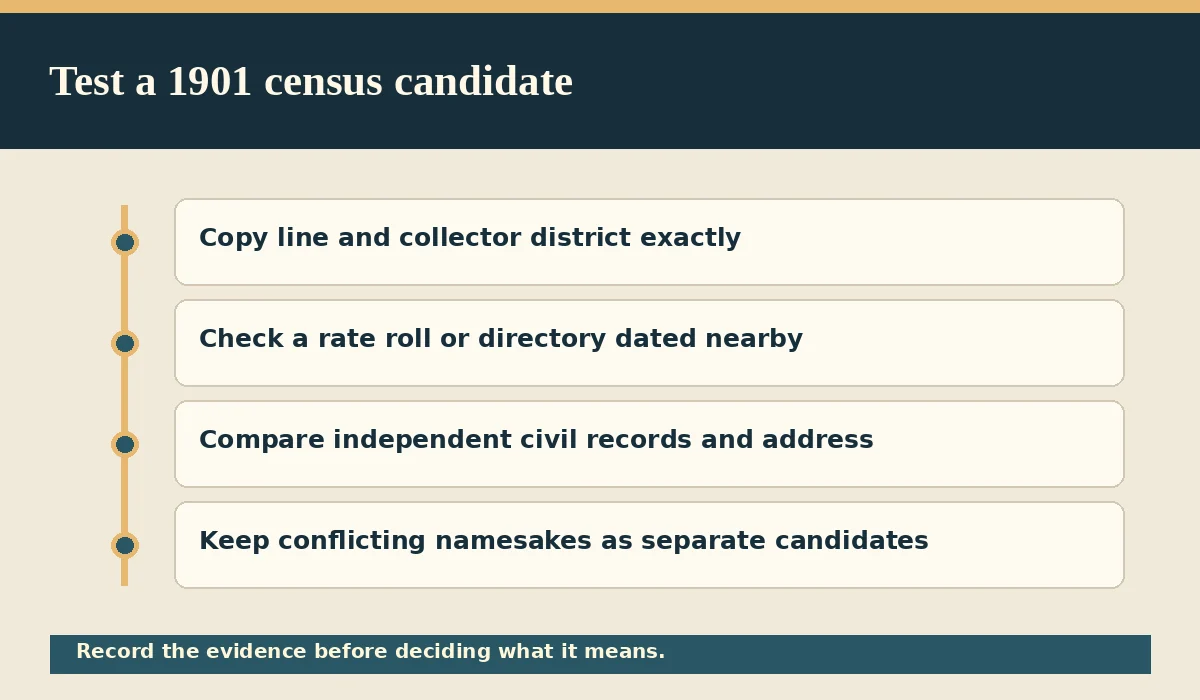
An adjacent line can suggest a neighbor, not a proven sibling or business partner. Street numbering could be incomplete or later changed. Preserve the order of entries and compare it with a contemporaneous directory or rate roll to locate the correct property. If the collector’s handwriting is uncertain, put the doubtful letters in brackets in your transcript, and save an image reference so another researcher can inspect it rather than copying a normalized surname without a warning.
Use an independent 1900–1902 source to resolve namesakes
Suppose two fictional people named Thomas Bennett appear as householders in different NSW districts. One is near an address cited in a marriage record; another has an occupation that matches a directory entry. Neither clue automatically wins. Build a matrix of candidate, census locality, independent dated evidence and contradiction. A birth registration, probate record, employment list or municipal rate assessment may identify the individual in a way the 1901 collector did not. To go further, our guide “1841 NSW Census” shows how to find householders and read the surviving abstracts.
Dates matter. A directory published in 1902 may describe information gathered months earlier, and a family may have moved after March 31, 1901. Mark whether a clue precedes or follows the census. If you cannot distinguish the candidates, keep both unresolved and search the named person’s occupation or premises in the neighboring years. Avoid importing supposed wives and children from a user-contributed tree into an unnamed census count.
| Research checkpoint | Document a defensible observation | Do not assume |
|---|---|---|
| Named person | the recorded householder | The same-name index proves the complete event |
| Counted people | male and female totals | The record proves a family relationship |
| Identity test | Match place, period and independent detail | A matching surname establishes the person |
| Coverage or access limit | Log missing years, item status and search route | A no-hit result proves nonexistence |
Check ships, temporary accommodation, and missing coverage carefully
The NSW guide notes collector entries for ships in port, but these enumerate a ship and people aboard rather than identifying every traveler. An emigrant ancestor reported to be on a vessel should be researched with passenger manifests or shipping notices; a vessel count alone cannot establish embarkation, disembarkation or permanent settlement. Similarly, a lodger can be counted at an address without appearing as the named householder.
Before concluding somebody was absent, check the correct district and page ranges, nearby subdivisions, spelling variants and any known move. In a research log distinguish a database search that returned no matches, a full visual browse with no matching householder, and a missing or unpreserved book. These are different levels of negative evidence. Older census returns in NSW are also different sources, and a successful 1891 lookup does not substitute for the March 1901 entry.
Create a citation and a narrowly framed family conclusion
Cite the custodian, series NRS 685, the specific census district and subdistrict, collector volume or item number, fiche or image locator, page and consulted date. If the only accessible material was a transcribed online hit, identify that transcription as such and note that the original page remains unchecked. Keep a copy of each variant spelling you tried and the exact neighboring entries that informed your location decision.
A defensible sentence might read, ‘The March 1901 collector recorded T. Bennett as householder at this address and counted four other residents, whose names are not recorded.’ That is stronger than an invented family roster. Follow it with a targeted question: whether a dated municipal roll or vital registration can independently identify the other household occupants. The citation should let a second researcher reproduce both the positive entry and its interpretive limit.
How We Research 1901 NSW Census
We checked the linked sources on 2026-10-22. Source descriptions are not a substitute for inspecting a specific original manuscript. The worked identities are fictional and intended only to show how to test a record. Rights, fees, privacy rules, digitization and finding aids can change: recheck item-level conditions when requesting or reproducing documents.
More Records and Archives Guides
Original Archive Finding Aids for 1901 NSW Census
Museums of History NSW describes the March 31, 1901 census, NRS 685, district holdings, collector book fields, missing districts and reading-room fiche (mhnsw.au).
Official NSW census and musters guide distinguishes surviving 1891 and 1901 collector books from earlier census forms (mhnsw.au).
State Library Victoria guide identifies collector books and describes FamilySearch and library-access options (guides.slv.vic.gov.au).
This guide contains no affiliate links. Respect restrictions on identifiable living persons, sensitive allegations and copyright when researching or sharing historical sources. See the GenHis affiliate disclosure for our site-wide link policy.
No. Collectors’ books generally identify only the householder and count the other residents without naming them.
The census was taken on March 31, 1901. Use that date for residence and household comparisons.
Museums of History NSW identifies NRS 685 and lists districts, subdistricts, fiche and item references.
The official NSW guide notes missing districts 8, 47 and 65. Confirm the historical district before treating a missing result as meaningful.
No. Counts do not identify ages, names or relationships; test those claims with independent contemporary records.