
New South Wales railway employment is not documented in one master database. The NSW State Archives’ Railway Employees Guide identifies a small searchable register index for 1856–1917 and many other employment series, especially personal history cards classified by birth era, location or branch. Begin with a documented job, approximate years and place of service, then route the search to the correct register or card series. A surname appearing in the archive index is a locator, not proof of a complete career or a particular family identity.
Verify the railway connection before searching a staff index
A death certificate, contemporary occupation entry, local newspaper notice or family-held appointment letter may supply the worker’s occupation. Copy the original wording: a “porter,” “ganger,” “fitter” or “clerk” is a stronger archival clue than a later family story that someone worked somewhere on the railway. Also capture the town and year. Employment could move between stations and workshops, and the administrative branch handling a job changed over time.
Make a one-person profile with birth range, spelling variants, partner or address, known railway role and the earliest dated evidence. Leave the employer uncertain if the occupation could have belonged to a private contractor. Searching rail records before confirming the railway connection can produce several indistinguishable namesakes and create a false career story. Our guide “NSW Teachers’ Rolls, 1869–1908” adds more detail on this.
Use the 1856–1917 register index for a precise first locator
Museums of History NSW exposes a searchable index called Railway employment records 1856–1917. It describes 763 entries drawn from NRS 19407, a register of salaried officers for 1856–1890, and NRS 15895, a Darling Harbour personnel register whose records continue into 1932. An index entry may supply a name, first position, date, item number and page. Those fields tell you where to look next. To go further, our guide “South Australian Railway Employee Records” shows how to find the right personnel file.
Keep the series and page together: an early position in the salaried-officer register should not be interpreted as a complete file for a workshop laborer. Search initials, surname variations and plausible alternative jobs. When two indexed candidates look similar, do not choose the one whose job sounds more impressive; compare dates, work location and an independently established address or relative.

Choose a personal history card using the worker’s birth era
The official guide describes NRS 12922 for railway employees born before 1900 and NRS 19333 for those born between 1900 and 1962. Other collections, including NRS 19375 and branch-specific cards, cover different employees, places and periods. The headings describe the scope of particular archives, not a guarantee that every employee born in those periods has a surviving card.
Check the card’s creator and any office or branch before assuming two entries belong to the same person. A card may record appointment, transfers, employment status, qualifications or retirement information, but the fields depend on the specific series and surviving item. If the first series gives no result, try relevant departmental cards rather than concluding no railway service existed. Our guide “Queensland Railway Staff Books” shows how to find employee service in series S9996.
Treat the 1917 strike markings as historical workplace evidence
NRS 15895 includes a Darling Harbour personnel register with evidence of the August 1917 railway strike and subsequent temporary appointments. Its reported “remained loyal” stamp reflects the administration’s language and political context, not a neutral modern measure of a worker’s character. Record the literal wording, the date and where it appears; avoid using a workplace annotation to infer a family member’s beliefs.
When a person’s appointment or departure falls near 1917, compare the staff register with wage, local newspaper or other employer records before assuming dismissal, strike participation or voluntary resignation. The same name may appear in multiple lists for different reasons. Distinguish a dated administrative remark from a separately corroborated account of an individual’s actions.
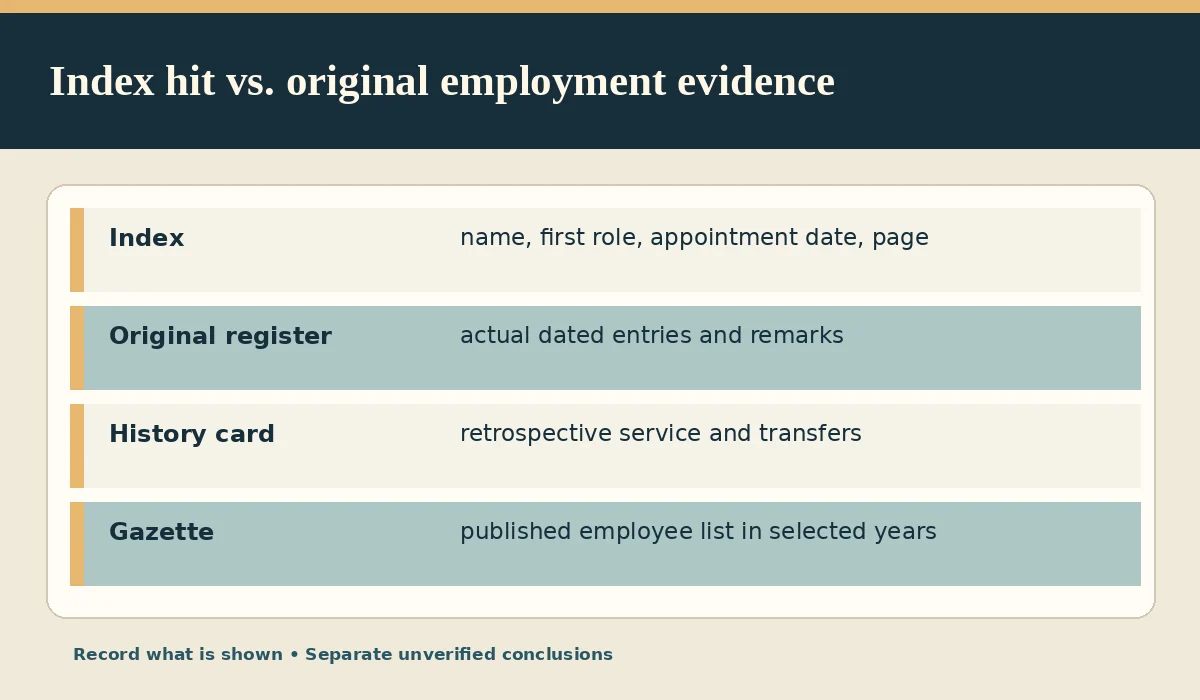
| Research checkpoint | Document a defensible observation | Do not assume |
|---|---|---|
| Index | name, first role, appointment date, page | The same-name index proves the complete event |
| Original register | actual dated entries and remarks | The record proves a family relationship |
| Identity test | Match place, period and independent detail | A matching surname establishes the person |
| Coverage or access limit | Log missing years, item status and search route | A no-hit result proves nonexistence |
Check access before expecting a digitized employee card
Museums of History NSW says personal history cards are closed to public access for 30 years after the employee’s date of separation from service. Item-level access status can differ; the guide directs researchers seeking permission for closed records to Transport for NSW. Some available records require use in the Western Sydney Reading Room or a copy request rather than an online image. For the fuller picture, see our guide “Western Australia WAGR Service Cards”.
The separate railway records guide also warns that cataloging of transferred State Rail material remains incomplete and that interim lists are held in the reading room. A missing online catalogue result can therefore reflect finding-aid coverage. Log what you searched, then ask the repository which list or item reference corresponds to the branch and period instead of guessing a web link.
Reconstruct a career through appointments, not one date
Create a table with the literal job title, appointment date, location, branch, series and folio for each record. If a worker was at one location in 1882 and another in 1890, do not turn the gap into a continuous posting without transfer evidence. Lists printed in NSW Government Gazettes for selected years can supply supplementary personnel information, although they are a different source type.
A personal history card may summarize earlier service based on later office records. Preserve the difference between a contemporaneous appointment and a retrospective service total. If years of service disagree with a newspaper retirement notice, check whether temporary employment, leave, departmental changes or inconsistent dates explain the difference before changing a family-tree chronology.
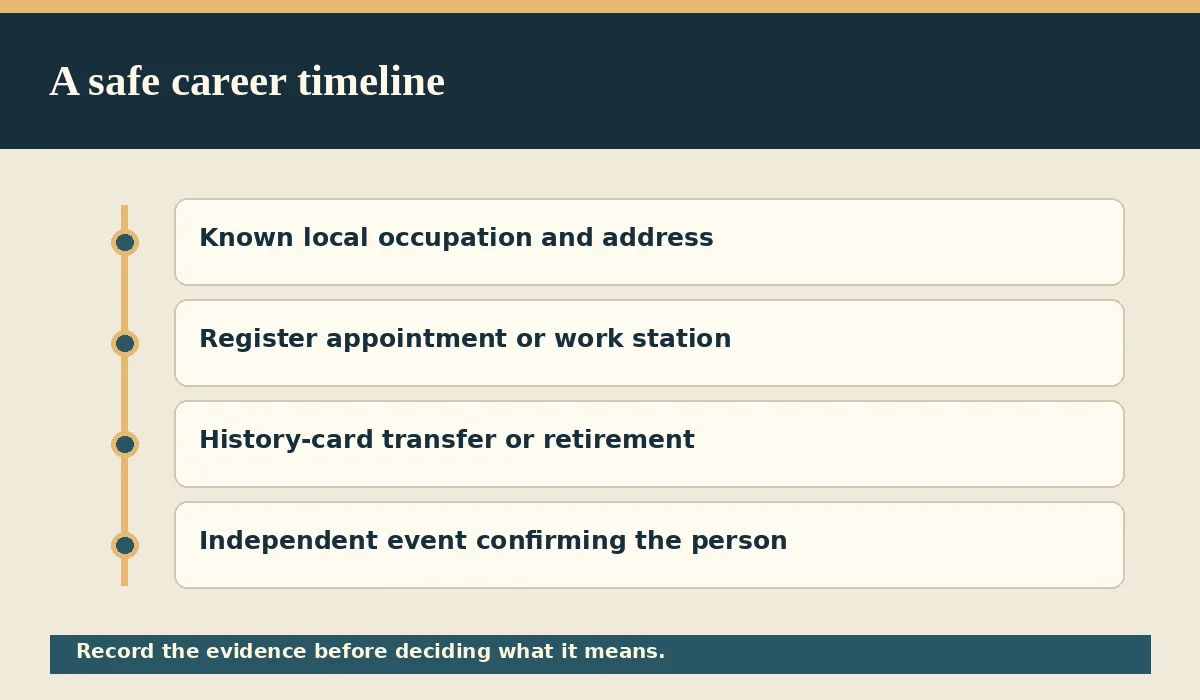
Test a fictional same-name railway worker
Imagine a fictional William Marsh working as a clerk in Sydney while another William Marsh worked in regional track maintenance. An indexed NRS 19407 entry could fit the first occupation, while a later branch card could belong to either. Keep two candidate rows with known addresses, jobs and dates rather than importing every railway reference into one profile.
Find an independently dated marriage entry, house directory or death record listing an occupation and locality. Compare it with appointment dates and any staff-card birth details. If the evidence supports only a probable match, label it probable; if it contradicts a claimed birthdate, preserve that conflict and seek a second source. The goal is to identify a person, not assemble the longest possible career.
Cite the exact series and decide the next archival request
A useful citation includes NSW State Archives as custodian, the full series identifier such as NRS 19407 or NRS 12922, register or card description, item and page or image, and how the material was consulted. The searchable index needs its own citation if the original staff entry has not been examined. Save any rights or access information separately from the historical facts.
End the search with an explicit decision: request a named card, inspect a page of the salaried-officer register, browse an interim branch list or seek a local employment reference. Record unsuccessful searches with exact spellings and series names. This prevents an index miss from becoming an unsupported claim that the ancestor never worked for the railway.
How We Research NSW Railway Employee Records
We checked the linked sources on 2026-10-22. Source descriptions are not a substitute for inspecting a specific original manuscript. The worked identities are fictional and intended only to show how to test a record. Rights, fees, privacy rules, digitization and finding aids can change: recheck item-level conditions when requesting or reproducing documents.
More Records and Archives Guides
Original Archive Finding Aids for NSW Railway Employee Records
Museums of History NSW identifies personnel-card series, the 1856–1917 index and the 30-year post-separation restriction (mhnsw.au).
The archive index has 763 entries derived from NRS 19407 and NRS 15895, including names, first positions, dates and page references (mhnsw.au).
The railway guide explains changing R-series identifiers, incomplete cataloging and reading-room interim lists (mhnsw.au).
This guide contains no affiliate links. Respect restrictions on identifiable living persons, sensitive allegations and copyright when researching or sharing historical sources. See the GenHis affiliate disclosure for our site-wide link policy.
Museums of History NSW offers Railway employment records 1856–1917, with entries derived from NRS 19407 and NRS 15895.
No. It contains 763 described entries and is not a comprehensive staff register for every branch or year.
The archive guide identifies NRS 12922 as personal history cards for employees born before 1900, with separate later series.
No. The archive states that these cards are closed for 30 years from an employee’s separation date unless access is authorized.
Compare an original staff entry with independently dated occupation, address, age and family evidence; a matching surname is insufficient.