
South Australian railway employee records can identify a worker’s station, position, hiring date, employee number and changes of employment, but no single searchable database covers every railway worker. State Records of South Australia identifies distinct staff sheets, registers, cards and appointment records, some indexed by surname and others viewable only on microfilm or microfiche. Start with an approximate service period and job; then choose the series likely to document that period. A name in a special-list index is a finding aid, not proof that every event in a family story occurred.
Build a railway employment timeline before searching
Write down the worker’s full name, plausible spelling variants, approximate birth date, town or station and the earliest known job. A photograph caption saying “railwayman” is too broad to identify a department: the locomotive, traffic and maintenance branches created different employee records. Distinguish the date someone lived in a town from the date they actually worked there. If two relatives held railway jobs, create separate timelines before attempting to merge their paperwork.
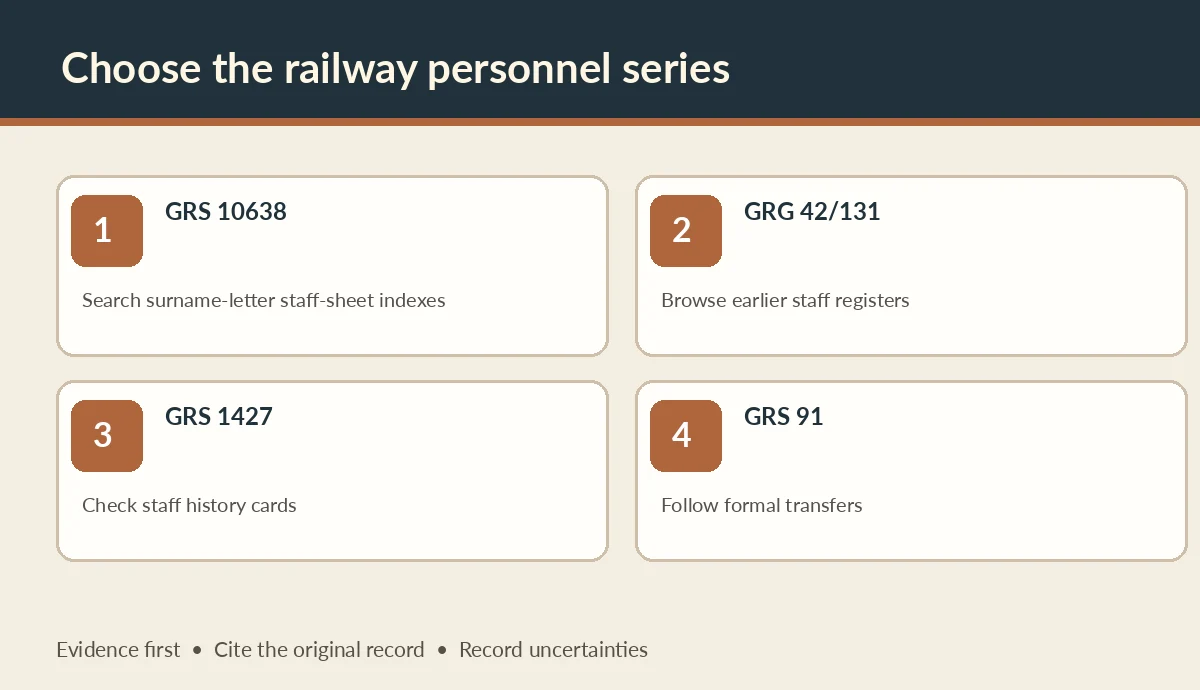
Start with the GRS 10638 surname indexes
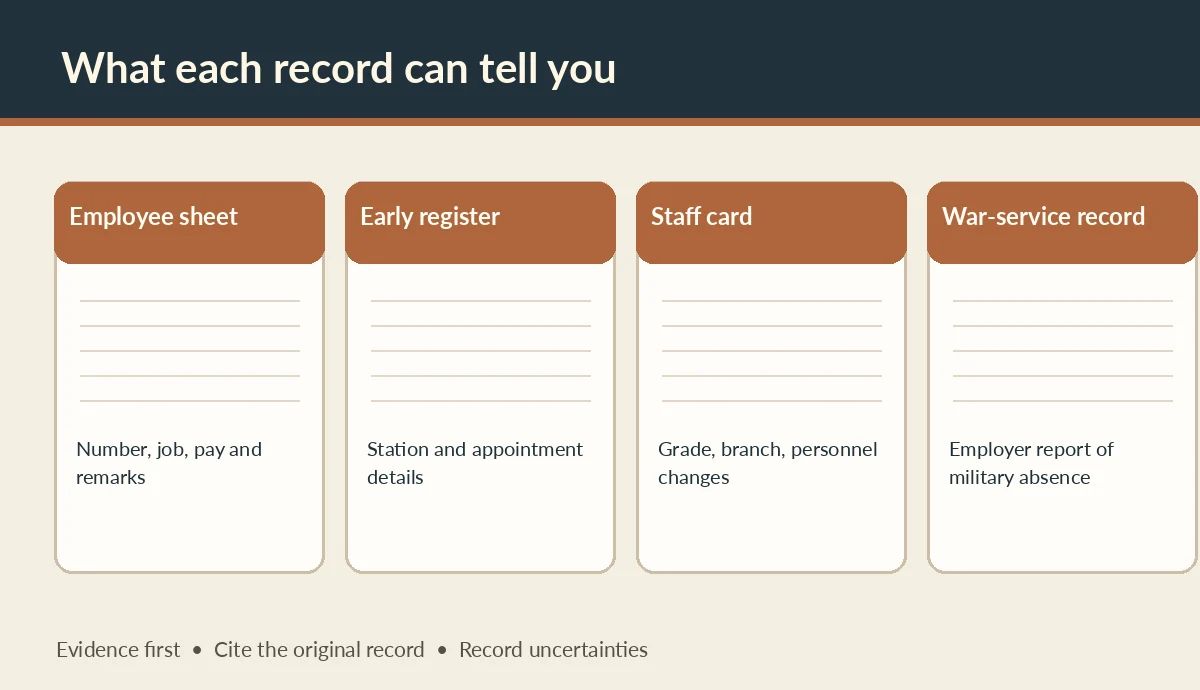
The State Records railway guide links surname-letter indexes to GRS 10638, records of employment sheets compiled across roughly the 1880–1970s period. These sheets may document an employee number, occupation, pay, leave, postings, promotions and remarks. Open the correct letter-range index and record the person’s exact spelling, box number and envelope range. The index is an access tool: to check a disputed date or disciplinary notation, request the actual sheet rather than copying an abbreviated entry into your tree.
Request the original sheet by box and envelope
The published GRS 10638 index explains that a Research Centre appointment or a digital-copy request may require the name plus box number and envelope range. Preserve all three in your log. Search a maiden surname or changed surname when the index indicates a name change; do not assume one alphabetic entry contains the full career. When the relevant page is a scan of a transcript, check its handwriting and column heading against the physical or digitized original whenever permitted.
Compare GRG 42/131 early staff registers
For earlier employment, the railway guide describes GRG 42/131 staff registers spanning 1853–1913, available on Research Centre microfilm. Entries may include birth date, start date, station, position and rate of pay. This is a different administrative record from GRS 10638, so an apparent disagreement about a start year may arise from different definitions such as appointment, transfer or later rehiring. Cite both volumes, and state which date each actually records. Our guide “Western Australia WAGR Service Cards” adds more detail on this.
Check GRS 1427 staff cards and their missing names
GRS 1427 staff history cards cover about 1907–1961 and are described by the official catalogue as alphabetically arranged microfiche. The cards may contain names, employee numbers, birth dates, grades, department branches and changes in position. The catalogue explicitly warns that surnames beginning WE through WH are missing. If a person in that alphabetical interval is absent, do not interpret the gap as a lost railway career: pivot to GRS 10638, appointments and contemporary electoral or directory evidence. Our guide “Queensland Railway Staff Books” shows how to find employee service in series S9996.
Compare South Australian railway personnel series
| Source to try | What it can establish | Important limit |
|---|---|---|
| GRS 10638 employment sheet | Employee number, job and changes | Index entry is not the full sheet |
| GRG 42/131 register | Early station and start details | Microfilm access, overlap |
| GRS 1427 history card | Branch, grade and service notes | WE–WH cards missing |
| GRS 91 transfers | Formal appointment or transfer | Move of home not proved |
Look beyond the main staff sheets for a transfer
The guide identifies GRG 42/73 appointments confirmed for 1889–1926 and GRS 91 appointments and transfers for 1917–1963, arranged by branches and volumes. Use these if family letters claim a particular move from one station to another. A transfer entry supports an administrative reassignment, not necessarily the date a family changed residence. Examine the relevant station directory or electoral roll for independent location evidence. Some volumes must be ordered with assistance from archive staff.
Use railways war-service records only for what they state
The State Records guide lists GRS 6232, employees’ records of war service for 1914–1953. These can report service-related facts relevant to staff benefits. Treat such entries as railway employer records rather than substitutes for a complete military service dossier. For military unit movements or wounds, consult the original defence records held by the competent national archive and compare identities by number, unit and contact address. Our guide “South Australia Teacher History Sheets” covers how to find service Records, 1915–1965.
Test an illustrative two-worker namesake problem
Suppose two fictional men named Henry Mason appear in a railway surname index, one in locomotive work and another in traffic. A family story places “Henry Mason the porter” at a regional station in 1915. Do not attach the locomotive sheet simply because it has the earlier birth date. Create a two-column comparison of employee number, department, dated station, residence and independent family facts. The better match is the person supported by several consistent facts, not the first search result.

Know when a missing entry is inconclusive
State Records lists gaps in additional series, including the missing 1927–1929 years of GRS 116 classified lists and WE–WH names in GRS 1427. Some series are incomplete, unindexed, or arranged by station and job rather than surname. Access conditions also vary by record type: the general guide warns that personal, financial or disciplinary records are often open only after 60 years, although individual series may have different determinations. Recheck the particular catalogue item before ordering.
Cite each staff source so the search can be repeated
Record the creating agency, series number, item or volume, box and envelope where applicable, employee name as written, relevant dates, and precise page or image. Separately record a “searched, not found” result with series, letters examined, access status and coverage gap. A citation such as “South Australian railway records online” conceals whether you used an index, an original employment sheet or a secondary transcription. For the fuller picture, see our guide “South Australia Railway Employee Records”.
How We Research South Australia Railway Employee Records
Our method begins with the named archive’s descriptions of the collection, series and access conditions. We distinguish official finding aids from original entries and from our own inferences. We check known date boundaries and catalogue warnings before proposing a search path, and use fictional examples solely to illustrate how researchers can test ambiguous identities. Also, We do not claim to have inspected a particular ancestor’s file or to know which family stories are true. Recheck archival availability and restrictions at the time you search.
More Records and Archives Guides
Primary archival guides for south australia railway employee records
State Records of South Australia guide: series, indexes, coverage gaps, custody and access (archives.sa.gov.au).
GRS 1427 archival catalogue description, 1907–1961 staff cards and WE–WH gap (catalogue.archives.sa.gov.au).
Example index instructions for GRS 10638 box and envelope retrieval and transcription cautions (archives.sa.gov.au).
Editorial and affiliate disclosure: GenHis is an independent educational family-history publication. No archive listed here is claimed as a sponsor or affiliate partner. Official access rules, privacy restrictions and fees may change. Use archival records thoughtfully and do not identify living people from sensitive files. Read the affiliate disclosure for our general approach to commercial links elsewhere on the website.
Begin with State Records of South Australia’s Railway Employees guide and its named series indexes.
No. The index helps locate files, but original sheets may require a Research Centre appointment or copy request.
The official GRS 1427 description reports a WE–WH gap; check other employee series.
No. A work station and a residential address are different claims that require different records.
It can provide clues about reported service, but verify military details against original defence files.