
The South Australian Police Gazette is an official police publication, not a general-interest newspaper or a verdict register. State Records of South Australia catalogs the series as GRG5/50 for 1861–1973, with gaps and partially open access. Its notices can point to missing friends, deserters, arrests, prisoners, inquests and official appointments. Such entries may give a date or distinctive description worth testing, but they do not automatically establish criminal guilt, a completed court case, an exact identity or even a person’s continued residence. A reliable family-history search begins with a dated notice and follows the administrative record that could confirm what happened next.
Start with the archival series GRG5/50
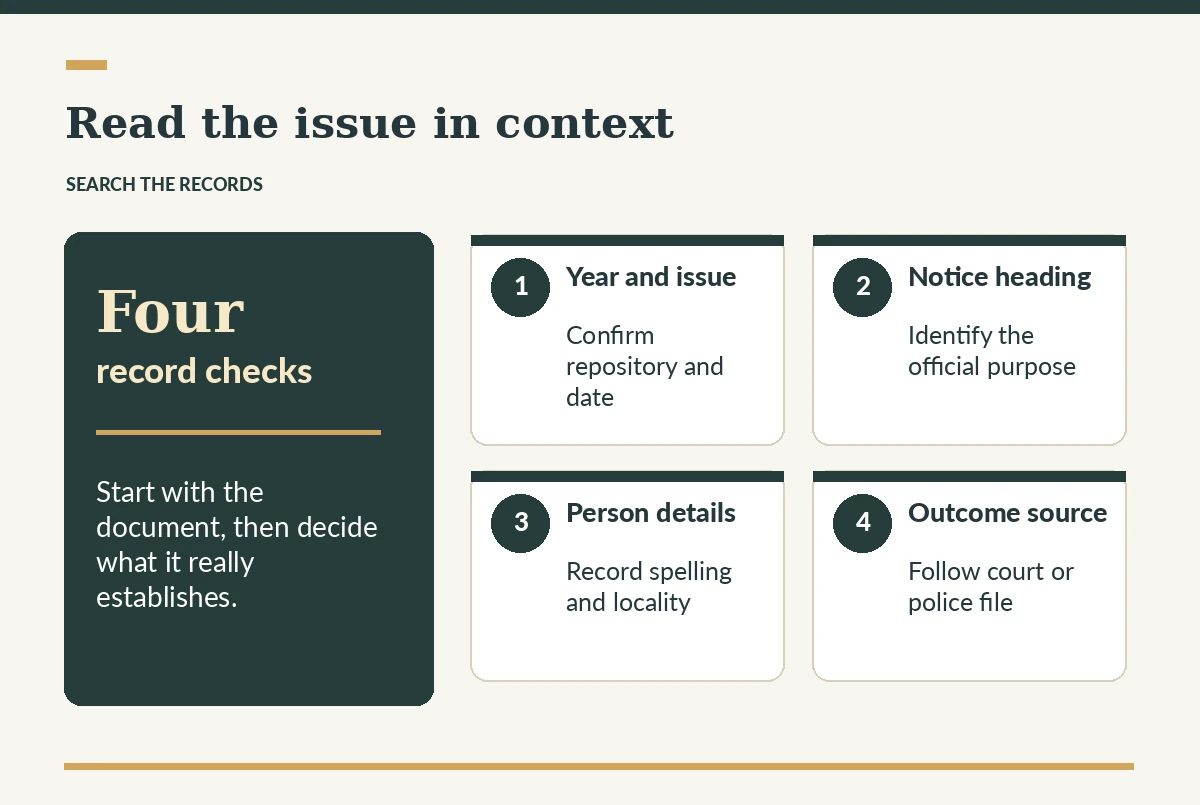
Open the State Records ArchivesSearch entry for the South Australian Police Gazette and note series GRG5/50. The catalogue gives a broad date range of 1861–1973 but explicitly warns of gaps. Do not assume that every issue is represented in the archival consignment or that every page is digitally searchable. Search a surname alongside an approximate year, town, physical descriptor, occupation or ship when known, then shift to issue browsing if no text search is available. Keep the publication year separate from the date of the underlying event. A police communication could describe an earlier incident, a continuing inquiry or a later correction. Our guide “South Australia Police Personnel Records” goes into more detail.
Check which institution has the issue
The State Records catalogue states that the State Library of South Australia holds an unbroken set of gazettes from 1868 onward, while the State Records series has gaps. That is an important fallback, not permission to invent instant digital access. Record the repository, issue date, volume and page number before attempting to order or view the material. For a period before 1868, verify what actually survives; the catalogue mentions an isolated surviving 1852 predecessor publication, the Hue and Cry, rather than an uninterrupted pre-1861 run. A no-result search in one repository says little about another institution’s copies. Our guide “South Australia Inquests, 1877–1930” adds more detail on this.
Understand the notice categories before making claims
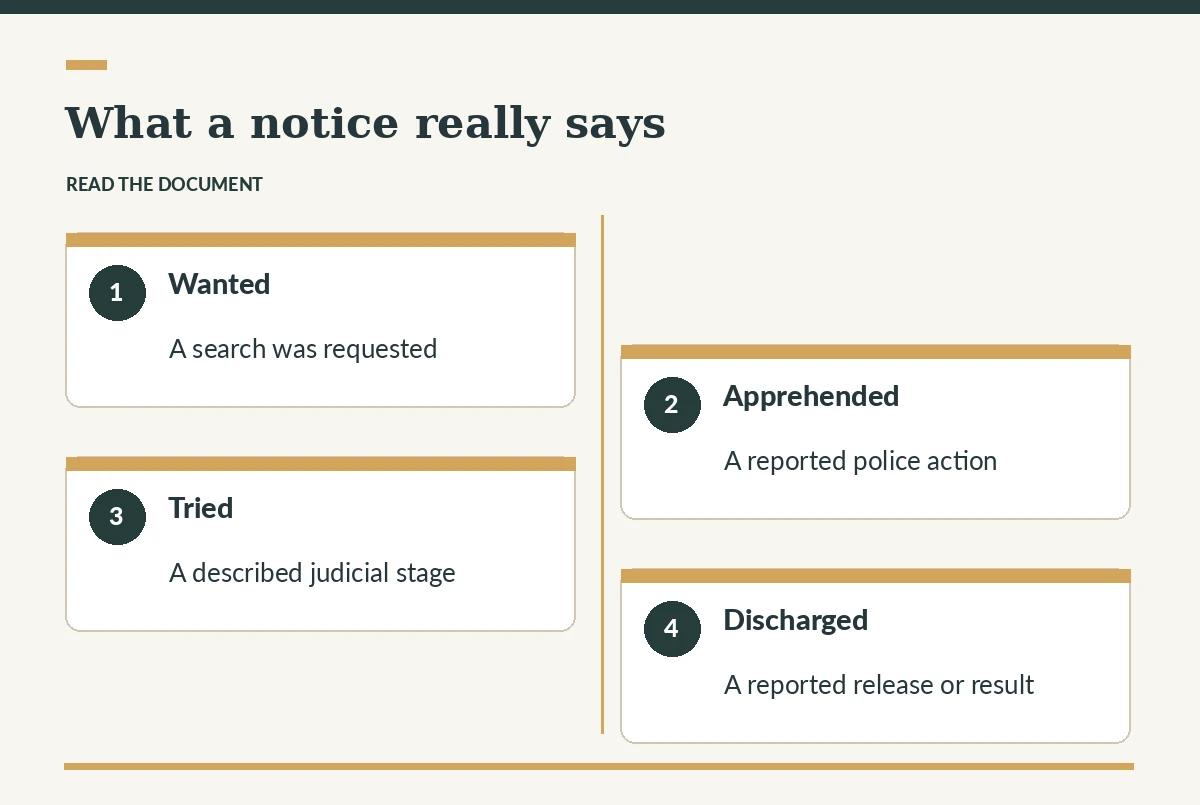
GRG5/50 contains police service information and diverse notices: wanted and absconding people, apprehensions, prisoners tried or discharged, inquests, missing friends, ships’ deserters and some later photographs. These categories were assembled for officers’ duties, not for a genealogical encyclopedia. A notice about a runaway worker is different from a conviction, and a report that someone was sought is different from evidence that they were found. Always transcribe the heading and the verbs used in the original column. Avoid modern assumptions about family separation, policing, vagrancy, ethnicity or lawfulness based on a brief administrative label. For the same kind of choice in another place, see our guide “New Zealand Police Gazettes”.
Search common surnames by date, place, and context
Begin with at least two independent anchors from another record: an age range or occupation plus a town or event year. A surname search may surface unrelated people and people listed with aliases. Try spellings, abbreviated initials and former locality names, but preserve the exact spelling printed. If search results give only a short extract, browse the complete issue to retrieve its date, column and any continuation. Search neighboring issues for withdrawal notices, updates and corrections rather than cherry-picking one mention. Build separate candidates for individuals whose names overlap; do not merge them until independent identifying details agree.
Take an inquest notice to the proper follow-up series
An inquest mention is a possible pointer to a coroner or police report, not a complete cause-of-death certificate. The State Records police guide identifies Police Commissioner’s Office correspondence GRG5/2 and miscellaneous papers GRG5/4 as separate routes for related inquiries. Check whether the relevant coroner, court or civil registration material survives and where it was created. Death date, body discovery, inquiry date and gazette publication may differ. The absence of an inquest file can reflect historical destruction or custody gaps. Maintain a record-to-record trail instead of converting the notice into an uncited narrative of death circumstances. For the fuller picture, see our guide “Western Australia Historical Inquests”.
Handle prisoner and court references without assuming guilt
A gazette report may refer to apprehension, an outstanding warrant, a trial, sentence or discharge. These are different procedural stages with different documentary sources. If the wording reports a charge, seek the court docket or sentencing record before describing an outcome. If it reports release, confirm the identity and custodial context through a surviving gaol register or police series where lawful. The State Records guide also distinguishes later descriptions and photographs of convicted persons in GRG5/58 and its index GRG5/59; do not assume all such photos were printed in every gazette. Respect conditions on sensitive personal files. To go further, our guide “Victoria Police Gazettes, 1853–1971” shows how to find notices and check the evidence.
A fictional two-person name collision
Imagine one Gazette issue mentions a hypothetical Henry Bell near Port Adelaide, while a family diary places another Henry Bell in an inland farming district during the same month. Both names may be genuine, but the notice by itself cannot choose between them. Make a comparison grid of age, occupation, place, physical description, alias and other dated records. If two indicators conflict, label the notice an unproven candidate and follow the stated police district or vessel. This illustration invents neither a real charge nor an archival page: it demonstrates why the next step should verify identity before repeating a potentially harmful allegation. Our guide “Tasmania Police Gazettes, 1861–1933” adds more detail on this.
| Finding | Next verification | Do not assume |
|---|---|---|
| Name in notice | Save issue, page and notice type | Identity or allegation is proven |
| Gazette issue missing | Check State Library holdings | The notice never appeared |
| Apprehended or charged | Locate court or prison outcome | Conviction followed |
| Inquest mentioned | Seek separate inquiry and civil record | Cause of death established |
Apply the access determination to the exact item
The catalogue identifies GRG5/50 as partially open and states that records become unrestricted after 60 years under the cited access determination. The wider police collection contains other access periods, including stricter protection for some sensitive records. Consult the item description and current repository decision rather than assuming every publication or underlying file can be downloaded. Do not attempt to obtain restricted details about living people or turn historical police material into a present-day accusation. For an image that can be legally viewed, note whether it is a public digitization, an ordered scan or a reading-room consultation.
Capture the original issue, not only a transcription
For each candidate entry save a complete issue citation: Gazette title, full date, issue or volume when supplied, page, column, verbatim notice category, and archival holder or permanent catalogue locator. Keep a transcription in a separate field from your interpretation. Mark illegible words and OCR guesses explicitly; the original layout can reveal that two adjacent notices concern separate people. If only a database transcription is available, label it secondary access and do not report image verification. Revisit the original issue before relying on a middle initial, a township or a relationship term in a published family tree.

What a negative search does not establish
If you find nothing, first ask whether your target type of event would likely have been reported. Most residents never appeared in these gazettes. Then check the relevant years, name variants, gaps in the held series, unindexed issue images and State Library access. A failed keyword search may reflect weak OCR or a change in the heading used by editors. You can document that a particular range was searched without claiming a person was never arrested, sought or appointed. Re-route to court records, civil certificates or police correspondence only where the research question warrants it. For the next step, our guide “Western Australia Police Gazettes, 1876–1900” explains how to find names and issues.
How We Research South Australian Gazette notices
We consulted the current State Records of South Australia GRG5/50 catalogue and its police and gaol research explanations. We distinguished that primary series description from the separate question of whether a particular name can be verified in an actual issue. The identity case is explicitly fictional. Because these publications contain potentially stigmatizing descriptions, our method requires literal quotation with context, independent verification and proportionate treatment of privacy. The series number and issue citation matter more than a dramatic story built from an unverified database excerpt.
More Records and Archives Guides
State Records SA catalogues for police gazette searches
Primary catalogue for GRG5/50, 1861–1973, gaps, notice types, access and State Library holdings (catalogue.archives.sa.gov.au).
State Records SA police series, administrative context and sensitive-record access (www.archives.sa.gov.au).
Related custodial records, photographic series and their separate access limits (www.archives.sa.gov.au).
Editorial and affiliate disclosure: GenHis is an independent family-history publication. This article does not imply sponsorship, privileged access or a paid relationship with any archive. Check current repository access and privacy requirements before making inquiries. Our affiliate disclosure explains how commercial links are handled elsewhere on the site.
State Records catalogs GRG5/50 for 1861–1973 with gaps; check the exact issue and holder.
No. They were official notices prepared for police work, with different purposes and evidentiary limits.
No. A search, allegation, charge or apprehension is not a court verdict.
The State Records catalogue identifies the State Library of South Australia as a separate holder with a run from 1868 onward.
No. The archival series is partially open and format, location and access must be checked at the item level.