
Queensland State Archives indexes mineral leases from 1871–1940 and a much narrower set of miners’ rights from 1874–1880. These records document government administration of land and mining permissions, not a complete workforce census. A lease applicant could be an individual, an agent or a company, while a miner’s right belongs to a different record category. Begin with the historical goldfield or mining district, choose the correct index, copy its lease or license reference, and consult the original register or file. The aim is to distinguish a documented application, an actual grant, a land interest and evidence that a specific person worked at a mine.
Choose mineral lease or miner’s right before searching
Queensland State Archives lists Mineral Leases 1871–1940 as an index drawing on multiple Mines Department and Mining Warden series. It includes types such as gold (GML), mineral (ML), coal (CML) and water race (WRL) leases. The separate Miners Rights 1874–1880 index mainly relates to licenses and business licenses issued by the Maytown Warden’s Office, with references to other Palmer-region localities. A person who mined elsewhere or outside that shorter period will not necessarily appear in the rights dataset. Decide which legal activity you are trying to document before treating the two indexes as substitutes. Our guide “Western Australia Land Records, 1829–1933” adds more detail on this.
Start with the goldfield rather than a modern town
Record the person’s approximate period, district, and any mine, creek, run or field name from independent sources. Historical mining jurisdictions did not always match modern town boundaries. The Queensland Archives mining overview lists lease localities from Charters Towers and Gympie to Cloncurry, Palmer and numerous other districts; these are examples of indexed administrative locations, not proof that every settlement had equal surviving paperwork. Try local spelling variants and the mining wardens’ offices responsible at the date. Preserve the geographic terms used in the original source, and use dated maps before merging two similarly named mines or claims. Our guide “Victoria Mining Wardens’ Registers” shows how to find goldfields cases and claims.

Read applicant names and company names differently
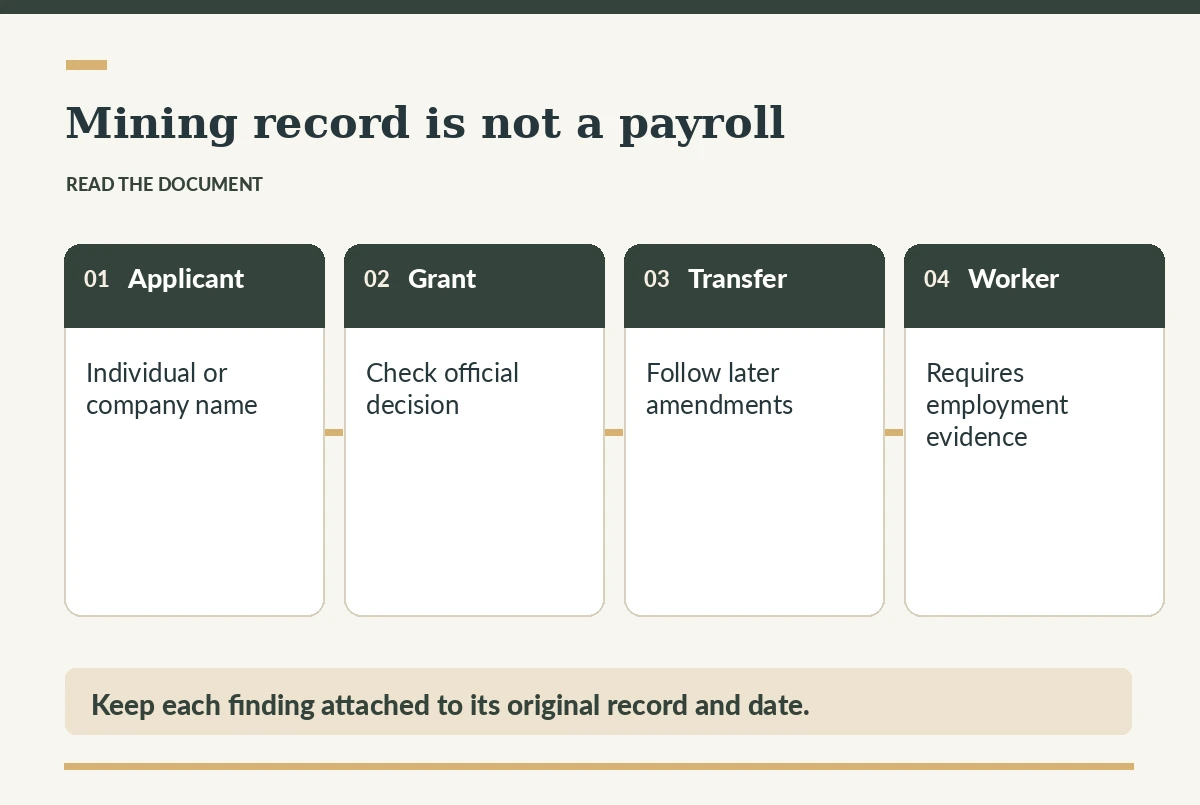
Queensland’s open-data description warns that the listed applicant is sometimes a company. Even an individual applicant need not be the miner physically extracting ore at the site; partners, agents and later transfers complicate the picture. Transcribe the exact entity name, lease class, area, application date and administrative reference when present. Build a second column for what the source does not show, such as daily employment, residence or the eventual disposition. If a family account says an ancestor ‘owned the mine,’ a listing of a pending lease application is only a starting lead. A grant or subsequent transfer requires its own dated evidence.
Follow the index into the original mining record
The Queensland Archives research guide explains that ArchivesSearch is the main finding aid, and distinguishes series IDs, item IDs, physical representations and digital representations. Copy the source’s identifier rather than relying on a downloaded spreadsheet row number alone. Some original registers and indexes are digitized, while other records require on-site consultation or a copy request. Find the exact lease book or warden file, read the application and any disposition, and check its map or boundary sketch if included. A catalogue series title may cover many years and places; verify the individual item before claiming a particular holding is available.
Respect the thin early-1860s record coverage
Queensland’s official mining guide states that few records about individual mines and miners exist for roughly 1860–1870, before later legal reporting and administrative changes. An 1865 miner’s absence from a later lease index is therefore unsurprising. For earlier years, look at departmental correspondence and government gazettes appropriate to the date and activity, and make the coverage limitation explicit. This is an important difference from assuming the indexed 1871 starting year marked the beginning of mining in Queensland. A missing register entry cannot prove a person never worked on a field or that a particular mine did not operate.
Distinguish an application, a lease and freehold title
Administrative stages matter. Mining records may capture an application, gazetted notification, approval, rental payments, transfer, surrender, forfeiture or cancellation. Not all stages occur or survive for every claim. The official guide explains that some early mineral selections could be freehold, while later legal regimes used mineral leases. A record that allows mineral working is not automatically freehold ownership of the land. Place each document on a dated legal-status timeline and verify wording on the original instrument. If the research question concerns the owner of the surface land, you may need a separate land-title or survey record rather than a mining register. A similar decision comes up in our guide “New Zealand Goldfields Wardens’ Court Records”, which explains how to find a claim or miner.
Keep miners’ homestead leases on a separate route
A miner’s homestead lease could concern occupation of Crown land on a mineral field and is not necessarily the same as a mineral extraction lease. Queensland State Archives publishes a separate guide to miners’ homestead leases, including applications, descriptions, maps, transfers and other administrative actions in some files. When family tradition mentions a cottage or block near a mine, check whether the record is a homestead file rather than a gold-mining lease. Preserve the type of tenancy, transfer and district. A homestead application may reveal locality but does not prove the applicant lived continuously at the property or was employed at the nearby mine. Our guide “Queensland Land Selection Files” adds more detail on this.
| Finding | Next verification | Do not assume |
|---|---|---|
| Mineral lease 1871–1940 | Applicant, class and original series | Actual daily work at the mine |
| Miners rights 1874–1880 | Selected warden license records | Statewide miner coverage |
| Homestead lease | Crown land occupation paperwork | Mineral extraction or freehold |
| Mining Gazette notice | Dated administrative event | Completed transfer or production |
A fictional lease candidate comparison
Imagine two hypothetical R. Wilson entries in an index, one for a coal mining lease by R. Wilson Pty Ltd and the other for a goldfield application by an individual Robert Wilson. A family photograph labelled ‘Robert at the mine’ cannot decide between them. Compare district, date, business name, original filing number and nearby civil records. Keep the company and the individual in separate entity columns unless a signed document links them. Even with a matching name, a lease is not a payroll. This made-up example illustrates why identity, legal interest and occupation must each be tested with different evidence.
Recover lost or unindexed mining evidence
If the public dataset lacks a person, check whether your target location, year and lease class fall within that dataset’s actual scope. Browse the Mining Warden and Mines Department series described in the government research guide, including correspondence and relevant maps. Check the Queensland Government Gazette for legal notifications when cited by the guide, but verify any resulting claim against the original file. Search corporate names and mine names as well as personal surnames. Record missing or destroyed record groups and restricted access plainly; an exhaustive search of one index is not the same as a complete search of all governmental mining files.

Cite mineral leases and mining rights precisely
Cite the archive, creating office or department, mining district, lease or right class, applicant as printed, item and series ID, register folio or file number, date, and exact image or consultation details. A spreadsheet download link is only a finding aid citation when the original has not been viewed. For maps include the survey or parcel locator and date; do not insert a modern GPS pin as if it were an original survey coordinate. Keep transfer details separately cited. This allows a later reader to distinguish between a lease awarded to a company and an individual family’s unverified connection to its workers.
How We Research Queensland mining permissions
We compared Queensland State Archives’ current mining collection overview, its lease-index description and government mining research guides. These explicitly separate index types, geographic administration and a thin early-record period. The R. Wilson example is fictional, with no real company, lease number or accusation implied. We treat each index as a doorway to particular original records, not as a list of everyone who worked on the goldfields. Any claim of employment, ownership, residence or family relationship needs a properly identified second source, and current access arrangements must be rechecked for the exact item.
More Records and Archives Guides
Queensland mining lease indexes and official archival guides
Queensland State Archives mining index scope, lease types and miner-rights locality and period (www.qld.gov.au).
QSA open-data mineral lease index and applicant, including corporate applicant, coverage (www.data.qld.gov.au).
Queensland government mining research guide identifying gold lease series and indexing limitations (www.publications.qld.gov.au).
Separate miner homestead lease guide and potential file content (www.publications.qld.gov.au).
Editorial and affiliate disclosure: GenHis is an independent family-history publication. This article does not imply sponsorship, privileged access or a paid relationship with any archive. Check current repository access and privacy requirements before making inquiries. Our affiliate disclosure explains how commercial links are handled elsewhere on the site.
Queensland State Archives publishes a mineral lease index labeled 1871–1940 and routes researchers to ArchivesSearch.
No. The official index describes selected registers mainly associated with the Maytown Warden’s Office and nearby localities.
No. An applicant could be a company or agent; employment needs separate proof.
The state mining guide describes limited individual mine and miner records for roughly 1860–1870.
No. It concerns a distinct Crown land tenure, with different administrative records and evidentiary limits.