
A New South Wales ticket of leave allowed a convict conditional liberty under specified rules; it was not the same as a certificate of freedom or pardon. Museums of History NSW provides an index to tickets of leave dated 1810–1875, while related original records include ticket-of-leave butts and other administrative series. Search with a person’s name and ship, copy the index citation and exact ticket identifier, then inspect the relevant original record where accessible. A surname match alone does not establish the convict’s identity, and a ticket does not mean the transport sentence was completed. The research task is to prove both the individual and the status shown on a dated document.
Identify which convict status the family story describes
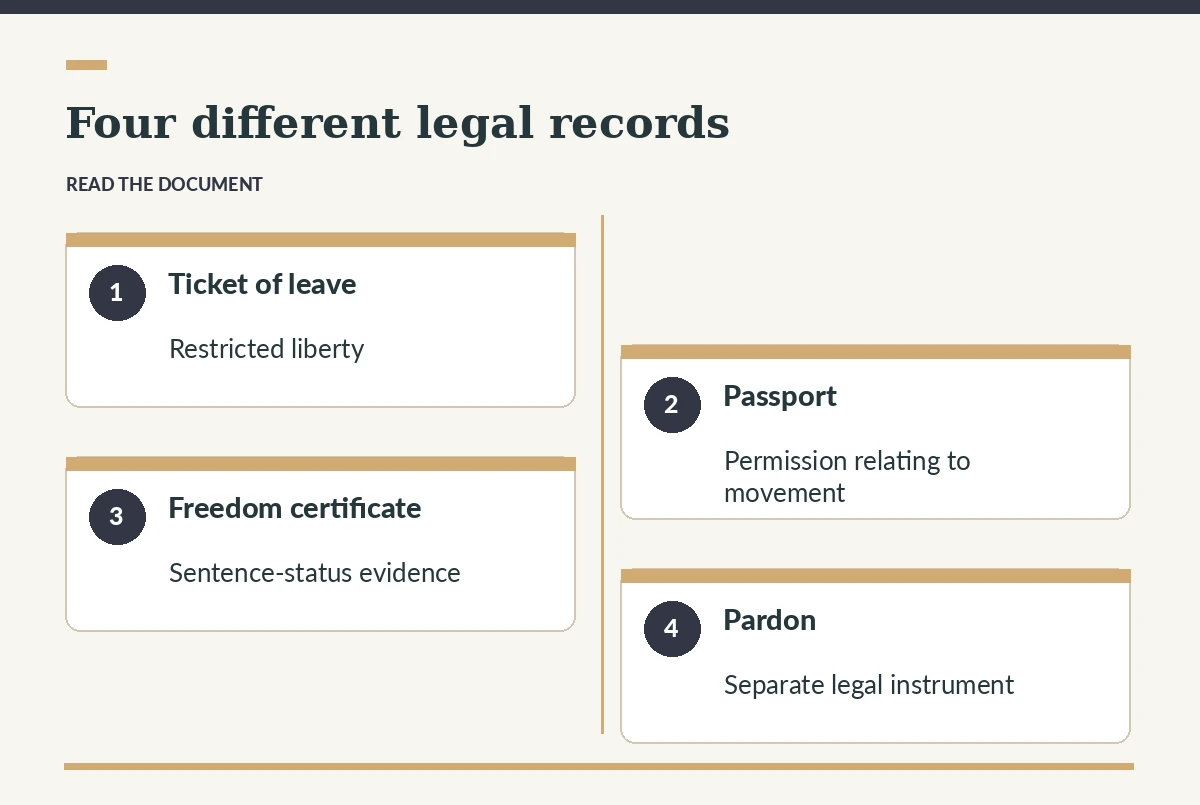
Before searching, distinguish a ticket of leave, a ticket-of-leave passport, a certificate of freedom, a conditional pardon and an absolute pardon. The National Library of Australia describes these as separate categories. A ticket permitted a restricted form of liberty under local rules; a certificate of freedom relates to completion of a sentence; pardons had other legal effects. A family phrase such as ‘freed in 1842’ may obscure a far narrower event. Write the exact phrase from the source and keep competing interpretations open until an original administrative record identifies the instrument and date.
Start with the official NSW convict index
Use the Museums of History NSW Convicts index, selecting tickets of leave or the closely related early records as appropriate. Its 1810–1875 ticket list is not the same as the smaller 1810–1819 combined index. Search name variants, aliases, ship and approximate year rather than assuming a modern spelling is authoritative. Copy every available field: given name, surname, alias, vessel, date, ticket number, remarks and especially the citation. The official Data.NSW dataset displays these index fields and was drawn from historical series. Its coverage represents indexed surviving records, not every person transported or every document created.

Follow the indexed result to its original butt
Museums of History NSW identifies ticket-of-leave butts under NRS-12202, alongside other ticket and register series. The series or reel number in the search result is an archival locator, not a decorative reference to omit. Use it to identify the correct filmed or imaged register. The National Library of Australia notes that digitized butts may be available through subscription resources at participating libraries, with access conditions that vary by institution. A database card can omit qualifiers or carry a transcription error, so open the original entry and capture the printed or handwritten number and date with the surrounding page headings. For the fuller picture, see our guide “Western Australia Convict Records, 1850–1868”.
Use the transport ship as a strong identity check
Convict names repeat frequently, and many records include alias spellings or phonetic variants. A ship name and arrival year can separate people who otherwise look identical, but even matching ship details should be checked against an indent or arrival record. Compare stated native place, trade, sentence and age when those fields occur on the relevant original document. If an index suggests an unexpected ship, do not simply ‘correct’ it to the family story. Preserve both statements and examine the original record for a copying error, an alias or a different convict. Document your confidence rather than presenting a guess as a proved ancestor.
Read conditions and geography without overclaiming
A ticket could allow the holder to work or reside subject to restrictions. Rules and local administration changed with time, and a particular ticket must be interpreted according to its date and wording. A named district in an entry may describe the permitted district, not proof that the holder remained at one street address continuously. Search appropriate local employment, church or household material to test later residence. If the ticket was cancelled or altered, a subsequent document may reflect another status. Do not claim permanent release, property ownership or family formation from a single ticket-of-leave date.
Do not mix a ticket with its passport
The NSW convict index also identifies tickets-of-leave passports dated 1835–1869. The National Library describes tickets and passports as distinct records, and the official archive indexes them separately. A passport can be useful for a movement hypothesis, but its existence does not imply the convict traveled on the proposed route or crossed a border on the given day. When tracing a person between districts, preserve the specific permission document and then seek an independently dated arrival, employment, parish or court record to demonstrate an actual move. Use exact administrative terminology in your citations. To go further, our guide “NSW Convict Bank Accounts, 1837–1870” shows how to find warrants and balance records.
Worked fictional convict identification
Imagine two hypothetical convicts named William Gray: one arrived on Ship A and received a recorded ticket; the other arrived on Ship B and later received a certificate of freedom. A relative remembers only that William ‘got his papers.’ Build two columns for ship, year, alias, age, number and official status. The correct research answer cannot be determined from the shared surname or remembered phrase. If an independent marriage record names Ship A’s district, that may strengthen the first candidate but still needs testing. This is a constructed example, not a transcription of any convict’s actual criminal or family history.
| Finding | Next verification | Do not assume |
|---|---|---|
| Ticket of leave | Conditional liberty under rules | Sentence completed |
| Ticket-of-leave passport | Permission relevant to movement | Travel definitely occurred |
| Certificate of freedom | Sentence-status document | Same event as earlier ticket |
| Index entry | Locator with ship and reference | Original image verified |
Interpret a later certificate or pardon in sequence
If an original ticket entry references a subsequent certificate, pardon, transfer or cancellation, follow each document as a separate dated action. A later certificate can clarify an individual’s legal status without making the earlier ticket redundant. Note whether an entry is a recommendation, grant, receipt or administrative memorandum. The archival index separates these categories for a reason. A family tree that lists only the last status loses the evidence of intervening years. A timeline with one row per original document can expose both chronology and contradictory readings, and it prevents the researcher from backdating freedom to the first surviving index date.
Handle missing or conflicting original records
If there is an index citation but no immediately viewable scan, consult the referenced record series and the repository’s current access guidance. Availability in a subscription interface is not the same as survival at the official archive. Try a different spelling or ship, inspect neighboring entries and compare the butt number against index details. Where a source is missing, keep the index as a finding aid with its limitation noted rather than declaring the original inspected. A negative name search cannot prove that no ticket was issued: missing material, unindexed variants and indexing errors all require consideration.

Cite the actual ticket and linked evidence
A full citation identifies the convict as named on the page, document type, date, ticket number, issuing jurisdiction, original series such as NRS-12202 when applicable, reel or image locator, and the archive or access platform used. Note any ship and alias exactly as recorded. For an independent identity link cite the passenger indent or a marriage record separately rather than appending an unsupported relationship claim. If you transcribe abbreviations, retain an exact-text column and explain expansions in editorial brackets. Make another reader able to return to the same original page and reproduce your conclusion. For the next step, our guide “NSW Convict Certificates of Freedom, 1823–1869” explains how to find the original record.
How We Research NSW ticket-of-leave evidence
We checked the official Museums of History NSW convict-index guidance, NSW open-data field descriptions, and the National Library of Australia’s distinctions among legal status records. The two-William illustration is fictional and makes no assertion about real convicts. The method requires reading the instrument’s own words and connecting it to a separately verified transport identity. We do not treat index hits, legal categories or liberty dates as interchangeable, and we flag records whose image has not been inspected. Current digital access or repository fees should be checked before arranging a visit or purchasing copies.
More Records and Archives Guides
NSW ticket-of-leave indexes and original record guides
Museums of History NSW guide to ticket indexes and NRS ticket-of-leave record series (mhnsw.au).
National Library of Australia comparison of tickets, certificates and pardons and digitized access options (www.library.gov.au).
NSW open-data index to tickets of leave 1810–1875 and its recorded fields (data.nsw.gov.au).
Official searchable NSW convict index and recorded source citations (mhnsw.au).
Editorial and affiliate disclosure: GenHis is an independent family-history publication. This article does not imply sponsorship, privileged access or a paid relationship with any archive. Check current repository access and privacy requirements before making inquiries. Our affiliate disclosure explains how commercial links are handled elsewhere on the site.
It records a conditional form of liberty subject to historical restrictions, not necessarily a completed sentence.
The official NSW ticket-of-leave index is labeled 1810–1875; survival and indexing remain distinct from total issuance.
Museums of History NSW identifies original series including NRS-12202 ticket-of-leave butts; use the index citation to locate the item.
No. Passport records are a separate administrative class and do not by themselves prove travel.
Compare ship, arrival year, alias, number, trade and other independently dated original evidence.