
New South Wales convict indents are transport-and-arrival records, not fully verified personal biographies. For 1788–1842, begin with the ship, arrival date and claimed name; then locate the indent and compare trial details and identifiers before connecting it to a known family. The NSW archive describes early indents with relatively few fields and later indents with much fuller physical and biographical descriptions. Some entries carry ticket-of-leave or pardon annotations written after arrival. A same-name index hit is therefore only a starting candidate. This guide gives a period-sensitive reading method, an annotation follow-up route and a way to test whether a ship record truly belongs to your ancestor.
Understand why 1788–1842 is the central indent era
Museums of History NSW describes transportation and indent material centered on 1788–1842, while later convict exiles and related administrative records follow different pathways. The original lists are generally associated with transport vessels, not organized like a modern alphabetical passenger database. Before searching, write down a likely arrival span and consider whether the reported ancestor instead reached Tasmania, Western Australia or another colony. An absence from an NSW indent search does not erase a transportation tradition. It may mean the person arrived elsewhere or belongs in later exile records. Search the right population and time period before inferring anything about identity. Our guide “Western Australia Convict Records, 1850–1868” goes into more detail.
Read the correct fields for the record date
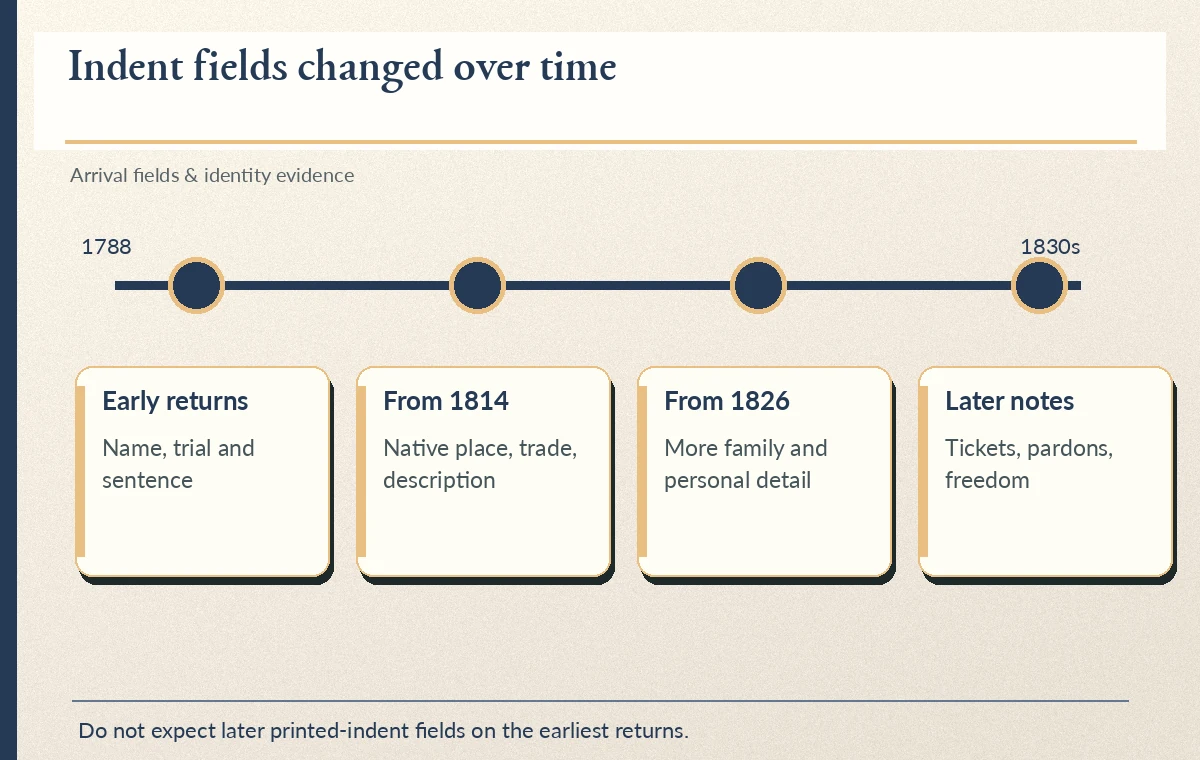
Do not impose a nineteenth-century printed format on First Fleet-era papers. The NSW guidance says early indents may contain only name, trial place and date, and sentence. Later entries gained native place, trade and physical description, with additional personal categories appearing through the 1820s. The archive identifies an important expansion from July 1814 and further columns from 1826. Missing birthplace or family details on an early page usually means the form never requested them, not that an official omitted them for your ancestor. Record the exact headers used on the particular image and label any information absent because of format.
Start with the official index, not a copied pedigree
The Museums of History NSW digitized convict-indents index covers an early 1788–1801 selection with linked images; that does not mean the whole 1788–1842 run is identically searchable there. State Library NSW also describes microfiche indexes and library-only routes for broader years. Search surname variations, including initials and aliases, and save the ship and trial details for each candidate. If a database provides an abstract only, ask which archival series the abstract represents. An index entry can be mistranscribed and may omit later annotations. Make separate citations for the index and its underlying indent image.
Link name, vessel and trial before adding a family
A reliable match usually requires several independent points: approximate recorded age, ship and arrival, trial jurisdiction and date, occupation or recorded physical features, where present. An alias deserves its own column, not an automatic replacement for the person’s everyday name. If two people named John Sullivan arrived on different ships, store both candidates until a new record differentiates them. Dates and native places may be wrong or reported through an official, so do not declare a match proved by one apparently precise field. Compare the person’s later colonial address or spouse with a separate record before asserting a lineage connection.

Treat marginal numbers as directions to other records
The NSW guide explicitly notes that indent pages can carry later ticket-of-leave, certificate-of-freedom or pardon numbers. Copy the exact letters, punctuation and number, including any uncertainty. These annotations may be more useful than a doubtful age because they can lead to another administrative series. A ticket of leave did not mean a sentence had ended, and a conditional pardon was not identical to absolute freedom. Use the matching archive guide to find the correct follow-up collection and confirm that its ship, arrival and trial fields refer to the same person. Keep the chronology of grants and later changes visible. To go further, our guide “NSW Convict Pardons, 1791–1873” shows how to verify conditional and absolute grants.
Use the archive series, not a generic image label
The NSW Archives Resources Kit lists indent holdings across series such as NRS 1150, 1151, 1152, 1153 and 1154 and separately cataloged printed series. It also identifies ship musters and related papers, assignment registers and other potential follow-ups. An online scan name without an NRS reference is difficult to find again. Record the series, reel or fiche when relevant, volume, image or folio, the vessel, and the current holding institution. The exact catalog reference should take priority over commercial database wording. Some originals require a reading-room or library service rather than direct download. For the fuller picture, see our guide “NSW Convict Assignment Registers, 1821–1825”.
Worked example: the same name on two transport ships
Imagine two fictional men named Thomas Kelly arriving several years apart. A family story identifies a wool worker convicted in County Cork; only one indent candidate records that trial location, but the other has an apparently similar age. The researcher cites both entries, checks what each form actually captured, and seeks an assignment or marriage permission record matching the trial, ship and occupation. If either detail conflicts, the conflict stays in the log. The name plus estimated age is not enough to collapse the two men into one. This process illustrates why the arrival record should open the investigation instead of closing it.

Broaden the search when an arrival cannot be found
Check whether a married surname was acquired after transportation or an alias used in court. Search the ship by date, compare period transportation registers, and use state library guidance to locate unindexed images. A missing result may reflect damaged originals, an inconsistent transcript, a transfer to another colony or the person’s status as a later exile. Do not turn every search failure into evidence that the family legend was false. Record exactly which years and index scope you checked. When you find another candidate, ask whether a later colonial record can place that individual in the locality associated with your known ancestor.
| Indent clue | How to use it | What it cannot prove |
|---|---|---|
| Vessel and arrival | Find the original ship listing | A later residence or marriage |
| Place and date of trial | Distinguish same-name candidates | Accuracy of every allegation |
| TL / pardon number | Trace a different archive series | Immediate full freedom |
Make a claim narrower than the record’s story
An indent may support a statement that an individual of a stated name was listed on a ship with a recorded sentence and trial. It does not prove that the court allegation was factually accurate, that every physical detail was precise, or that this person is a later ancestor. Penal descriptions and offences are embedded in a coercive colonial system; quote only necessary terms and distinguish recorded accusation from established action. Researching convict history also requires care about colonial violence and dispossession. Cite the original page, note exact and uncertain text separately, and state which later document would close the remaining identity gap.
How We Research
We checked Museums of History NSW’s convict transportation guide, digitized early-indents index, and Archives Resources Kit against State Library NSW’s description of the physical microfiche search. The research route deliberately tests document-era differences before interpreting a missing column. Marginal letters and numbers are treated as references to separate administrative records, not completed biographies. Its fictional names and comparisons are teaching examples only. We do not treat penal officials’ categories or allegations as neutral statements of historical truth; citations and the source image should be retained for every contested claim.
More Records and Archives Guides
Primary sources and archive guides
Museums of History NSW guide covers indents, ship arrangement, changing fields, and later annotations (mhnsw.au).
Official digitized index specifically covers early 1788–1801 indents and links to images (mhnsw.au).
NSW archive series identifiers and fiche or reel reference framework (mhnsw.au).
State Library NSW explains microfiche-to-original lookup and historical access differences (guides.sl.nsw.gov.au).
Research limitations: transportation records were made within a coercive colonial system and may contain offensive descriptions or mistaken allegations. This independent guide has no paid referral links. Avoid exposing sensitive information about living descendants. See GenHis affiliate disclosure.
An administrative list associated with transported convicts and vessels, recording trial and sentence details and, in later periods, additional identifying information.
Not necessarily. The early forms are sparse; field coverage changes substantially over the years.
No. A specific digitized early index covers 1788–1801; broader years require additional indexes, images or microfiche routes.
In the official abbreviation list, TL is Ticket of Leave; use the related number to look for a corresponding administrative record.
No. Cross-check ship, trial, identifying details and independent colonial or family records.