
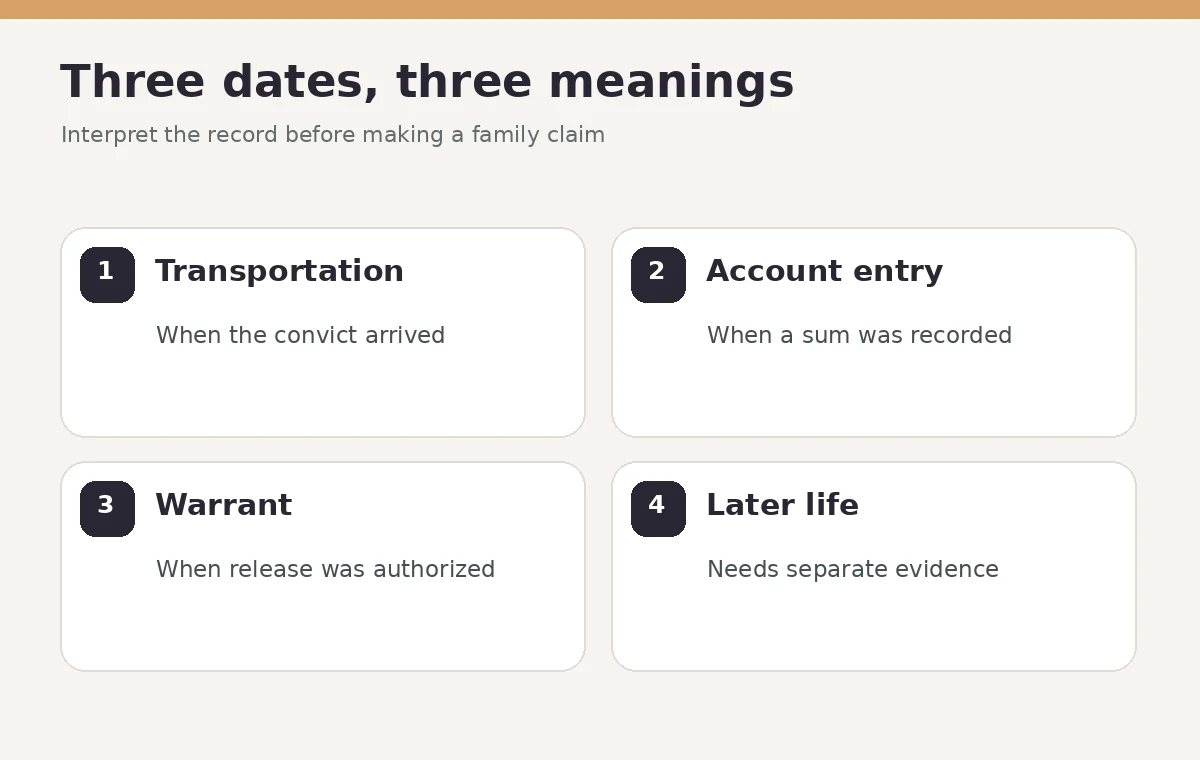
NSW convict bank records can identify money held for a transported person, but the main online bank-account hits usually point toward a warrant or balance—not an entire personal banking history. Search the Museums of History NSW Convicts Index, capture the ship and series number, then choose the correct warrant, ledger or balance volume. A payment warrant dated 1850 does not mean the convict arrived in 1850.
Begin with the specific financial claim
For many transported convicts, money or property was held under arrangements that limited when it could be withdrawn. Museums of History NSW explains that access could depend on a ticket of leave, a pardon, sentence completion or other approved grounds. A warrant could then authorize a withdrawal. This is administrative evidence of a financial transaction; it is neither a full family budget nor proof that the person personally visited a bank on the recorded day. To go further, our guide “NSW Convict Tickets of Leave, 1810–1875” shows how to find the original record.
State your question narrowly: Was a savings balance recorded for the particular convict? Was a warrant later issued? If so, how do the ship and status details identify the individual? Collect the known transportation ship, arrival year, trial information and later freedom document before searching the bank entries. A surname match alone is weak when many convicts had the same name and when the financial record was created years after transportation. Our guide “NSW Convict Assignment Registers, 1821–1825” goes into more detail.
Know which of the four record groups you need
NRS 12221 covers warrant butts for release of convict bank balances during 1837–1870; the source guide says they can show the warrant number and date, name, ship and the person’s condition or status. The date range is for the warrant, not necessarily the person’s transportation. NRS 12218 is an earlier balance list arranged by ship, with entries chiefly from 1833–1840; an additional dated notation appears later in that volume. Neither series should be read as a passenger manifest.
NRS 12219 consists of savings-bank ledgers described for 1824–1848, arranged by ship, with fields such as principal, interest, remarks and dates paid. NRS 12220 includes an 1824–1827 cash book and associated correspondence. These holdings answer slightly different questions. A researcher asking about accrued sums needs the ledger, while one asking whether withdrawal was authorized should start with the warrant. Do not assume all four record types survive for the same individual.
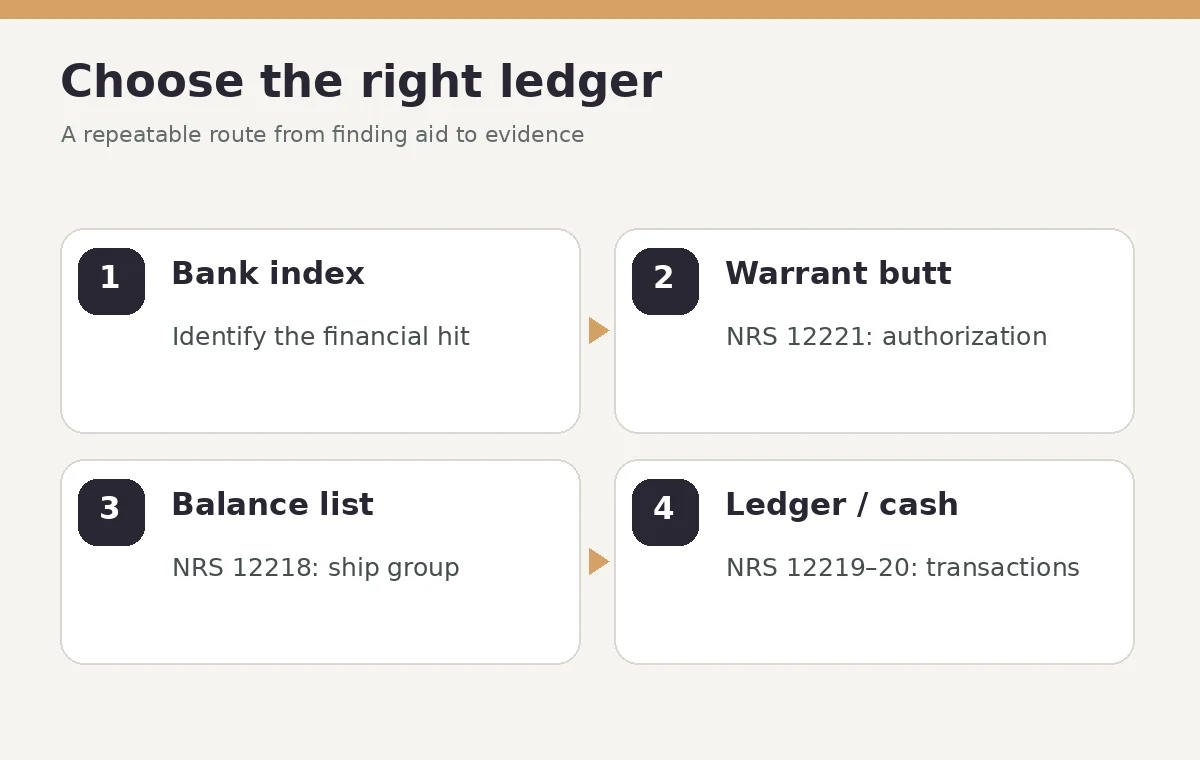
Search the index and collect the source locator
Open the NSW Convicts Index and filter or search the prisoner’s name. Its broad index also contains certificates of freedom, pardons and tickets of leave, so identify the record type on each result. Capture the ship of arrival and the archival locator or reel. A result in a certificate-of-freedom series is not a bank-account result, although it may be very useful for verifying identity later.
Create a short transcription card with name exactly as indexed, record class, warrant or page number, dated event, ship and reference. The index describes approximately 1,300 convict bank-account entries; that figure is a guide to the indexed subset rather than a count of every prisoner who ever saved money. Search any spelling variants and ship aliases separately. If the bank reference is not immediately viewable online, use the repository’s catalogue or reference service to obtain the original page. To go further, our guide “NSW Convict Certificates of Freedom, 1823–1869” shows how to find the original record.
Distinguish authorization from actual financial life
The warrant-butt system recorded an administrative authorization addressed to the bank trustees. A warrant date supports the issuance of that authorization; it may not document the exact moment the named person physically received cash, and it cannot prove how funds were spent. If the original page says “dead” or another status, copy the word and its context without turning it into an independently registered death event.
Amounts also need their ledger context. An interest notation, principal figure and amount paid may belong to distinct columns or calculations, and their dates may not coincide. When using a transcription, verify whether pounds, shillings or pence are shown in separate columns. Do not modernize monetary values or assume a total without reading the headings. For a family tree, the chief value is often a firmly identified ship and status-linked event, not a spending estimate.
| Series | Primary function | Do not assume |
|---|---|---|
| NRS 12221 | Warrant butts, 1837–1870 | Warrant date equals arrival |
| NRS 12218 | Balances arranged by ship | Balance equals full savings history |
| NRS 12219 | Savings ledgers, 1824–1848 | Every prisoner has an entry |
| NRS 12220 | Early cash book and letters | Surviving letters explain every case |
Trace Colonial Secretary References and Verify Convict Identity Across Records
The Convicts Guide reports that some 1840–1855 warrant volumes carry Colonial Secretary letter-number references; other references may lead to correspondence that did not survive. Where an original entry provides such a number, preserve it verbatim and search relevant Colonial Secretary material. A missing letter does not invalidate the surviving warrant. It simply prevents further inspection of the reason behind the administrative decision.
Compare the convict’s arrival indent and any ticket of leave or pardon to the ship and status stated at the bank. The ideal match has several shared identifiers and a plausible chronology. For a fictional example, a payment warrant for “Thomas R.” arriving aboard a ship named in an 1829 indent might refer to the same person; add trial place, age or a later certificate to distinguish him from another Thomas R. Never present that illustrative scenario as a real archival person. Our guide “NSW Convict Pardons, 1791–1873” shows how to verify conditional and absolute grants.
Log searches that fail as well as those that succeed
If there is no bank index hit, record the exact query, spellings, date range and type of records covered. Perhaps the person had no such recorded balance, perhaps the name is spelled differently, or perhaps the surviving financial series and index do not cover the case. These are competing explanations, not interchangeable conclusions. It is rarely sensible to infer poverty, punishment or dishonesty from absence from this narrow collection.
If an indexed balance exists but the ledger is not immediately accessible, record “index consulted; original not yet examined” in the source note. A negative finding in the index is not the same as searching each surviving ledger page. Follow the ship arrangement where indicated and ask the archive about its current access method. Treat a missing financial ledger as an evidence gap, not as evidence that family testimony about money must be false.

Build an audit-ready financial chronology
Keep a three-column chronology: transported person and ship; financial entry and source; separately documented change of legal status. In many cases this will show decades between arrival and a warrant. That difference is historically meaningful and protects the researcher from attaching the payment date to an incorrect ancestor in the family tree.
Conclude in calibrated language. “NRS 12221 records a warrant in this name and ship” can be a defensible statement after original verification. “The prisoner received all of his savings and bought a farm” requires independent evidence of payment and land. Cite series, volume, page, reel or item number, and whether the material used was the index or the underlying original. To go further, our guide “Parramatta Female Factory Index, 1826–1848” shows how to find women and children.
How We Research NSW Convict Bank Records
Our method starts with the named archival series and its official repository guide, then separates searchable derivatives from original pages. We checked the stated date span, entry purpose, reported fields and known gaps against the sources below. The examples are illustrative rather than claims about actual people; no ambiguous identity or family relationship is presented as proven. Record locators, contradictory details and lawful access limits remain part of the research result.
More Records and Archives Guides
Official archives and collection guides for this record
Official descriptions and date spans of NRS 12218–12221 and restrictions on access to convict funds (mhnsw.au).
Searchable convict index including bank accounts and archival locators (mhnsw.au).
Archival series details on bank balances and surviving returns (concise.mhnsw.au).
Editorial disclosure: This guide contains no approved paid placement or affiliate recommendation. Read the GenHis affiliate disclosure. Historical administrative labels can be incomplete, biased or offensive. Preserve original wording when citing but avoid unsupported conclusions about identity, race, loyalty, parentage, medical status or wrongdoing. Protect living people and follow the archive’s current access terms.
An authorization record can name the convict, ship, warrant date and status; inspect the original for precise fields.
No. These years describe the surviving warrant record dates, and arrivals may have been much earlier.
No. Land title or a separate transfer record is needed for property ownership.
No. This index covers a limited subset of financial records, not all transported people.
The ship, identity details, status chronology and at least one independently created convict record.