
The New South Wales Principal Superintendent of Convicts kept registers of applications for permission to marry from 20 December 1825 to 26 February 1851. The first recorded permission dates to January 1826. These are administrative decisions about proposed weddings, not church registers of completed ceremonies. A positive entry is a lead toward a marriage, while a refused application may preserve valuable information about an intended spouse who never became a husband or wife.
Start with an application, not a marriage certificate
Begin with the precise claim you want to test. “Did these two named people ask to marry?” is a question the register may answer. “Did they marry?” needs a separate church or civil record. “Are they my ancestors?” requires linking both applicants to independently identified people. Keep all three claims in a research log so a compelling name match cannot silently become a proven family branch.
Locate the NRS 12212 entry and its citation
Museums of History NSW provides an online index to convicts’ applications to marry for NRS 12212, recording the applicants, ships, remarks, place, date of permission, clergyman and a register citation where indexed. Search both possible surnames independently, because spelling variations, initials, remarriages and changing names can affect a result. Try the ship name or place as a second control rather than assuming the top alphabetical match belongs to your person. Our guide “Tasmania Convict Permissions to Marry, 1829–1857” adds more detail on this.
Copy the register reference exactly: NRS 12212, the numbered volume and page, and any reel or fiche locator supplied. The archives’ convict guide identifies fiche 780–802 and distinguishes granted entries from refused entries. Open the image or request an archival copy when necessary. An index transcription may omit qualifications written on the original page, and a search result is not a substitute for checking its complete citation.

Separate permission granted from refusal and missing results
The surviving register material includes distinct sequences of permissions and refusals; a negative name search in one sequence is not a search of the other. Official guidance lists an index to grants in January 1826–May 1833, partial female indexing in May 1833–December 1837, refusal indexes for specified periods, and later grants through February 1851. Because the index and the manuscript holdings are not identical in arrangement, record what was actually searched.
A refusal may reflect an administrative decision and is not evidence of the couple’s conduct or that the relationship ended. Likewise, a missing entry does not show that the applicants never sought permission. Check spelling, the other partner, neighboring dates, registers arranged by the male applicant, and a possible earlier Colonial Secretary record before writing a negative conclusion. Explain which fiche, date period and repository description supports any coverage statement.
Use ship, status and ages as identity controls
Register entries may record a ship of arrival, sentence, age, free-or-bond status and clergyman, alongside applicants’ names. Compare the recorded ship and sentence with an independent indent or conduct record. Ship names can repeat across voyages, so keep the voyage designation and arrival date distinct. A person called “free” in a marriage application should not automatically be assumed to have immigrated as a free passenger.
Treat the reported ages as approximate unless independent evidence supports an exact birthday. Compare residence or parish clues with later marriage or baptism records, and check whether the proposed partner appears again in the same district. Even a perfect match on name and age is weaker than a combination of named spouse, ship or occupation, date and credible locality. Preserve contradictory details instead of averaging or silently correcting them.

Find the actual ceremony and test an apparent match
After identifying a grant, search the historical NSW church marriage records by both surnames, possible spelling variants, clergyman and locality. The NSW registry explains that its pre-1856 marriage evidence comes from church records, not compulsory civil registration. Compare witnesses and parish against your other documents. An application dated months before a wedding may be genuine, but the intervening chronology needs to fit the candidates.
If an apparent marriage record names a different couple, do not force the link. The archive expressly warns that a granted application did not guarantee a wedding, and some convicts received permission more than once. Record one outcome for the application, another for any discovered ceremony and a third for the identity comparison. That simple distinction prevents one of the most persistent errors in colonial-family trees.
| Source | What it can establish | What it cannot establish |
|---|---|---|
| Application register | Proposed couple and recorded decision | A completed wedding |
| Marriage register | A recorded church ceremony | Every earlier administrative application |
| Convict indent | Ship and convict identity clues | Identity of the intended spouse |
| Baptism entry | Named parents reported at a baptism | Automatic proof of this application |
Document a fictional permission-to-ceremony test
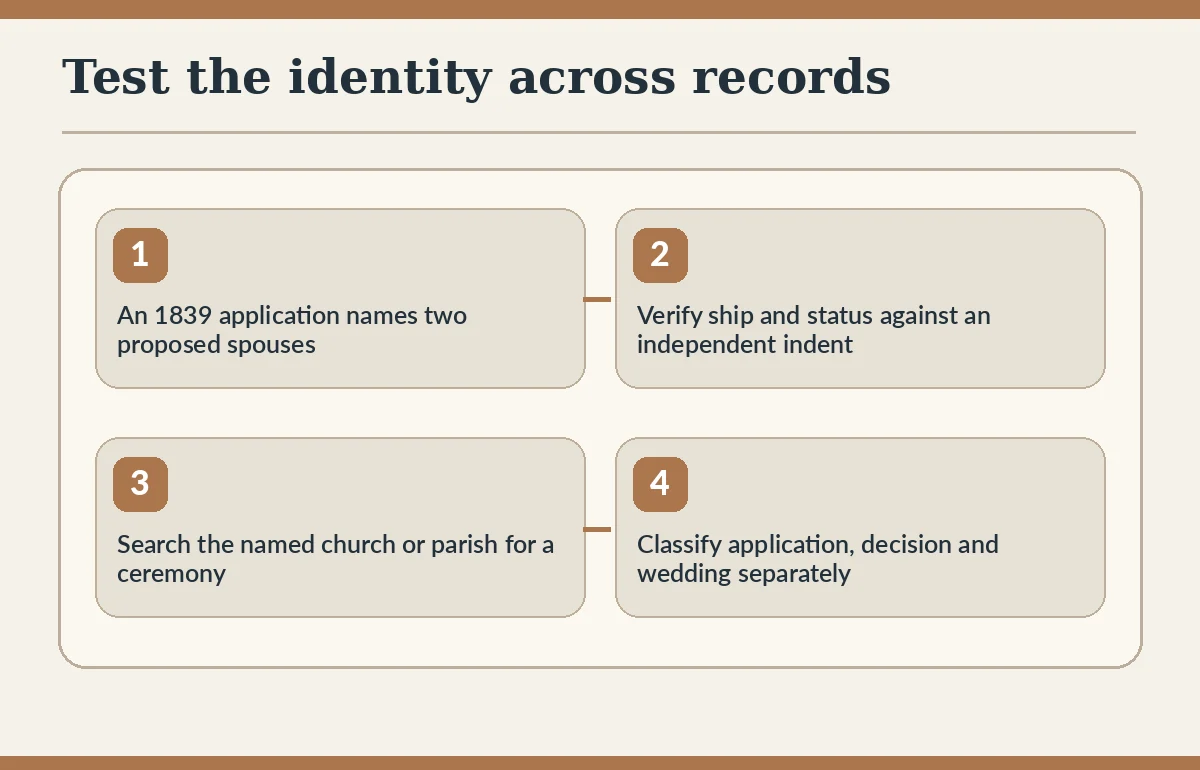
Imagine an indexed 1839 application by John Martin and Ann Kelly, describing John as having arrived on a named transport ship. This is a fictional example, not a transcription of an archival entry. You also find an 1840 church wedding with those names. First transcribe the application’s original folio, then compare ship and age with John’s convict indent and evaluate parish, minister and witnesses at the wedding.
If the application matches the indent but the church entry lacks identifying details, the proposed marriage remains a strong clue rather than a proved identity link. If a baptism later identifies the same parish and both parents, that may help, subject to its own informant and date. Enter all records with separate citations and record what additional source would resolve a conflict if two John Martins lived in the area.
Keep privacy, terminology and archival access accurate
These documents were generated within a coercive convict administration; terms such as “bond” or “free” describe recorded legal status rather than moral worth. Quote historic wording only where it clarifies an actual source and avoid turning an allegation or a refused permission into a character judgment. A family story can mention an application without repeating a sensational interpretation of its result.
Access routes may include an online index, original archival records, microfiche or reading-room copies. Confirm the current request method on the repository page instead of promising a universally free image download. When making a public family tree, transcribe only what you can document and do not present hypothetical descendants as established relatives.
How We Research NSW Convict Marriage Applications
We compared the archive’s own descriptions of this collection and its finding aids on 2026-10-22, mapped known time and coverage limits, and distinguished administrative observations from genealogical inferences. The worked names are fictional and explicitly illustrative. The steps describe how to verify a record rather than claiming we inspected an ancestor’s personal file. This guide is educational, not legal or professional archival advice; confirm access conditions and source images with the repository before relying on an individual record.
More Records and Archives Guides
Archive Collections and Finding Aids for NSW Marriage Permissions
Official NSW searchable index, NRS 12212, citations and indexing status (mhnsw.au).
Official granted/refused fiche guide and cautions about interpreting applications (mhnsw.au).
NSW Government explains pre-1856 church record context and civil registration transition (www.nsw.gov.au).
Editorial disclosure: This independently prepared research guide contains no sponsored recommendations or affiliate purchase links. View the GenHis affiliate disclosure for the site-wide link policy. Avoid publishing sensitive information about living people; copyright and archival restrictions may apply.
No. NSW State Archives explicitly warns that permission did not ensure a later ceremony; seek the church marriage entry.
The NRS 12212 series is held by the NSW State Archives Collection and is associated with microfiche 780–802 and listed volume references.
Yes. Refusals have separate registers and partial indexes, which must be searched independently of grants.
Some entries include the ship and sentence; transcribe the original record and compare it with an indent or muster.
Search the other applicant, variant spellings and relevant fiche or volumes, then document the precise coverage checked.