
A New South Wales certificate of freedom recorded that a convict with a finite sentence had completed that sentence. Start with the Museums of History NSW Convicts Index, then locate the original register or certificate butt. Do not treat a ticket of leave as the same document: it offered regulated liberty during a sentence. A pardon was another legal route, especially for life sentences. The useful research question is not simply “Was this person free?” but “Which dated record documents the end of this particular sentence?” Record that question before searching.
Distinguish the three relevant archival series
The official NSW guide names NRS-12208, registers of certificates of freedom covering portions of 1810–1833; NRS-12210, butts of certificates of freedom dated 1827–1867; and NRS-10990, colonial certificate butts dated 1860–1869. The online certificate index is described as covering 1823–1869, but that range does not mean every individual series covers every year. Colonial certificates relate to convictions committed within the colony, not just to the original overseas transportation sentence. Use the date and document type to choose the correct sequence.
Search the index without treating a name as identification
Search the surname in the official NSW Convicts Index, then repeat using spelling variants, aliases and abbreviated given names. Transcribe the result exactly, including certificate type, issue date, ship, recorded arrival year, reference number and reel or page when shown. A single surname may produce several certificates, sometimes for different convicts and sometimes for later colonial sentences. Make a candidate list before opening images. If only a transcript is visible, mark the image as not yet inspected; do not quietly promote a derivative index entry to a verified original.
Follow the reference to a register or retained butt
The original certificate issued to a person and the official retained butt are not interchangeable physical objects. NSW describes the butts as recording the certificate number and date, prisoner number and name, transport ship, trial, sentence and, for many examples, native place, trade, year of birth and physical description. Fields vary with time and series. Preserve the precise archival locator from the index, including NRS number and volume, reel or page details. If the image is not available remotely, check the archive’s access route instead of inventing the missing text.

Build a ship–trial–sentence identity cross-check
Before merging this certificate into a family tree, compare the recorded ship and arrival year with a NSW convict indent, and compare trial place, trial date and sentence length across both records. A physical description, native place or occupation can provide another independent discriminator when recorded. Treat approximate birth years with care: they can reflect a person’s reported age or an administrative calculation. A matching ship name is powerful only when paired with a compatible voyage, sentence and person. Preserve disagreements on your worksheet rather than choosing the more appealing answer.
Use an issue-date chronology rather than arithmetic alone
An expected completion date calculated by adding seven or fourteen years to a conviction or arrival date is a search clue, not proof of the date on which a certificate was actually issued. Transportation, sentence commencement, administrative processing and subsequent penalties may complicate a simple timeline. Place conviction, arrival, any ticket of leave and certificate date into separate columns, each with its own citation. If dates conflict, inspect the original wording and identify which event each date describes; never silently substitute the certificate date for the beginning of civilian residence.
Separate certificates, tickets and pardons at decision time
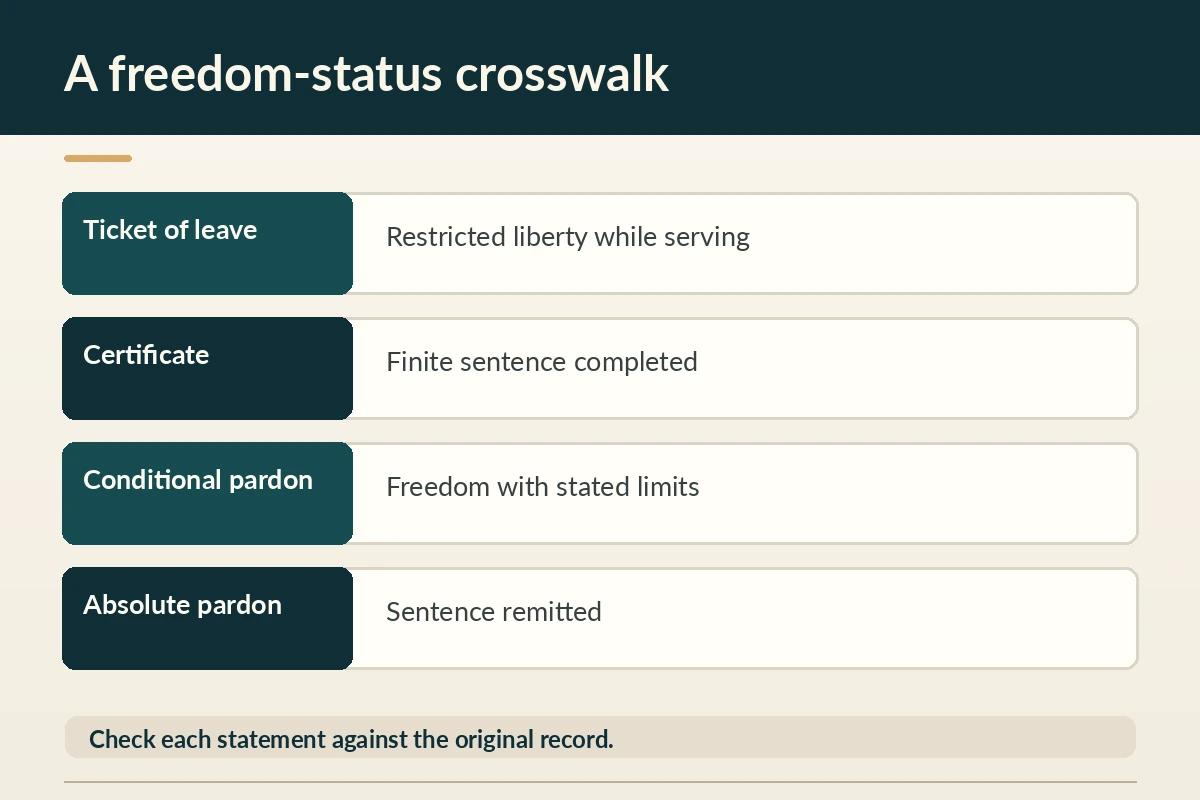
The NSW guide states that a life sentence did not qualify for the ordinary certificate-of-freedom route; a pardon may instead explain later liberty. A ticket of leave could permit work and residence in an allocated district while the sentence continued. A conditional pardon is distinct from an absolute pardon and could include restrictions on where the person lived. This matters for later marriage, land and movement claims: recording “free” without specifying the legal instrument turns a narrow administrative fact into a potentially misleading biography.
Investigate repeated certificates and lost originals
An index may show more than one freedom-related document for a person. NSW holds colonial secretary affidavits concerning lost certificates, and registers may carry cross-references to earlier or replacement certificates. Search by certificate number and variant name as well as by surname. If a later index record seems inconsistent with the earlier one, ask whether it documents a replacement, a new colonial offence or an unrelated namesake. Link the documents only after their internal references or corroborating particulars support the relationship. The mere repetition of a common name is insufficient.
Test a fictional two-candidate case before attaching a record
Imagine two fictional men named Thomas Brown, both indexed with certificates in the 1840s. One entry gives the ship York and a trial in London; the other gives the ship Asia and a trial in Dublin. A family letter names a Thomas Brown who worked near Parramatta, but it gives no transport ship. The letter does not decide between the two. First locate the local person in another dated record, then seek a compatible ship, occupation, residence or associated family member. Leave the certificate unattached while both candidates remain possible.
Turn a matching certificate into the next research question
Once the evidence supports an identity, ask what happened after the certificate. Use local marriage and death registers, newspapers, directories, employment or land records to establish the person’s later presence. The freedom document itself does not establish a marriage, residence at the listed delivery district, parentage or eventual return overseas. A later child’s baptism might establish a family connection that the certificate cannot. Cite the certificate directly and then cite any civil or church evidence separately, making clear which source supports each conclusion. For the next step, our guide “NSW Convict Bank Accounts, 1837–1870” explains how to find warrants and balance records.

Record an auditable original-image citation
A reproducible citation should name Museums of History NSW / NSW State Archives Collection, the NRS series, volume or item, certificate number and date, person’s name as recorded, and the image or reel reference actually consulted. Keep the source URL and access date with your research notes. If the record was consulted through a third-party database, record both that online container and the underlying archival series. Distinguish a copied transcript from a firsthand transcription of the original: other researchers must be able to retrace the precise page you used. To go further, our guide “NSW Publicans’ Licences, 1830–1861” shows how to find an innkeeper and the original record.
Recognize when the surviving index cannot answer the question
The stated 1823–1869 certificate-index span is a description of indexed records, not proof that every convict who became free appears in that set. The NSW archive also documents certificates from before 1823 and alternative status records. When searching fails, revisit sentence type, aliases, different custody routes and the original indent. Write “not found in the index searched on this date,” rather than “no certificate existed.” That statement preserves the actual limits of the search and points to a defensible next source. To go further, our guide “NSW Convict Tickets of Leave, 1810–1875” shows how to find the original record.
| Freedom document | What it establishes | What it does not establish |
|---|---|---|
| Certificate of freedom | Completion of a finite sentence | Family relationships or later residence |
| Ticket of leave | Qualified liberty during sentence | Unrestricted freedom |
| Conditional / absolute pardon | Terms of a pardon grant | A certificate-of-freedom issue |
| Index entry | Lead to a specific archival record | Error-free transcription or identity |
How We Research
This guide was written from the issuing archival institutions’ collection guidance and the National Library of Australia or another named primary custodian where appropriate. We checked the described record classes, stated years, search directions and limitations as of October 21, 2026. Illustrative people are fictional and are not presented as transcripts of authentic cases. The method separates an online index from an original image and a historical assertion from a proven family relationship. This article is educational and not legal, medical or genealogical certification advice.
More Records and Archives Guides
NSW convict certificate indexes and archival series
Museums of History NSW description of certificates, indexes and NRS record series (mhnsw.au).
NSW Convicts Index with certificate entries and archival locations (mhnsw.au).
NSW convict guide clarifying certificates, tickets of leave, indents and pardons (mhnsw.au).
National Library of Australia guide to certificate and ticket-of-leave indexes and access (www.library.gov.au).
Editorial disclosure: GenHis is an independent educational family-history publication. No sponsorship or paid archival access is asserted in this article. Check current repository access terms and protect living people’s information. Read our affiliate disclosure before following any commercial links elsewhere on this site.
The Museums of History NSW index describes certificates of freedom for 1823–1869; individual registers and butts have their own shorter or overlapping series dates.
No. A ticket of leave allowed regulated liberty during a sentence; a certificate of freedom recorded completion of a finite sentence.
They may belong to different namesakes or document separate administrative events. Compare ship, trial, sentence and certificate numbers before linking them.
Follow the series and reel reference to the original NSW register or retained certificate butt and check its access or image options.
No. It documents a status event. Later residence or family events need independent records.