
Begin With the Customs Port, Not a Nationwide Name Search
To trace a U.S. merchant seaman through a protection certificate, first identify the port or customs district, an approximate date and the sailor’s name variants. These certificates were designed as evidence of American maritime identity in an era of impressment. Congress authorized the certificates in 1796, and related records survive unevenly across ports and government record series. NARA’s historical research article explains both the purpose and the significant survival differences. A likely name in an abstract is a lead to a specific transaction, not a proof that the seaman served on a particular voyage.
Separate Application, Abstract, Register and Certificate
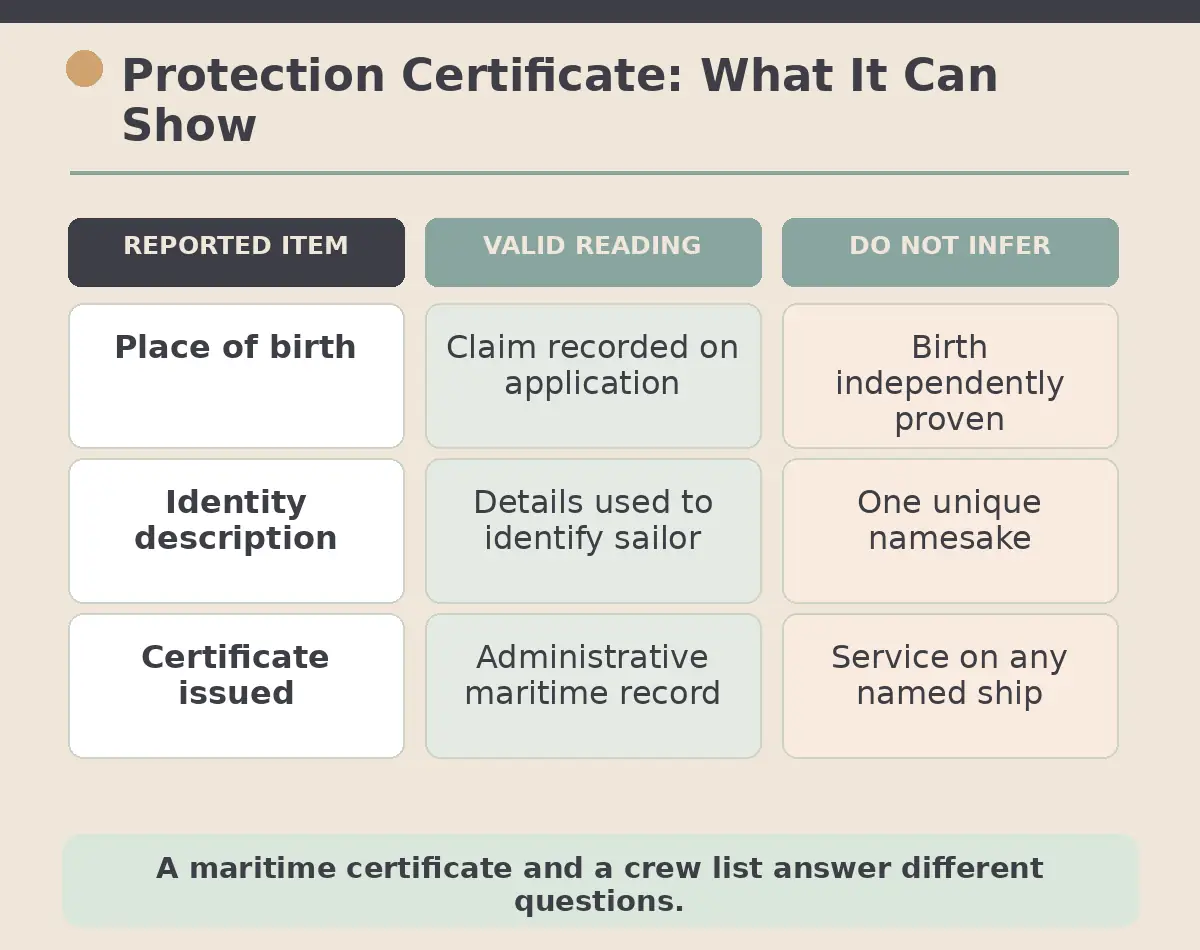
An original application may report a seaman’s name, age, birthplace and physical description, sometimes with corroborating testimony or documentation. A quarterly abstract created by a customs collector is a summarized report of issued certificates; a register or index may preserve still less. The certificate itself was normally given to the sailor, so comparatively few issued examples remain in federal archives. Create a source-type field before transcribing anything. Never copy a detail from one kind of record into an abstract that lacks it. A certificate number does not substitute for reading the evidence by which officials accepted or recorded the identity.

Use Philadelphia as an Example, Not the National Template
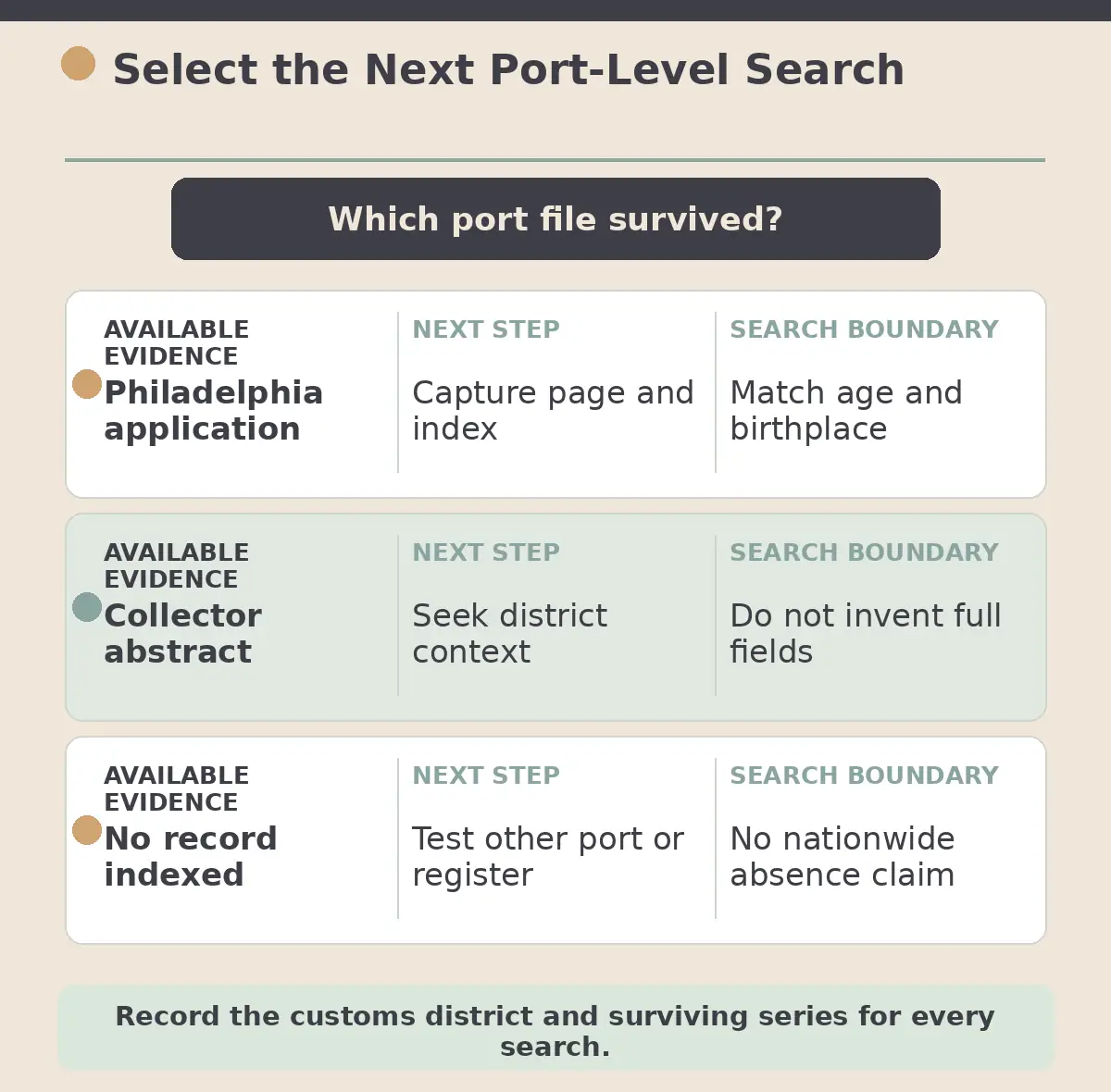
NARA describes Philadelphia as having unusually extensive and accessible applications. Early applications there were indexed on cards through 1823, and additional computerized indexing existed for selected years including 1814, 1824–1830, 1834, 1844 and 1854 in the historical finding aid. That does not make those years comprehensive for every United States port. For New York and various other locations, surviving abstracts and indexes may be the most accessible route. Record exactly which port, index period and record class a result came from. If a person traveled through several ports, investigate each appropriate customs district rather than assuming one continuous nationwide file.
Preserve Name, Birthplace and Physical Description Literally
When a substantive application survives, transcribe exact spelling, reported age, birthplace and features used by the official to describe the seaman. Compare them cautiously with later service or citizenship documents, because physical descriptions can be subjective, ages may be approximate and spellings change across clerks. Keep an image reference and any endorsement or witness statement. If a declaration indicates that an official accepted citizenship evidence, that establishes a recorded administrative process, not necessarily every detail of the applicant’s early life. The document’s creator, date and informant matter as much as the apparent name match.
Check National Archives Custody by Port and Period
NARA’s Boston holdings guide lists Bureau of Customs material containing crew lists and registers of protection certificates, and separate Bureau of Navigation material concerning certificates in the early twentieth century. The date span and completeness vary by customs district. Consult the regional holdings description and the broader NARA citizenship reference reports before requesting material. A collection description covering years of agency operation does not guarantee an application for every sailor or every port within those years. Note whether the document is in Washington or a regional NARA facility.
Do Not Confuse a Maritime Identity Document With a Crew List
A seamen’s protection record concerns an identity or nationality claim and its administration; a vessel crew list concerns persons recorded for a voyage or ship. The two may be compared, but they were made for different purposes. If a reported maritime ancestor has a ship name in family papers, look for independently held vessel registers, entry or clearance records and crew lists. A protection application without a ship connection should not become a fictional voyage itinerary. Conversely a crew-list listing alone does not prove that a particular seaman had a protection certificate. Maintain separate citations for both records.
Build a Namesake Test With Geography and Date
For two sailors of the same name, compare approximate ages, birthplaces, ports, occupations and residence clues. Enter each certificate application or abstract into a separate row, even when identical surname spellings occur. A seaman could submit more than one application or obtain replacements, so repeated records need not mean different people. Yet matching names alone are never a sufficient identity test. Compare independent ship records, census returns and local birth or naturalization documents where relevant. A discrepancy in birthplace could be a transcription problem or a genuinely different person; preserve both alternatives until another source resolves the difference.
Log Failed Searches at the Proper Document Level
A practical log has columns for customs district, year range, surviving application index, abstract series, register, name variants and retrieval outcome. Mark an index-only lead separately from an inspected original. If only an abstract survives, cite the abstract rather than claiming to have read the destroyed or unavailable application. A no-result in one Philadelphia index or a regional register cannot establish that no certificate was ever issued elsewhere. When ordering a search from a custodian, provide the name, port, plausible years, certificate number if known and exact series or roll identifier. Avoid requests premised on a nonexistent unified national database.
A Hypothetical Two-Sailor Comparison
Suppose a Philadelphia application lists a sailor named James Brown, age twenty-six and born in Maine, while a New York quarterly abstract gives the same name in a nearby year but no birthplace. It would be unsafe to merge the files. Record Philadelphia as an inspected application with detailed identity fields and New York as an abstract whose underlying application may not survive. Look for dated crew lists or port documents naming the sailor, then test the Maine birthplace with an independent civil source. If the second record still lacks distinguishing data, classify the identity relationship as unresolved instead of manufacturing a shared voyage or a single biography.
More Records and Archives Guides
How We Research Seamen’s Protection Records
We start with the port, then check NARA’s documented survival for applications, collector abstracts and registers. We transcribe only fields actually present in the source and separate the recorded citizenship assertion from independent identity evidence. A second search in crew lists and civil records tests whether the maritime record belongs to the proposed person, while an unsuccessful index search is confined to the port and years reviewed. See the GenHis affiliate disclosure; our workflow neither assumes commercial access is necessary nor implies an affiliation with the National Archives.
It was an official maritime identity or citizenship document intended in part to protect U.S. sailors from impressment.
No. Issued certificates were held by sailors and the surviving applications, abstracts and registers vary widely.
No. A ship’s crew list or other voyage evidence must be checked independently.
Customs districts kept differing records and indexes, with no single complete nationwide name source.
Compare birthplace, age, port and independently dated maritime or civil sources.