
Start with a Worker, a Place, and an Approximate Year
The Postal Museum preserves British Post Office personnel material, including the POST 58 class for nominations and appointments. Begin with a named ancestor and an approximate period when they joined, transferred or changed grade. The main appointment-book indexes begin in 1831, although earlier material exists in the larger class. Search by the administrative purpose of the record: who was nominated or appointed, when, and to what grade or workplace—not by expecting a modern consolidated human-resources file.
Collect a postal occupation from a census, marriage record, city directory, family letter or pension clue. Record the actual wording; a postmaster, sorter, messenger and sub-postmaster did not always have identical employment status. Also note where the person worked because two staff members with the same surname could be appointed in different towns. The first useful result is an index-to-record reference, not a confirmed start-to-finish career chronology.
Choose the Correct POST 58 Appointment Index
The Postal Museum’s family history research guide separates the 1831–1866 appointment-book search from the 1866–1969 appointment indexes. Researchers first establish the likely appointment years and then consult the surname range and appropriate microfilm or original finding number. For example, a date-and-letter segment can lead to a precise POST 58 piece rather than the entire class. Do not assume a single alphabetical file covers every appointment from the nineteenth century.
Write down the index span, surname range, reel or archival piece, and the spelling actually used. A later transfer or promotion may be separately indexed. When an online commercial transcription offers a result, its year span and included fields must be compared with the museum’s underlying collection description. Access through a subscription service is not the same thing as access to the complete primary archive. A precise POST 58 reference remains valuable even if the image is not immediately available.
Distinguish Nomination, Appointment, and Employment
POST 58 includes bound volumes recording vacancies, nominations and appointments as well as some related papers and bonds. The archive distinguishes established staff from non-established staff. Established employees had civil-service status and related benefits; others might be part-time and lacked those conditions. Sub-postmasters and packet captains could be subcontracted rather than serving as ordinary salaried employees. These administrative distinctions are essential before treating one entry as evidence of salary, tenure, or pension entitlement.
A nomination is a decision-stage fact, and a dated appointment is stronger evidence of an administrative change. Neither automatically proves the employee continued working for an assumed number of years. The archive also changed over time: centrally copied appointment records began in 1831, while earlier correspondence is less uniform. Identify which kind of notation appears on the particular page before writing a family narrative about a person’s postal career.

Follow Minute Numbers to POST 35 and POST 38
The museum guide places appointment indexes in POST 58 and associated Secretary-to-Postmaster-General minutes in POST 35 and POST 38. An index can show a minute number leading to a related decision. Transcribe that reference exactly, then consult the museum catalogue to learn whether the particular minute book is available online, on microfilm or through staff assistance. Do not report what the minute says until you have read it or received a documented extract.
The index and the minute may answer different questions. One records an administrative event in abbreviated form; the other may explain correspondence about a vacancy, promotion or decision. The absence of a minute reference is not evidence that no decision occurred. Keep a small two-column log: POST 58 observation on the left and the separately located POST 35/38 result on the right. This prevents later citations from collapsing into one untraceable assertion.
Read Name, Grade, Workplace, and Appointment Date Together
A useful POST 58 result often gives a name, grade, place of work and date of appointment. Capture all four fields, including spelling, abbreviation and any crossed-out correction. A grade may not have today’s meaning, and an office name may refer to a working location rather than the person’s residence. Use the museum’s glossary of abbreviations instead of expanding unclear letters by guesswork. An exact day attached to an appointment is an administrative date, not necessarily the first day on the job.
Consider a fictional example of two Thomas Evans entries: a clerk assigned to Liverpool and a rural messenger appointed in another county. A family census that identifies occupation and town may support one candidate while leaving the other unconnected. The identity match comes from combining time, workplace, and other records; it does not rest solely on the surname or a shared family tradition of “working for the Post Office.”
Use Establishment and Pension Sources as Separate Checks
The museum describes establishment books in POST 59, which can report staff by department, and some Treasury pension correspondence in POST 1. A promotion, long service or retirement claim may therefore require a separate source with different inclusion rules. It is unsafe to promise that every worker, particularly someone classed as non-established, will have a pension file. Find the relevant archive class from the worker’s status and period instead of requesting “all records” by surname.
Compare the earliest appointment date with independent directory or census appearances, then choose whether a later employment or pension record can address the open question. A later establishment list can support employment at a second date but does not fill every year between. If there is a disagreement, preserve it: individuals could move offices, switch grades or appear under initials. Record the reference for each item, not simply the website on which it was found.

Avoid Confusing Postmasters with Other Postal Roles
Historical British postal work included many jobs beyond postmen. A local postmaster might also operate a separate business, and subcontracted arrangements may be governed by different papers. The Postal Museum’s finding aids reflect this administrative variety, which can explain why an ancestor named as a sub-postmaster in a directory does not appear where a full-time sorting employee might. The right record depends on the exact employment relationship at the time.
Research the post office as an institution, not just the individual. Record the historical office name, its administrative level and the date a family source uses the title. If someone appears as “deputy” or “acting” postmaster, do not silently convert the role to a permanent appointment. A short note of uncertainty is more valuable than a neat but unsupported employment story. Different classes may have separate microfilm and permission procedures.
Cite the Archival Piece, Not Just the Online Name Hit
An adequate citation names The Postal Museum, POST class and piece, index years, entry name, page or folio when present, and how the copy was accessed. The museum’s guides illustrate the meaning of a reference such as POST 58/102. Preserve a linked minute reference as an additional citation, not as a substitute for the index entry. If a viewer gives its own image number, write that beside any page identifier printed in the volume.
Keep the scanned entry or a careful transcription with original abbreviations and a separate explanatory note. When a transcription and the image disagree, cite the image and document the discrepancy. Track unsearched letter sections so that a missed variant does not get reported as negative evidence. A no-result search in a single appointment period is not equivalent to a thorough review of the relevant museum holdings.
How We Research British Postal Appointments
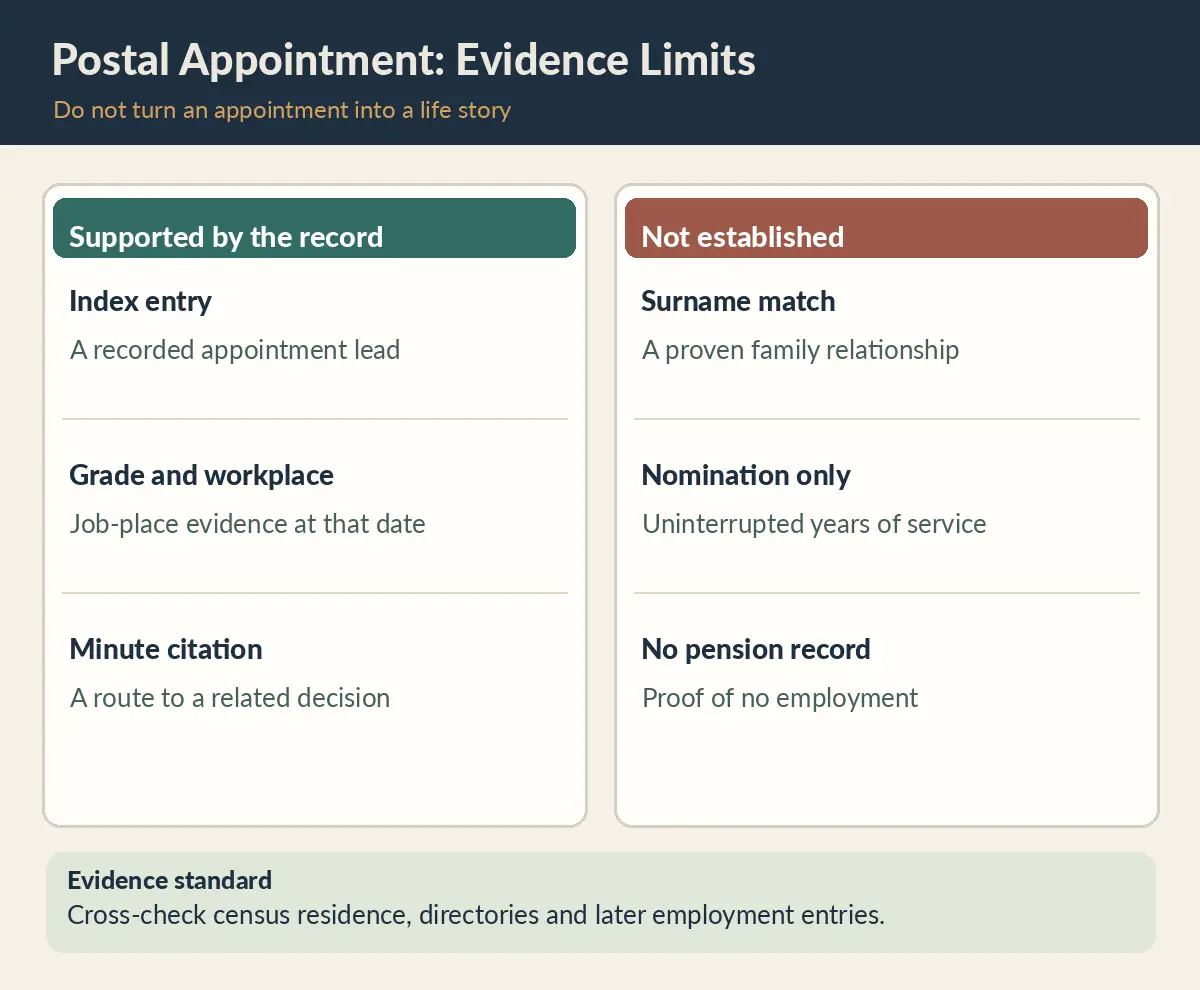
We first confirm the employee’s occupation and approximate date in an independent record, then use the museum’s archive search-room guide to choose the correct series and accessible format. We note whether the object is a POST 58 appointment index, a POST 35/38 minute, a POST 59 establishment volume or a POST 1 Treasury correspondence item. The source class defines what the entry can reasonably prove.
We then compare name, job grade and workplace across time and check a second independent record for identity. We do not infer unbroken employment, civil-service benefits or pension qualification from one appointment. We preserve alternate-name candidates and missing or unavailable minute references. A reliable answer makes it possible for another reader to request exactly the same piece and understand why its evidence supports only the stated conclusion.
For editorial transparency, see our affiliate disclosure; this independent archival workflow does not depend on an affiliate purchase or an invented access arrangement.
More Records and Archives Guides
Access, Rights, and Practical Follow-Up
The Postal Museum maintains a catalogue and research-room guidance; some pieces are available on microfilm and others require repository assistance. Use the current booking, copying and permission information, because a third-party online name search does not replace access rules for originals. The AIM25 series description adds contextual information about the scope of POST 58, but is not a substitute for an individual appointment page.
A focused next step is to establish one further date in the worker’s life: a later employment entry, household census, trade directory, retirement reference or burial record. If these contradict the original candidate, reopen the identity question rather than using the postal record to overwrite other evidence. This method builds a sourced career outline while leaving unexplained periods honestly unfilled.
No. It chiefly records nominations and appointments, with some related material; other classes may hold separate context.
A name, grade, workplace and appointment date, sometimes with a minute reference.
The museum identifies appointment-related minutes in POST 35 and POST 38.
No. Some were subcontractors, so employment and benefits must be evaluated by the period and role.
No. Compare date, occupation and place with census and other independent evidence.