
Western Australia’s digitized post office directories can locate an ancestor by town, street, surname or trade between 1893 and 1949. Choose the printed edition and appropriate internal section, then read the scanned page. A listing shows published contact information; it neither establishes ownership nor guarantees actual residence throughout the edition year.
Pick an edition, then choose how you know the person
The State Library of Western Australia provides digitized post office directories spanning 1893 to 1949. They can reveal a historical street, locality, occupation or business connection, but the site does not offer one dependable full-text name search across every scanned volume. The quickest method is to choose a year and then the correct internal section for the clue you have. Our guide to Sands Sydney Directories, 1858–1933 goes into more detail.
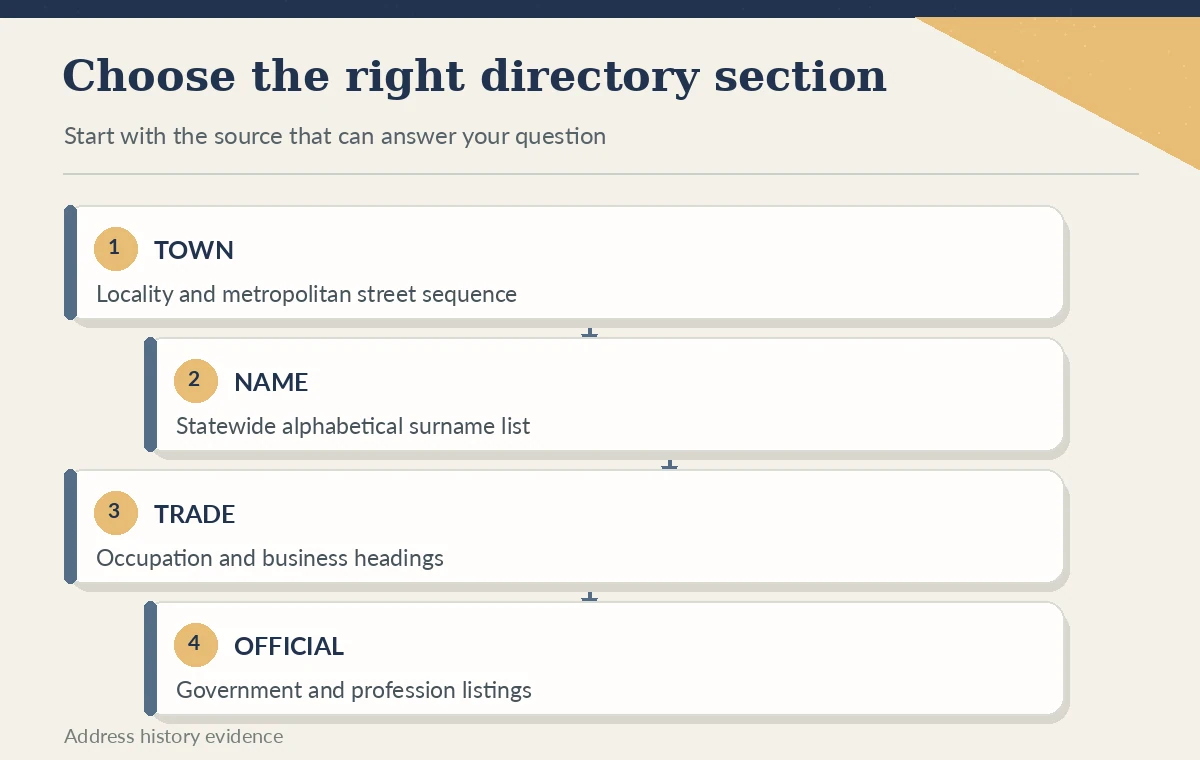
If you know the town but not the surname spelling, browse the locality list. If you have a surname and no location, use the alphabetic statewide section where present. If you know an occupation, turn to the trade sequence; for public officials or professional workers, consult the relevant classified lists. Transcribe the publication year exactly, as a single bound volume may carry a two-year title such as 1893–1894.
Understand the four commonly used directory sections
The State Library’s detailed Dead Reckoning guide explains that directories from 1896 commonly divide into four main sequences: town and metropolitan street addresses; surnames arranged across the state; trade and business listings; and selected professional or official directories. A named business may appear in more than one sequence, but not necessarily with identical wording or an identical address. Treat each appearance as a separate print statement. For a related choice, see our guide “Historical U.S. Telephone Directories”.
A street section is often best for determining who is listed next door, while an alphabetical surname entry can direct you to an unfamiliar district. Trades help locate a person whose surname was printed under a firm or partnership. Different editions can change editorial arrangements. Inspect the table of contents every time, rather than applying page numbers remembered from another year.
Browse original pages rather than trusting a search snippet
Open the library’s directory landing page and choose the decade and named edition. The 1893–1894 edition, for example, has a detailed online contents table directing readers to Perth and Fremantle street and alphabetical lists, trade pages, provincial towns and government sections. Use that structure as a model for page navigation, but do not assume the same layout persists into the 1920s.
Keep a note containing exact year as printed, section title, page, spelling, address, trade and any cross-reference. If a page image is damaged or a scanned page is missing, state that condition instead of producing a negative conclusion. A text transcription made from a fuzzy image should mark doubtful letters rather than silently modernizing a street name.
Use adjacent editions to date a move cautiously
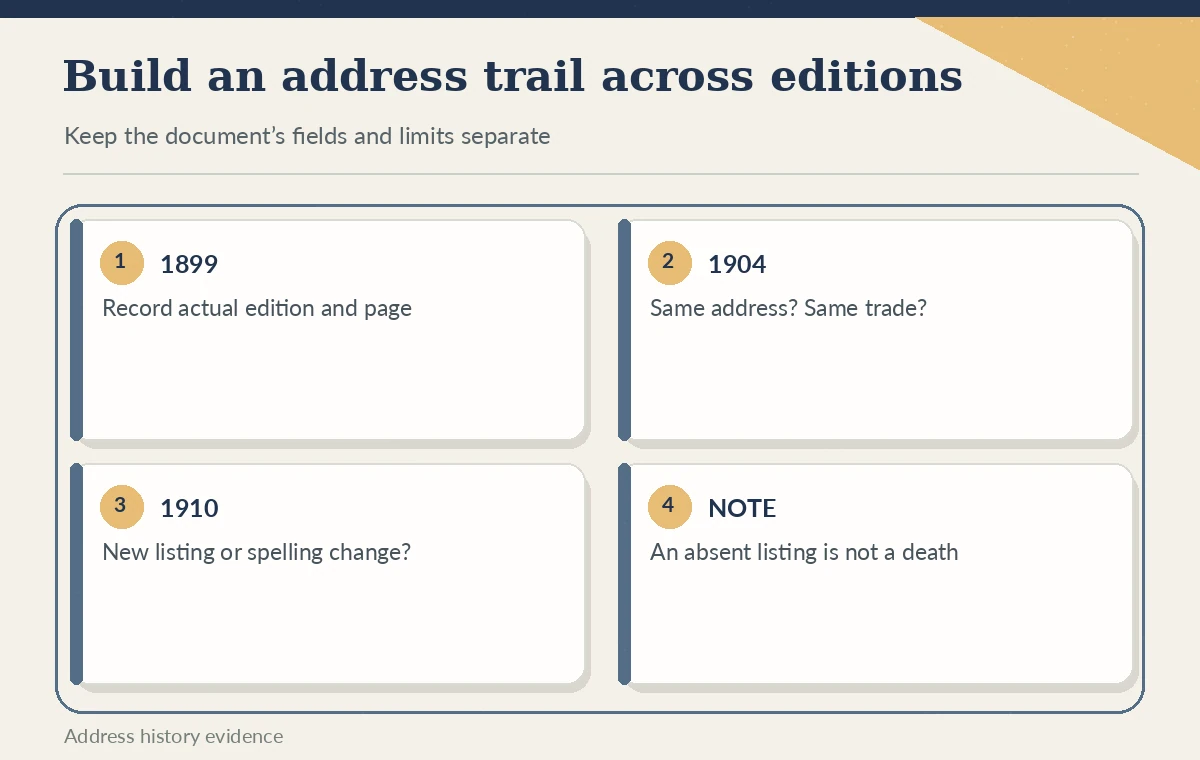
A practical family-history question is when someone began or ceased to be listed at an address. Build a year-by-year worksheet with separate fields for edition date, printed address and independent evidence of residence. For example, if a fictional Elizabeth Morgan appears on a Perth street in 1912 and in Fremantle in 1915, this suggests a possible move between listing cycles, not a proven moving date.
The State Library warns that directory entries could persist for years after a person departed or died. The detailed guide also identifies 1948 as a missing directory year. Neither a vanished name nor the 1948 gap provides evidence of a death or departure. Use an electoral roll, rate record, death certificate or contemporary advertisement to narrow a change; do not treat changes in typesetting as life events.
Distinguish householders, boarders, businesses and property owners
Printed directories heavily favor household heads and the people or firms the compilers could identify. Some residents, especially boarders, household members without a separate listing and people outside the surveyed reach, may not appear. The statewide surname sequence may name an occupation, but it still does not establish that a person practiced the trade continuously through the full year. A business advertisement can be older than the surrounding listing.
Crucially, a postal or street entry does not prove legal ownership. If a property claim matters, find the relevant land title, deed or rate-book evidence and check which document identifies an owner, ratepayer or occupier. A street name change or subdivision can also create the illusion of migration. Compare period maps or council records before assuming identical modern addresses represent the same parcel.
| Evidence checkpoint | Record the observation | Do not infer |
|---|---|---|
| A name was printed at an address | Identity without a second source | |
| DOUBT | Edition may lag real residence | A precise date not given by the record |
| TEST | Electoral roll, rate book or deed | An undocumented relationship or event |
| RESULT | Occupant and owner are separate | Certainty beyond surviving evidence |
Compare the four-way record before assigning identity
When a common surname appears more than once, use a four-way comparison: edition and date, street or town, occupation or business, and an independent person-level record. Preserve candidates in separate rows. An occupational clue plus a nearby street may increase confidence, but it does not link two printed entries as the same person by itself.
Imagine a fictional John Parker listed as a grocer in Albany and a John Parker shown as a clerk in Perth. Even in the same year, the directory does not tell you if the name belongs to one mobile worker or two different men. Check age, family members, an official employment record and the printed context of both entries. Report an unresolved same-name case when the other sources do not distinguish them.

Preserve page citations and the print-date caveat
A helpful citation names the publisher or directory title, printed year or year range, section, town or alphabet range, page, State Library of Western Australia and the scanned page URL or locator. Record whether the page was legible. If your conclusion refers to an address change, provide both edition citations and a dated independent confirmation when available.
The resulting family-history statement should be modest: a directory printed a particular name and address in a given edition. That is often an excellent lead to electoral, land, cemetery and newspaper records; it is not direct proof of relationship, ownership, exact residence dates or a final migration destination. A similar decision comes up in our guide “1893 New Zealand Suffrage Petition”, which explains how to find a signer and verify the sheet.
How We Research WA Post Office Directories
For this guide we examined the current official repository descriptions and related research guidance listed below. We separated catalog coverage from image-level evidence and used deliberately fictional examples for matching exercises. Search interfaces, restrictions and individual item survival can change; check the repository before requesting records. The method tests only the types of claims these documented sources can support, and it does not assert that any fictional person or sample transaction is an actual archival entry.
More Records and Archives Guides
Archive Catalogs and Primary-Source Finding Aids for WA Post Office Directories
State Library of WA: digitized 1893–1949 directories and navigation by year (slwa.wa.gov.au).
State Library of WA: four post-1896 sections, absent 1948 edition, pitfalls of stale entries and omitted people (slwa.wa.gov.au).
State Library of WA: original 1893–94 edition contents demonstrate page-by-page section navigation (slwa.wa.gov.au).
Editorial disclosure: This article contains no paid recommendation or approved affiliate placement. The site-wide policy is available at GenHis affiliate disclosure. Historical records may include inaccurate or discriminatory wording; reproduce it only as needed for a sourced analysis and avoid identifying or speculating about living people.
The State Library of Western Australia provides online directories spanning 1893–1949, with a known missing 1948 edition in its detailed guide.
Not reliably. The State Library notes that the digitized pages are navigated through directory contents, not a universal full-text name search.
No. A directory listing is evidence of published occupancy or contact information, not legal title.
Directories omit many people, especially boarders and non-heads of households, and some editions retain stale entries.
Start with the known town or street, surname alphabet, business trade or government-professional section; compare the original page and edition title.