
Start with the New Zealand South African War nominal rolls in AJHR H-6 for 1900–1902, then check any surviving named personnel file. The archives warn that the files are incomplete; a roll listing supports a specific service claim but does not provide an automatic full biography.
Identify the contingent before searching for a complete file
For a New Zealand ancestor who served in the South African War of 1899–1902, start with the published contingent nominal rolls, then look for a surviving individual personnel file. Archives New Zealand explains that its surviving records are uneven and incomplete. It points to the Appendices to the Journals of the House of Representatives, commonly abbreviated AJHR, especially the H-6 nominal rolls for 1900–1902. These are better starting anchors than assuming every volunteer has a complete digitized career file.
Collect any family evidence of the person’s full name, initials, rank, unit, uniform photograph or approximate enlistment. Keep the person’s civilian residence and the alleged service as separate hypotheses until a military source joins them. A photograph showing a uniform or a family story about Africa can generate a useful search lead; neither alone identifies a particular New Zealand contingent or proves military service.
Search AJHR H-6 by unit, rank and name
The Archives New Zealand guide says the nominal rolls in AJHR H-6 are organized by contingent and rank, with names alphabetical within rank. That arrangement matters when a broad surname search finds no result. First establish the likely contingent or year and browse the relevant publication section. Transcribe the person’s name exactly, along with any reported rank, unit and source page. If the name is abbreviated, do not expand initials silently. Our guide “New Zealand Register of Aliens, 1917” goes into more detail.
A separate casualty roll also appears in the AJHR material. Its function is narrower than a service dossier; it may identify a casualty without providing a full biography. Keep the nominal-roll listing, casualty reference and any medal roll as three citations, even when they agree. These different records were produced for different administrative purposes and can contain different dates or spelling choices.

Find digitized personnel papers without assuming full survival
Archives New Zealand states that individual South African War personnel files are searchable by soldier’s name in its Collections search and may be digitized. The New Zealand Defence Force likewise directs researchers to Archives NZ for most South Africa War and other pre-1920 service records, while advising that some originals or hard-to-locate files can remain with NZDF. Search using full name, initials and any service identifier from the nominal roll. Our guide “New Zealand WWI Personnel Files” adds more detail on this.
If a file is located, inspect its entire page sequence, including coverings, forms, endorsements and later notes. Identify which event each page records—appointment, health assessment, discharge, pay or correspondence—rather than treating the file as a uniform biography. The official guide warns that surviving files are erratic and incomplete. A missing embarkation page in one individual’s file is not evidence that the person did not sail if a more direct roll documents the voyage.

Compare rank, number and contingent to defeat namesakes
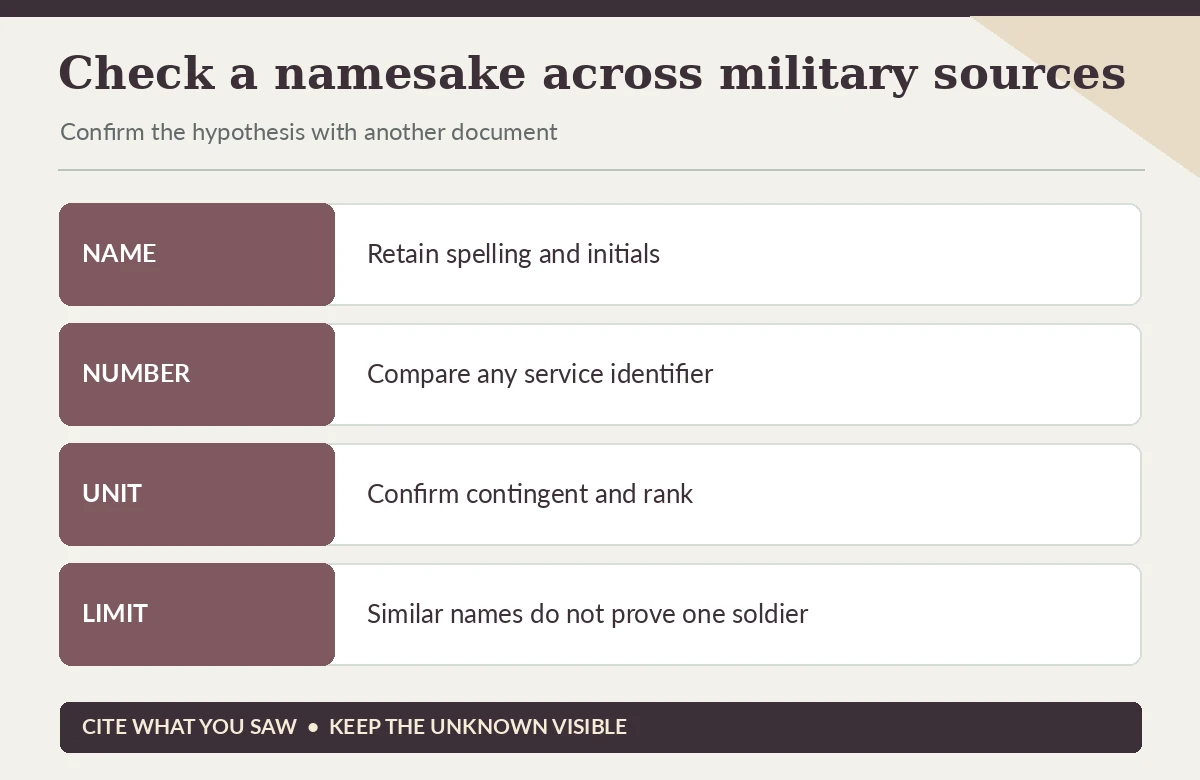
Make a four-point matching table: exact name or initials, contingent, rank and service number if one is documented. Add a civilian anchor such as birth year, residence or named relative only if the military document actually supplies it. Common names may recur across several contingents; a name match by itself is too weak to merge two men. Distinguish consecutive enlistments of one person from distinct volunteers with similar names.
For a fictional Thomas Clarke, the nominal roll lists a trooper in one contingent while a later personnel file has a similar name but a different rank and number. Do not combine them because a relative remembered only “Tom served in South Africa.” Look for contemporaneous residence, unit and service details, then decide whether the apparent discrepancy has a documented explanation. Leave the relationship unresolved if the records do not bridge the identity.
Use casualties and medals for narrower evidence questions
The official guide identifies AJHR casualty rolls and Archives NZ material within Army Department series AAYS 8663, including casualty and repatriation records; medal and award rolls are held separately. Ask one question of each: was a named casualty reported, was the person included in a contingent list, or was a medal recorded? A medal entitlement does not necessarily prove every journey reported in a family history, and a casualty list does not show the details of later civilian life.
If a military family story claims someone died on campaign, verify the recorded death against a dated casualty list and a separate death or burial source rather than relying on an online tree. If the story instead says a soldier returned, search repatriation or later civilian records before concluding what happened after service. The same person can be recorded under different forms of a name in military and domestic registers.
| Document checkpoint | What to record | What not to infer |
|---|---|---|
| NAME | Retain spelling and initials | Unstated family relationships or events |
| NUMBER | Compare any service identifier | Unstated family relationships or events |
| UNIT | Confirm contingent and rank | Unstated family relationships or events |
| LIMIT | Similar names do not prove one soldier | Unstated family relationships or events |
Understand record gaps and the war’s historical context
Archives New Zealand calls the South African War the first overseas war involving New Zealand and describes ten contingents of mounted troops. It notes the uneven survival of records and points researchers to publications when army files are lacking. Such gaps are not a defect to hide in a family-history article. State precisely which contingent, roll and archival series you searched, and which types of documents may not survive.
The war took place in a colonial setting with consequences for communities in southern Africa. Genealogists should distinguish an ancestor’s documented service from claims about individual actions, political beliefs or participation in a specific incident. A soldier’s name in a nominal roll does not establish an individual’s involvement in every action of the unit. The evidence is strongest when the specific service claim is attached to a dated primary document.
Document findings and choose the next identity check
A reproducible citation gives the full AJHR year, H-6 section, contingent, rank, page and entry for a nominal-roll result. For an archival file, record Archives New Zealand as custodian, its series or item identifier, individual name, page or folio and access date. Cite a casualty or medal list separately. If you consulted only a catalog entry, label it an index-level finding rather than claiming that its original pages have been inspected.
A strong conclusion might establish that a named volunteer appears in a specific contingent’s published roll and that a surviving file supports a particular event, while leaving other career details unknown. The next move should resolve a concrete uncertainty: compare a civil birth record, enlistment signature or separate address with the military entry. This is more defensible than inventing a complete war story from one surname result.
How We Research These New Zealand Military Sources
This guide is based on the official archival catalogues and public research guidance cited below, examined on October 22, 2026. The procedure distinguishes a series-level description from an original record and an administrative event from a family-history inference. Illustrative names and scenarios are fictional, not transcriptions of historical files. Item survival, reading-room access, online search and fees can change; check the original repository before requesting records. Uncertain details remain open rather than being filled in from an unsourced family tree.
More Records and Archives Guides
Primary Archive Descriptions and Finding Aids for the South African War
Archives New Zealand: Anglo-Boer War 1899–1902, AJHR H-6 nominal rolls, incomplete Wellington records and AAYS 8663 series (www.archives.govt.nz).
Archives New Zealand overview: research war records by series and personnel, with catalog guidance and access caveats (www.archives.govt.nz).
New Zealand Defence Force guidance: South African War and pre-1920 service files often digitized via Archives NZ, additional records may remain with NZDF (www.nzdf.mil.nz).
Editorial disclosure: There is no paid recommendation or approved affiliate placement in this guide. See the GenHis affiliate disclosure. Historical records may contain discriminatory language, personal allegations or imprecise identifications; attribute those statements to their source and avoid exposing information about living people.
Begin with Archives New Zealand’s war guide and the AJHR H-6 nominal rolls for 1900–1902, then search surviving named personnel files.
No. Archives New Zealand describes its South African War holdings as erratic and incomplete, so an empty file search does not prove non-service.
The official guide describes rolls arranged by contingent and rank, with names alphabetical within rank.
No. A medal or casualty record supports the specific entitlement or reported event, not every movement or service detail.
Test spelling and initials, contingent, rank or number; check the nominal roll before concluding a personnel file ought to survive.