
Find the surviving NSW district constables’ notebooks by year and historical locality, then examine NRS 1263 in its original house-by-house or limited alphabetical sequence. The notebooks can locate named residents before the 1828 census, but residence and reported convict status do not automatically establish family ties.
Begin with a small surviving set, not an imagined complete census
The quickest route is to determine whether a notebook survives for the ancestor’s place and year. Museums of History NSW lists District Constables’ Notebooks under NRS 1263 for 1822–1824. These were working records prepared in advance of colonial population musters; their survival is fragmentary. They can be especially useful when a later census did not name every child or when a Sydney street is known from another document. Treat them as dated observations, not as an every-household census.
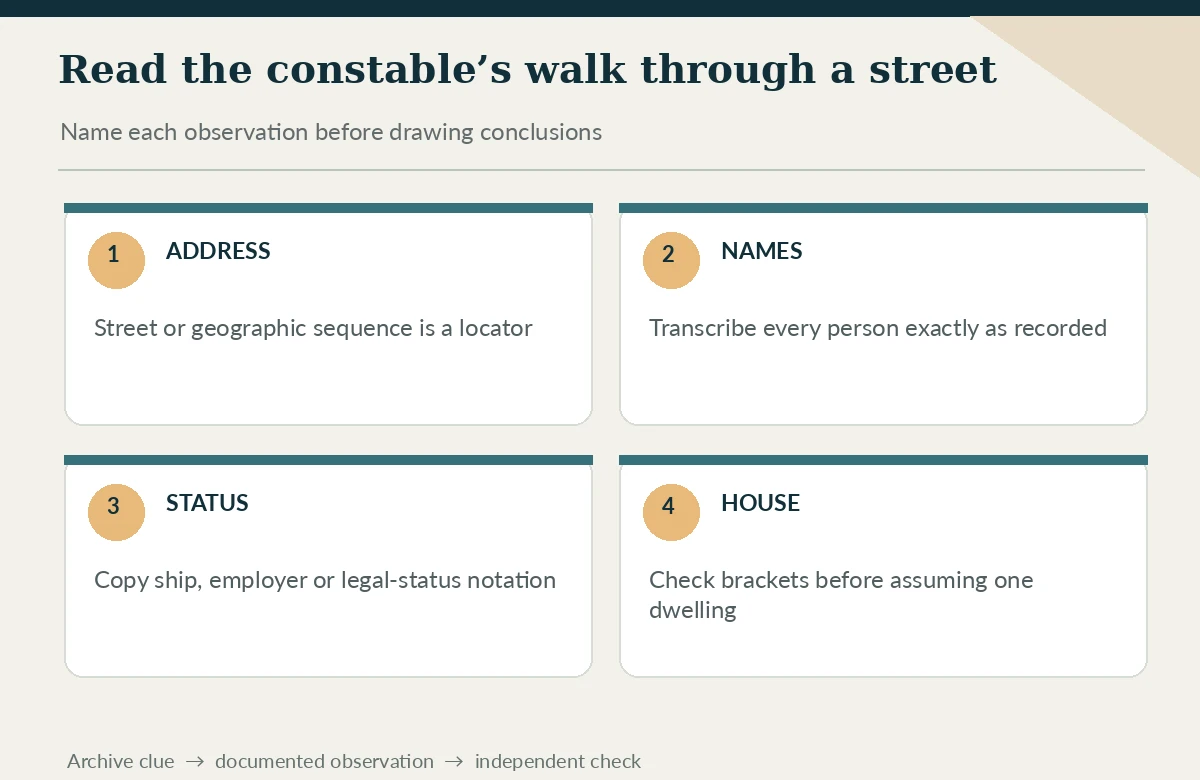
Start with a town, parish, street, or employment clue dated close to 1822. Distinguish present-day suburbs from the geographic labels used by the constable. A Sydney resident might be indexed under a city street, its vicinity, or a separate local area. Make a small place list and identify whether a manuscript entry, catalog description, or printed transcript is in front of you. An online surname result alone is not proof that the notebook includes your person.
Route Sydney and Parramatta searches to the right volumes
The archive describes Sydney books from 1822 and one from 1823, including entries for the George Street Male Orphan Institution and areas such as Lane Cove, Kissing Point and North Shore. Its guide places these items in manuscript references [4/1218] and [4/1219], with Reel 1254 for the microfilm. Sydney notebooks generally follow the constable’s physical route, with street or locality headings. Browsing the relevant sequence is often more reliable than waiting for a name-index hit.
The Parramatta 1824 volume is not an equivalent street-by-street series. The surviving listed portion covers surnames beginning O through S and is arranged alphabetically by initial; the archive identifies [4/1220.2]. A separate Baulkham Hills item for 1822 appears as [4/1220.1]. This uneven survival has a direct consequence: failure to find a surname outside O–S in the 1824 book is a coverage issue, not evidence that the family had moved away from Parramatta.

Transcribe the notebook’s original sequence and qualifiers
Once the right volume is located, record its title, year, page, locality heading and exact spellings. Some notebooks contain a street-and-house progression; the older concise series guide says names can be bracketed when people are associated with one dwelling. Brackets and neighboring entries are archival clues. They do not independently establish that everyone is a spouse, child, lodger or servant. Preserve that distinction in the research log instead of forcing a family-tree relationship onto every entry.
Fields may include children’s ages, whether a person arrived free or was born in the colony, legal-status abbreviations, ship or master, sentence and employer. The precise fields vary, and the archive notes an exception for the surviving 1824 Parramatta portion. Copy the wording before expanding initials or abbreviations. A reported employer or convict designation is useful for candidate matching; it still has to be reconciled against a separate convict administration or muster record for the same individual.
Decode status without confusing it with later freedom
Common muster abbreviations include B.C. for born in the colony, C.F. for came free, F.S. for free by servitude, A.P. for absolute pardon, C.P. for conditional pardon and T.L. for ticket of leave. These are interpretations of the field in a particular administrative document. Do not silently change a recorded T.L. into an absolute pardon or use a status word to infer the specific date of a legal decision. If the manuscript lettering is ambiguous, keep both the transcription and its uncertain reading.
For someone who may have arrived on a convict ship, compare ship name, approximate arrival period, sentence, age and occupation with a contemporaneous muster or an original convict record. Ships often carried people with similar names; a ship agreement alone is not a unique identity key. When entries conflict, create separate candidate profiles with the page citations attached, rather than selecting the version that best fits an existing tree.
Build a household identity table with independent evidence
Create one row per named person or dwelling group and columns for notebook year, exact spelling, location, reported status, ship, employer, nearby names and citation. In a separate verification column place a later baptism, an earlier muster, a colonial letter or a property reference. The table should keep household association and biological kinship as two different claims. No entry should be called a parent merely because it follows a child on the same page. Our guide “NSW Settlers’ Muster Book of 1800” shows how to read land, stock, and family clues.
For example, a fictional Mary Collins is recorded near a George Collins in a Sydney notebook. A separate parish baptism names Mary Collins as a mother, but its place and date are only approximately compatible with the constable’s entry. That is a candidate connection, not a proven parent-child or marital relationship. Check a second record with shared location, age, occupation or an explicitly stated relationship. If two Mary Collins candidates remain, the table should preserve both.
| Document checkpoint | What to record | What not to infer |
|---|---|---|
| MATCH | Compare reported ship and date | Unstated family relationships or events |
| AGE | Cross-check children and years of birth | Unstated family relationships or events |
| MUSTER | Look for the linked population record | Unstated family relationships or events |
| LIMIT | Shared residence is not proof of kinship | Unstated family relationships or events |
Recover from a no-result search without overstating it
If no name appears, first ask what has survived. Is the search within the Sydney 1822–1823 books, Baulkham Hills 1822, or the partial Parramatta 1824 volume? Have you browsed the geographically appropriate entries? Could a person be named by initials, an alternative spelling or under an employer? Record each actual volume checked. “Not found in the surviving O–S portion” is a precise result; “not present in NSW” is not.
Next search the colonial population musters, magistrates’ population books, convict records, church registers or a dated government correspondence file. The Museums of History NSW Census & Musters guide distinguishes these separate series and their dates. If an alternative record belongs to 1828, label the six-year gap explicitly. A later address cannot by itself reconstruct a missing 1822 street entry. Keep the possibility of relocation or incomplete coverage open.

Cite the notebook and the exact claim it supports
An actionable source citation includes the repository, NRS 1263, notebook locality and date, manuscript identifier, page or folio, access format and the date you inspected it. If using a derivative transcription, cite that separately from the manuscript page when you later see it. Copy the relevant line into a source extract; store any uncertain expansions in brackets so another researcher can distinguish the original from your notes.
The useful conclusion is narrow: a constable recorded a named individual, status or household association at a specified place during the survey. The evidence can lead to an employer, transport or neighborhood question. It cannot automatically resolve parentage or an ancestor’s lifetime address history. End the search session by naming the independent record most likely to confirm the particular family claim.
How We Research These Colonial Population Notes
This guide is based on the official archival catalogues and public research guidance cited below, examined on October 22, 2026. The procedure distinguishes a series-level description from an original record and an administrative event from a family-history inference. Illustrative names and scenarios are fictional, not transcriptions of historical files. Item survival, reading-room access, online search and fees can change; check the original repository before requesting records. Uncertain details remain open rather than being filled in from an unsourced family tree.
More Records and Archives Guides
Primary Archive Descriptions and Finding Aids for NRS 1263
Museums of History NSW: NRS 1263, locations, dates, reel 1254, incomplete 1824 Parramatta O–S survival and typical notebook fields (mhnsw.au).
Historical concise archive guide: house-by-house notebooks, Sydney volumes and record numbers; brackets may indicate shared dwelling (concise.mhnsw.au).
Museums of History NSW family history guide provides related census, muster and household record routes (mhnsw.au).
Editorial disclosure: There is no paid recommendation or approved affiliate placement in this guide. See the GenHis affiliate disclosure. Historical records may contain discriminatory language, personal allegations or imprecise identifications; attribute those statements to their source and avoid exposing information about living people.
No. NRS 1263 is a small surviving selection of district constables’ pre-muster notebooks, not a statewide complete enumeration.
The official guide describes several 1822 Sydney books and a 1823 Sydney notebook, together with nearby localities such as Lane Cove, Kissing Point and North Shore.
The listed Parramatta 1824 book survives only for surnames O–S and is arranged alphabetically rather than in the usual street sequence.
No. Bracketing may indicate a shared dwelling, but residence and kinship need independent evidence.
Cite NRS 1263, the original notebook or volume, locality, year, folio or page, reel where applicable and repository.