
Use Tasmanian district registers to check a specific birth, death or registry-office marriage against the central historical registration—not to count two copies as two events. Libraries Tasmania identifies surviving district registers as partial duplicate books kept by local registrars. Returns were sent to the central registry in Hobart, but only some district books entered archival custody. The official district-register inventory gives the record series and coverage dates. This guide makes those identifiers actionable, including what to do when a duplicate appears to disagree with the central record.
Identify the District and the Record Class Before Searching
First locate the event by its historical district, not merely a modern local-government label. Record a person’s exact reported residence, likely date and alternative spellings in a search log. Tasmania began official civil registration in the late 1830s; for earlier events, surviving church registers may be a better first source. A child’s baptism is not necessarily a registration of birth, and a burial date is not necessarily a date of death. District registers were duplicate administrative books, so establish the type of event before choosing a series. Libraries Tasmania explains that the local registers are incomplete and useful principally for cross-checking events already located through the central registry. An empty local book is not proof that the event never happened in Tasmania. Write down the district, record type and precise period you are testing rather than running a broad surname query and assuming its results are exhaustive.

Route Bothwell and Sorell Entries to Their RGD Series
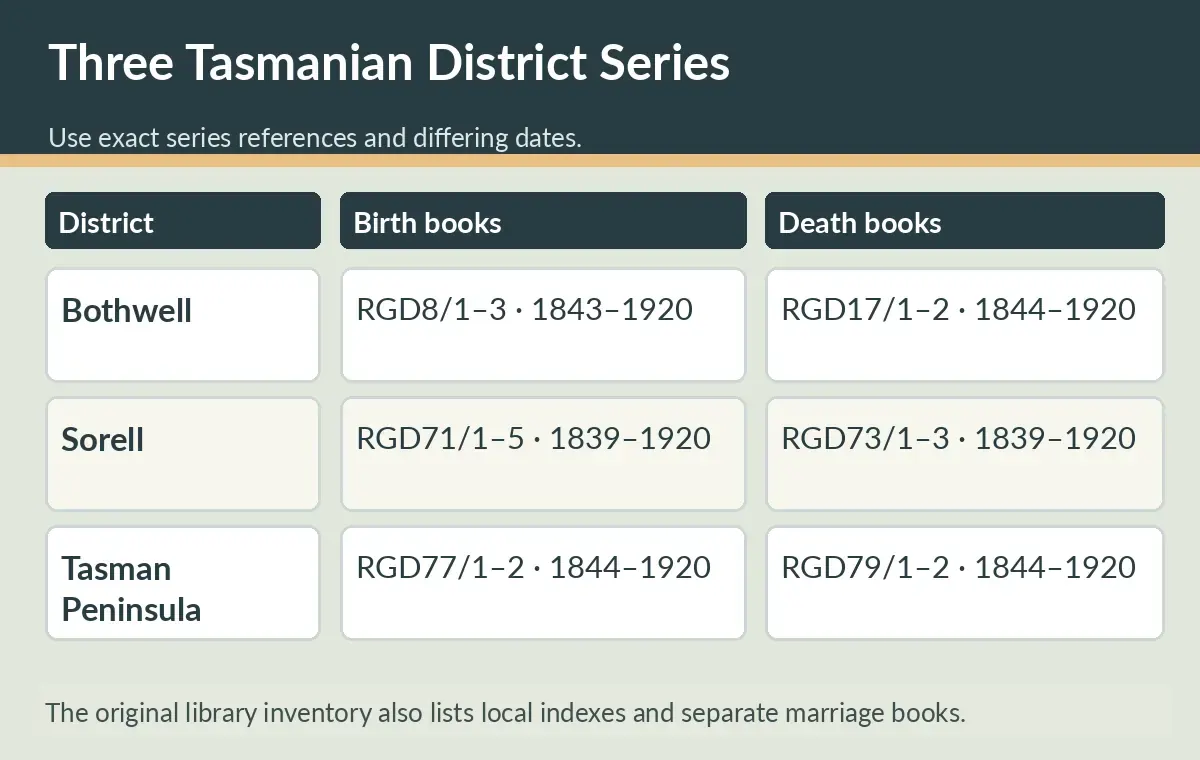
The official inventory specifies a Bothwell birth index for 1844–1920 as RGD101/1, birth registers for 1843–1920 as RGD8/1–3, deaths for 1844–1920 as RGD17/1–2, and registry marriages for 1844–1874 as RGD16/1. Sorell has a separate birth index RGD72/1 covering 1842–1920 and birth registers RGD71/1–5 beginning in 1839. Its deaths are in RGD73/1–3, 1839–1920, with an index in RGD74/1. Do not transfer the Bothwell RGD number into a Sorell citation. Search the central Names Index for an event and then check whether its locality and date fall within the matching district series. Copy a page image identifier, archival item, registration number and spelling exactly; a series range identifies holdings, not an automatically verified person.
Recognize the Special Limits of the Tasman Peninsula Books
The Tasman Peninsula district has a birth index RGD78/1 and birth registers RGD77/1–2, both listed for 1844–1920. The death index RGD80/1 begins in 1843, while death registers RGD79/1–2 begin in 1844 and extend to 1920. Its marriage registers RGD81/1–2 cover 1843–1895 with gaps, and its notices of intention to marry are RGD82/1 for 1881–1898. These date distinctions matter: an index’s earlier start does not magically create a missing register page. Nor should a notice of intention be cited as proof that a ceremony occurred. The district-register inventory explicitly says local marriage books include only marriages performed in marriage registry offices. For a church wedding, a missing local duplicate may be entirely expected; inspect the relevant church record or central registration instead.
Compare Central and Local Copies Without Duplicating a Life Event
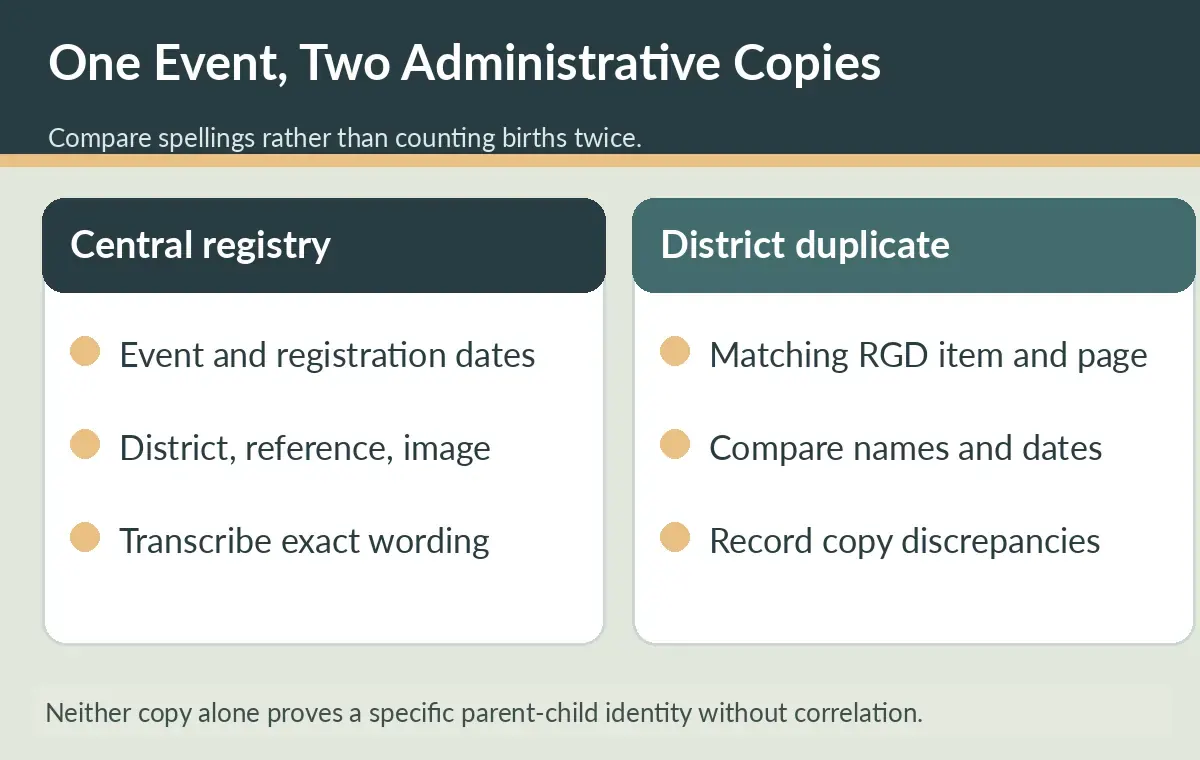
The Libraries Tasmania online holdings guide lists central birth registers under RGD33, death registers under RGD35, and historical marriage series RGD36 and RGD37. Begin with a candidate central entry, recording event date, registration date, district, parties, witnesses or informant when visible, and exactly which image was viewed. Then find the corresponding local copy if the district survived. A disagreement might reflect a copying or transcription error, a later correction, or two genuinely different people. Set the two transcriptions side by side rather than silently replacing one date. Keep the original spellings in separate columns and mark text that is unreadable. A duplicate entry confirms a recorded administrative event only to the extent its field and provenance justify it; it does not supply an additional independent witness to parentage.
Handle Missing Volumes and Competing Namesakes
Suppose two fictional people named Mary Brown appear in a broad Tasmanian index during adjacent years. One is connected to Bothwell in a family letter; the other to a different district in a later directory. Make two candidate rows, not a merged profile. Compare recorded parents, spouse, profession, informant, residence, registration district and sequence of events from independently dated sources. If the Bothwell duplicate is unreadable or missing for a particular year, explain exactly which RGD book and date range were checked and seek the central record. An absence from a duplicate ledger cannot be converted into evidence that Mary was absent from the region or that her parents were someone else. Distinguish the event’s actual date from the date on which a registrar copied the return. That distinction can explain a few days’ difference without inventing a second birth or death.
Save Complete Archival Citations and Choose the Next Source
For each image save the custodian, series, volume or item number, page or folio, individual entry number, date and stable catalog URL where possible. Label the source as ‘local district duplicate’ or ‘central register’; a citation that says only ‘Tasmania BDM’ hides the comparison that makes this search useful. The Tasmanian Registry explains that early certificates and church records vary considerably in their fields, so never import assumed parents or exact birth dates from a sparse index. If your question is about a marriage outside a registry office, pivot to the church register and supporting newspaper announcement rather than demanding a missing duplicate. When a mismatch remains, state it with both references and a concrete next record to obtain. For transparency, see our affiliate disclosure; these government archive references are not partnership claims.
More Records and Archives Guides
How We Research This Collection
We compared the official district-register inventory with Libraries Tasmania’s central-series list and the Tasmanian Registry’s descriptions of registration and certificates. The example names are fictional. We did not claim to inspect a particular ancestor’s original entry or invent complete district coverage. Our proposed crosswalk preserves competing copies as linked, separately cited sources.
No. District books are incomplete local duplicate records; compare the event and identifiers rather than treating the copies as separate life events.
The inventory lists an index RGD101/1 (1844–1920) and birth registers RGD8/1–3 (1843–1920).
No. Those books contain registry-office marriages, have gaps, and are not a comprehensive church-marriage series.
Libraries Tasmania says surviving district registers in its listed holdings have been digitized. Check the precise archive item and image.
Give separate central and district citations with series and item, transcribe each exactly, and record the unresolved conflict.