
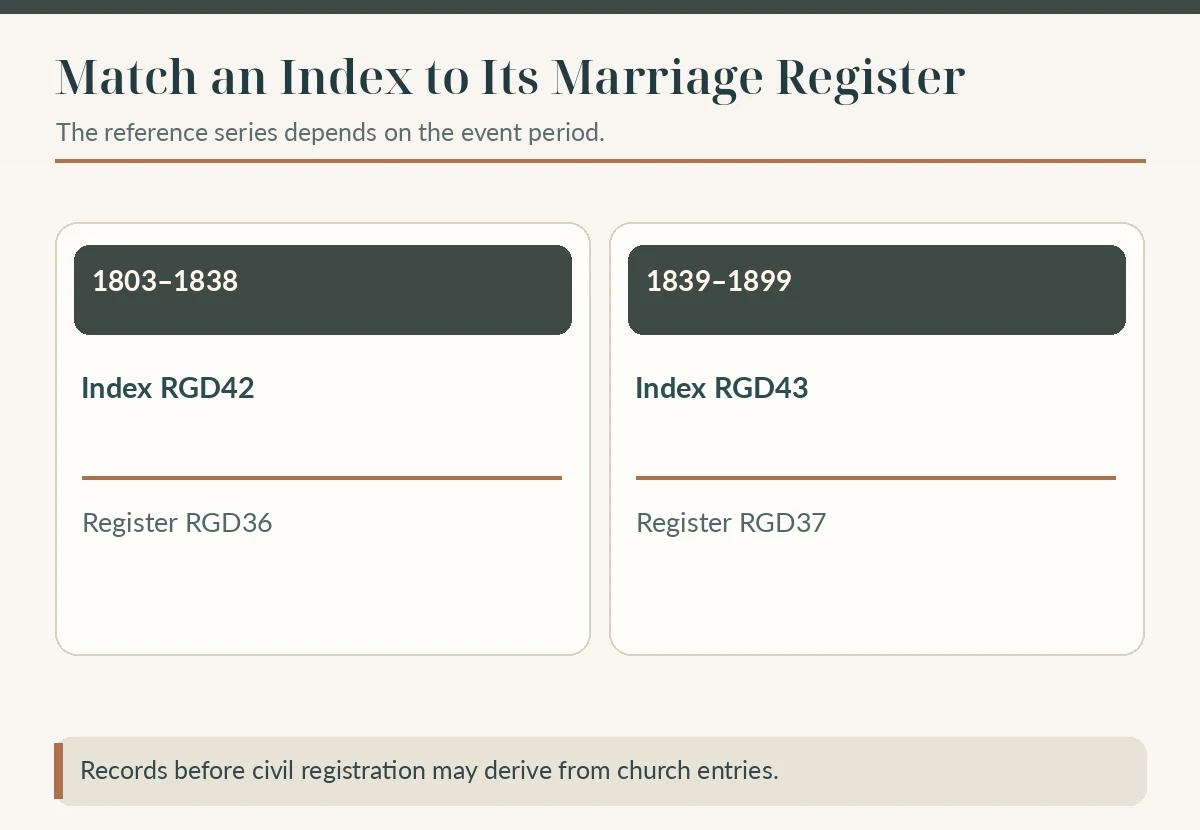
Tasmanian historical marriages have an unusually clear index-to-original route. The Libraries Tasmania guide lists marriage indexes RGD42 (1803–1838) and RGD43 (1839–1899) and digitized original register series RGD36 and RGD37. Civil registration began in December 1838, so many earlier entries derive from church records. A bride and groom in a search result are a candidate match; the real research work is matching the original entry, reading its witnesses and recognizing when names of parents were not routinely recorded.
Start with the Tasmanian Names Index and the correct period
Open the Libraries Tasmania online holdings guide and follow it to the Tasmanian Names Index. Search by either spouse, an approximate date and place if known. Distinguish the 1803–1838 index series RGD42 from the 1839–1899 series RGD43. An index record may point to a scanned page; capture its registration or item reference rather than transcribing only the displayed names.
Use period-appropriate spellings and abbreviations, and remember that a marriage reported in later records might have happened before a household moved to Tasmania. If two people share names, do not select the first image with a familiar surname. Compare locality, marital status and later records before attaching a marriage to a family. For more detail, our guide “Tasmania Historical Marriage Registers, 1803–1899” looks at indexes and images.
Link RGD42 to RGD36 and RGD43 to RGD37
Libraries Tasmania lists digitized marriages 1803–1838 under RGD36 and those in the later period under RGD37. This series distinction provides a repeatable search route from a derivative name index to the underlying historical register. Note the volume, page or image identifier and look at the actual entry in the context of nearby marriages. An indexed event without a readable image may need help from the archive rather than a guessed transcription. For the fuller picture, see our guide “Tasmania Convict Permissions to Marry, 1829–1857”.
For records around the 1838 boundary, the government says official registration began in December 1838. Do not write that all 1838 events were created under the same civil system. Earlier surviving church information was in some cases copied later by the Registrar General. Describe the record as church-derived or civil as supported by the actual entry and its repository description.
Do not expect parents’ names in every nineteenth-century marriage
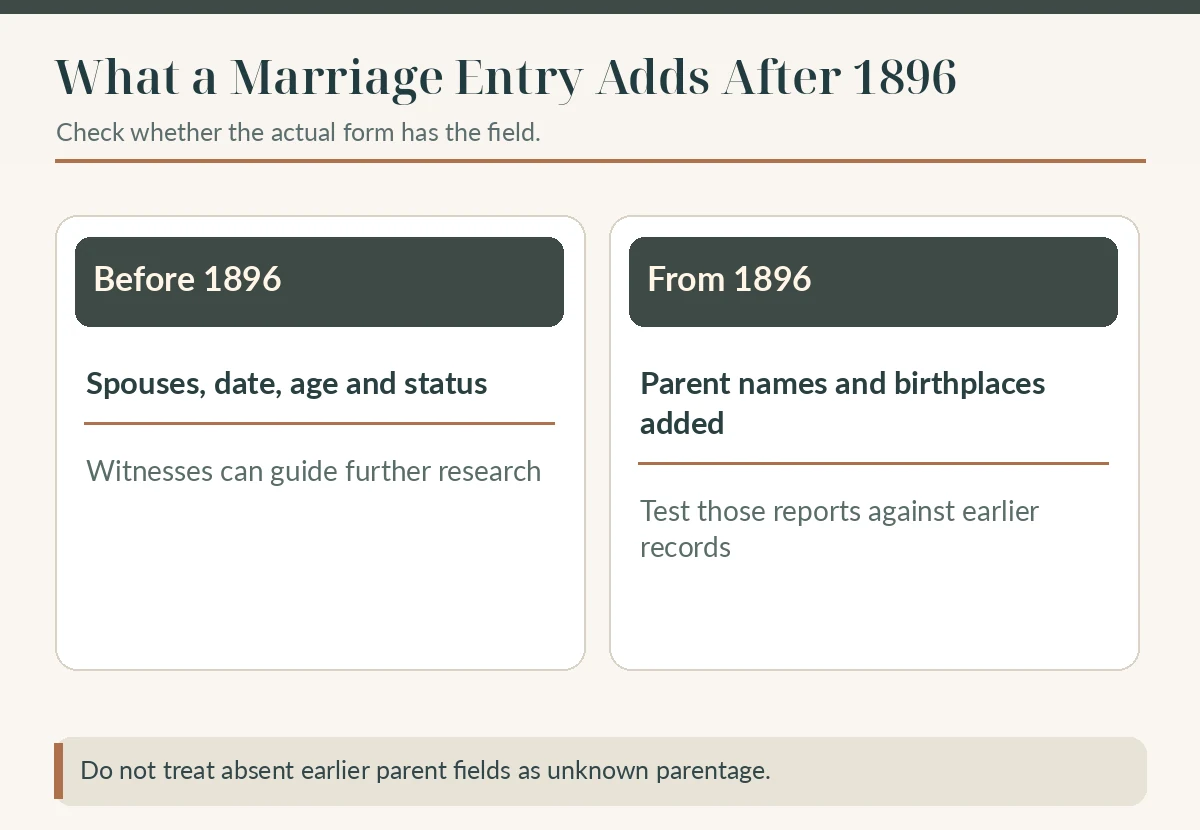
The official marriage-field guide says that before 1896 registers commonly record the spouses, date and place, ages (sometimes only above or below 21), occupations or status, and witnesses. From 1896, parent names and places of birth were added to the standard historical information. A missing parent column in an earlier entry is not evidence of unknown parentage.
For an 1850 marriage, test identity using a combined group of fields: spouses, witnesses, local residence, occupation and later children’s records. For an 1898 marriage, parent names and birthplaces may support a stronger comparison, but still assess who supplied that information. Do not project a later form’s fields backward into an earlier register.
| Archive series | Period | Record purpose |
|---|---|---|
| RGD42 → RGD36 | 1803–1838 | Index to early church-derived marriage entries |
| RGD43 → RGD37 | 1839–1899 | Index to later marriage registers |
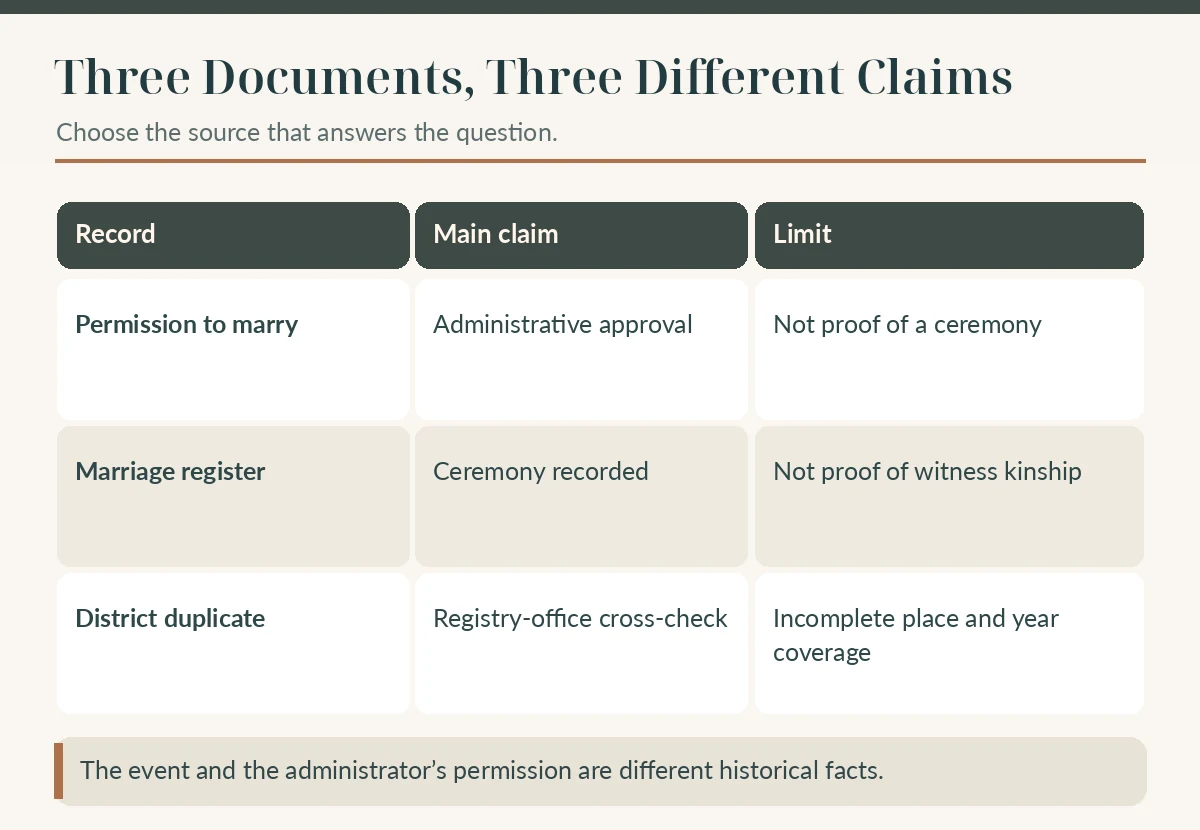
| District duplicate registers | Specific places and years | Limited registry-office cross-checks |
Compare witnesses, ages and actual marriage dates
Read age and status literally. An entry saying a party was “of full age” cannot be converted to a precise birth year. A witness with the same surname may be a relative, but that is a hypothesis rather than a fact. Record both witnesses exactly and search independent baptisms or other documents before accepting kinship. A modern standardized spelling should never erase what the nineteenth-century form actually shows.
If family correspondence gives a different wedding day, compare banns or notices with the marriage register. Announcements can precede or follow the ceremony; a permission to marry is not an event certificate. This is especially important for convict-period families: a permission to marry and a registered ceremony are distinct records requiring distinct citations.
Use district duplicate registers only for their limited purpose
Libraries Tasmania describes district birth, death and marriage register survivals as incomplete duplicates. Its district-register guide explains that district marriage registers cover marriages performed in a marriage registry, not every church ceremony. They can clarify an uncertain entry where the specific district and dates survive, but are not a complete alternative to the main central registry.
The existence of a digitized district volume does not prove your church wedding must appear in it. Check the district, event date and type of service first. Some districts have notices of intention to marry without a corresponding marriage register, so identify the administrative purpose of each record before drawing conclusions. For a comparable plan elsewhere, our guide “New Zealand Intentions to Marry, 1856–1956” shows how to find notices and proof.
Use the 1896 field change as a controlled identity test
A practical comparison uses two columns: fields actually present in the chosen registration and fields needed to verify the family. In an 1885 entry, the parents may be absent by design; search later children’s birth or baptism entries instead. In a 1900 marriage, additional parental identifiers can be checked against independent birth records, but consider common names, inconsistent spellings and the possibility of an informant mistake.
Treat apparently conflicting ages as a reason to investigate, not immediately reject a match. Transcribe the original wording, calculate an approximate range only if justified, and compare location, occupation and witnesses. The target is a demonstrable identity chain rather than a forced exact match on one field.
Preserve a precise record-series citation and a real no-result log
A complete citation identifies bride and groom as written, marriage date and place, the Tasmanian register series RGD36 or RGD37, volume and image or item reference, and the repository or online service consulted. Cite any Tasmanian Names Index hit separately as a derivative source. Explain if you have not personally viewed the original, or if a register sheet is illegible.
For a failed search, record name variants, place, time window, index series and image spans inspected. Try parish, newspaper and later civil evidence when the earlier register is absent; do not interpret incomplete survival as proof that a couple never married. The strongest conclusion states the ceremony source, fields actually reported, and kinship questions still open.
More Records and Archives Guides
How We Research Tasmanian Marriage Series
Our review starts with the record creator and holdings guidance rather than repeating an index description. We compared the dated archival instructions and forms above, checked which fields are genuinely present, tested the difference between an original record and a derivative index, and built the visual worksheets around one specific failure mode: confusing index and register series or projecting post-1896 fields backward. The examples are illustrative, not transcriptions of real individuals, and source claims should be rechecked if a custodian changes its access policy.
All recommended resources here are informational archival sources, not sponsored endorsements. We have not inserted paid links or assumed that an affiliate relationship exists; see the affiliate disclosure. Keep identifying information about living people private, and document unresolved claims rather than publishing unverified family connections.
Start with the Tasmanian Names Index, following Libraries Tasmania’s marriage holdings guide and the underlying image references.
RGD42 is the index to marriages in 1803–1838; RGD36 is the digitized register series for that early period.
Official civil registration began in December 1838; earlier entries may survive through church records later incorporated into official holdings.
Parent names were added to the standard marriage record information from 1896, so earlier entries often lack them.
No. The surviving district volumes are incomplete and cover marriage-registry ceremonies, not every religious wedding.