
Sands Sydney directories can help you trace a resident, shop or street through decades, but an address entry is not a deed and a missing name is not proof of departure. The City of Sydney Archives holds digitized directories from 1858–59 to 1932–33, with gaps in publication. Search names and street sections together, identify the edition actually consulted, and verify occupancy or business claims with independent records.
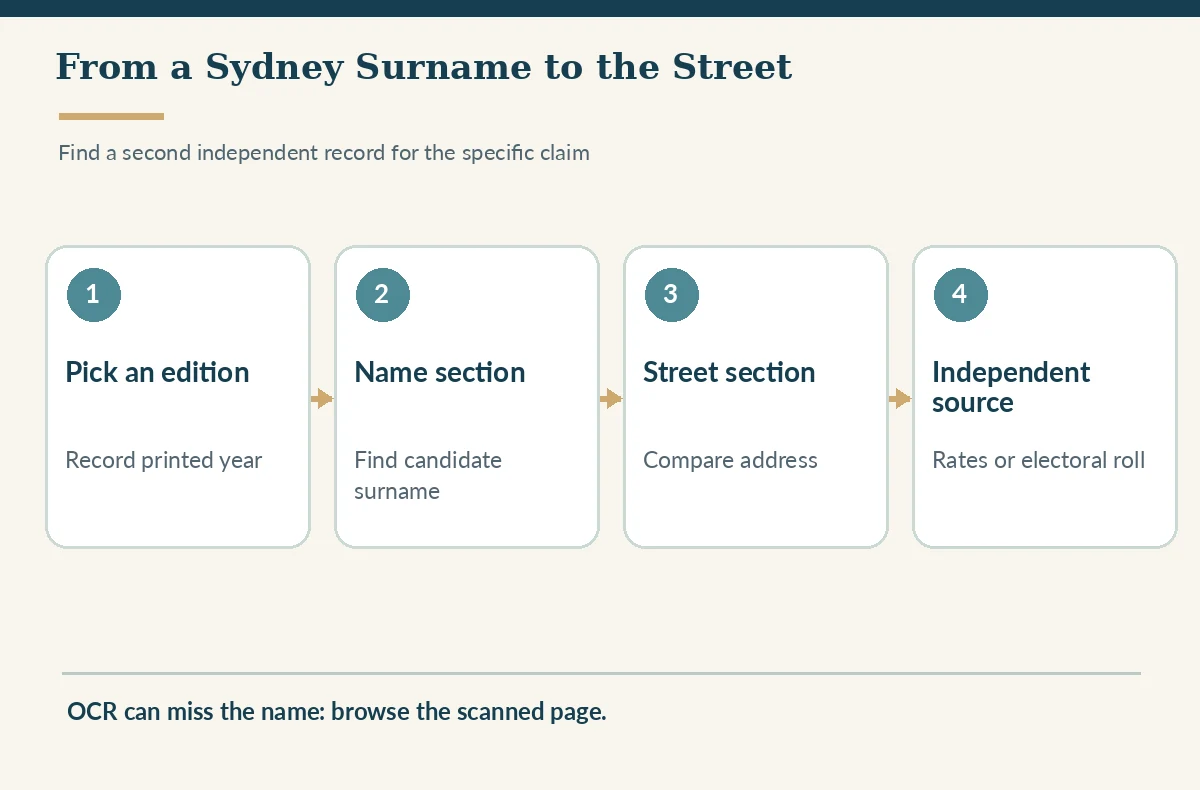
Identify the Sands Directory Edition and Coverage
The City of Sydney Archives describes Sands Sydney, Suburban and Country Commercial Directories under archival series AS-1202, spanning 1858–1933. That series description notes exceptions for 1872, 1874, 1878 and 1881; a separate City of Sydney house-history guide gives a different missing-year list, including 1860 and 1862. Check the actual cataloged volume for each target year rather than treating either summary as an exhaustive list. The titles and internal organization change across the run. Start with the actual edition shown on the digitized volume, not a database label that rounds a span of years. If the edition does not exist, do not enter an empty search result as evidence that a family left Sydney. Keep the printed publication year and any year range together in your log.
Understand the Street and Name Sections
The Sands Postal Directory guide describes alphabetical occupier listings, streets for central and suburban Sydney, and commercial information about trades, businesses and institutions. One person may appear in more than one section, or not at all. Identify the section heading before copying a result. A business address can be a shop rather than a residence; an alphabetical name list may provide a different spelling from the street section. Page numbers can restart within a volume or belong to different sections, so retain both the section and image number.
Search an Address Before and After a Suspected Move
Take a confirmed address from a dated rate book, letter, birth registration or electoral roll. Search the street section of the appropriate Sands edition, then the edition before and after if those volumes exist. Record the street name, house or building number, suburb and listed occupier. Street numbering and even names can change, making a simple exact-address match misleading. City maps and later municipal records can help align a property across time, but a mapped location is still a hypothesis until the numbering conversion is supported. Use the original page sequence when text search misses an entry.

Find People Despite OCR and Spelling Variants
Digitized volumes can be searched, but optical text recognition of old type and worn microfilm is fallible. Begin with surname and a likely suburb, then search only one distinctive word, alternate spelling or business name. The City of Sydney recommends keyword searching as well as examining within a selected volume. If no result appears, browse the alphabetic names or appropriate street section directly. Log whether a no-result came from full-text search or actual manual inspection. A name can also disappear when a business closes or the publication omits smaller occupiers.
Separate an Occupier Listing From Property Ownership
Directories were commercial publications documenting names, streets and businesses, not land-title registers. A listed household head may be a tenant, a business operator or another occupier; an absent legal owner might live elsewhere. For house history, make one column for directory occupier, another for ratepayer and a third for documented deed owner. Do not fill the columns with the same surname because the address matches. A real-estate transfer should be supported by land titles or conveyances, while a directory provides evidence of what the compiler published about a person at the address.
| Source question | What to use | Important limit |
|---|---|---|
| What survives? | Annual issues with gaps | Names, streets, businesses |
| What is not automatically proved? | Ownership and complete residence | Seek a different independent record |
| How to proceed | Read the actual archive item | Record repository, series, date and page |

Watch for Publication Delays and Missed Years
A Sands volume can lag the event it seems to describe, especially if information was collected before publication. A person might be listed after moving or omitted during a fast change of tenancy. The archive records publication gaps, so a single-year blank may be caused by an edition that never existed. Build a sequence of surviving volumes, marking year, observed name, exact address and confidence. A directory is a snapshot produced by a commercial compiler; it is not a complete annual census or a guarantee that everyone had a listing.
Use Commercial Entries to Build an Occupation Timeline
A person who appears repeatedly as a grocer, saddler or lodging-house proprietor may supply a useful occupational thread. Compare the business name, trade category and street section across multiple editions. A change in trade could represent a different namesake at the same address, a family succession, or a real occupational change. Do not infer that a trade listing proves a professional license or that a business survived throughout all intervening years. Newspapers, business registrations and insolvency records can provide independent tests. Preserve the exact historical trade label instead of rewriting it as a modern occupation. Our walkthrough on how to use historical city directories for family research sets out each step.
Resolve Same-Name Sydneysiders With Place Clusters
Suppose two people named William Brown appear in different Sydney suburbs. A surname search alone cannot decide which is your relative. Compare associates, the street, occupational description, spouse’s dated records and neighboring businesses over several editions. A repeated occupier in the same street can be consistent with continuity, while a sudden appearance at a new address may signal a move or a namesake. Make two candidate timelines rather than merging them immediately. A marriage or probate record naming an address can be a stronger independent anchor than a plausible trade label. Our guide “Western Australia Post Office Directories, 1893–1949” shows how to find people and places.
Use the Archive Series Identifier in Citations
A reproducible citation identifies the Sands Directory edition, section, page or image, the literal name or address, City of Sydney Archives and series AS-1202. If accessing through a State Library portal or a mirrored image, record the platform as the version consulted. Digital files may originate from microfilmed volumes rather than the paper originals, as the City of Sydney archive notes, so a clean image should not be mistaken for pristine source photography. Saving the image number and exact printed edition helps another researcher reproduce the search. For a related choice, see our guide “Historical U.S. Telephone Directories”.
Choose Follow-Up Sydney Records by the Claim
For a residence question, compare electoral rolls, municipal rates, census substitutes or dated correspondence. For a property title question, use NSW land records; for a business chronology, try licensing papers, trade registers and newspapers. A directory can narrow the period and street but rarely provides complete identities, household relationships or an exact move date. End with a small evidence table showing each claimed fact, Sands entry, independent confirmation and remaining uncertainty. Doing so preserves the directory’s real strength—year-by-year street context—without forcing it to become an official population register.
More Records and Archives Guides
How We Research Sands Sydney Directories
We checked the primary repository description against the independent scope or custody guide and another archival or library reference as applicable. Our tables distinguish information actually recorded from hypotheses about family identity. Illustrated books, forms, maps and example charts are conceptual teaching aids, not reproduced or attributed historical pages; no individual family discovery is asserted. Actual name-index coverage, image permissions and copy procedures should always be checked at the custodian before use. No product or paid referral is recommended; see our affiliate disclosure.
The City of Sydney series runs from 1858–59 through 1932–33, with some years missing.
The City of Sydney Archives series description lists 1872, 1874, 1878 and 1881, but another city guide differs; verify individual volumes before declaring a missing year.
No. A directory listing identifies a published occupier or business entry, not necessarily legal title.
Browse the alphabetical names and the street or suburb section in the selected year; consider OCR and spelling errors.
The City of Sydney Archives provides digitized editions; the State Library of NSW also links to the free resource.