
The Sands Sydney directory can link an old Sydney street address to a named householder or business, but it is not a property title deed. The City of Sydney Archives provides digitized Sydney, Suburban and Country Commercial Directories covering editions from 1858–59 through 1932–33 with gaps. Start with the target year, then compare an alphabetical name listing to the suburb or street section of the same edition. That second lookup is the central safeguard against a mistaken street number or a shared surname.
Open the City of Sydney archival edition list
The City of Sydney’s Sands directory series AS-1202 records editions beginning in 1858 and ending in 1933. The archive organizes entries into volume sections rather than one universal person database. Select a year close to the known residence event, read the volume contents and choose its alphabetical, suburban or business section. Searchable OCR is useful but not a replacement for inspecting the actual printed list; typefaces, page breaks and damaged scans can produce false omissions. Save the year, directory part, page or image number and source URL. If you find only a business name, do not presume the proprietor personally slept or owned property at that address. The listing identifies a directory association, not an estate transaction.
Cross-check alphabetical names against suburban streets
The archive’s user instructions allow a keyword search across all volumes or within a chosen volume. Begin with a surname, then try a street name or occupation if the surname has many variations. The directory’s alphabetical resident or occupier list is one view; the suburban street listing is a second. Create a paired transcription of the name, printed address, directory year and the nearby occupants on the street page. A person may appear once as a shopkeeper and again in a street section, or the two locations may represent distinct businesses or people with the same name. It is your task to test the overlap, not to automatically collapse it into one identity.

Check missing editions before calling someone absent
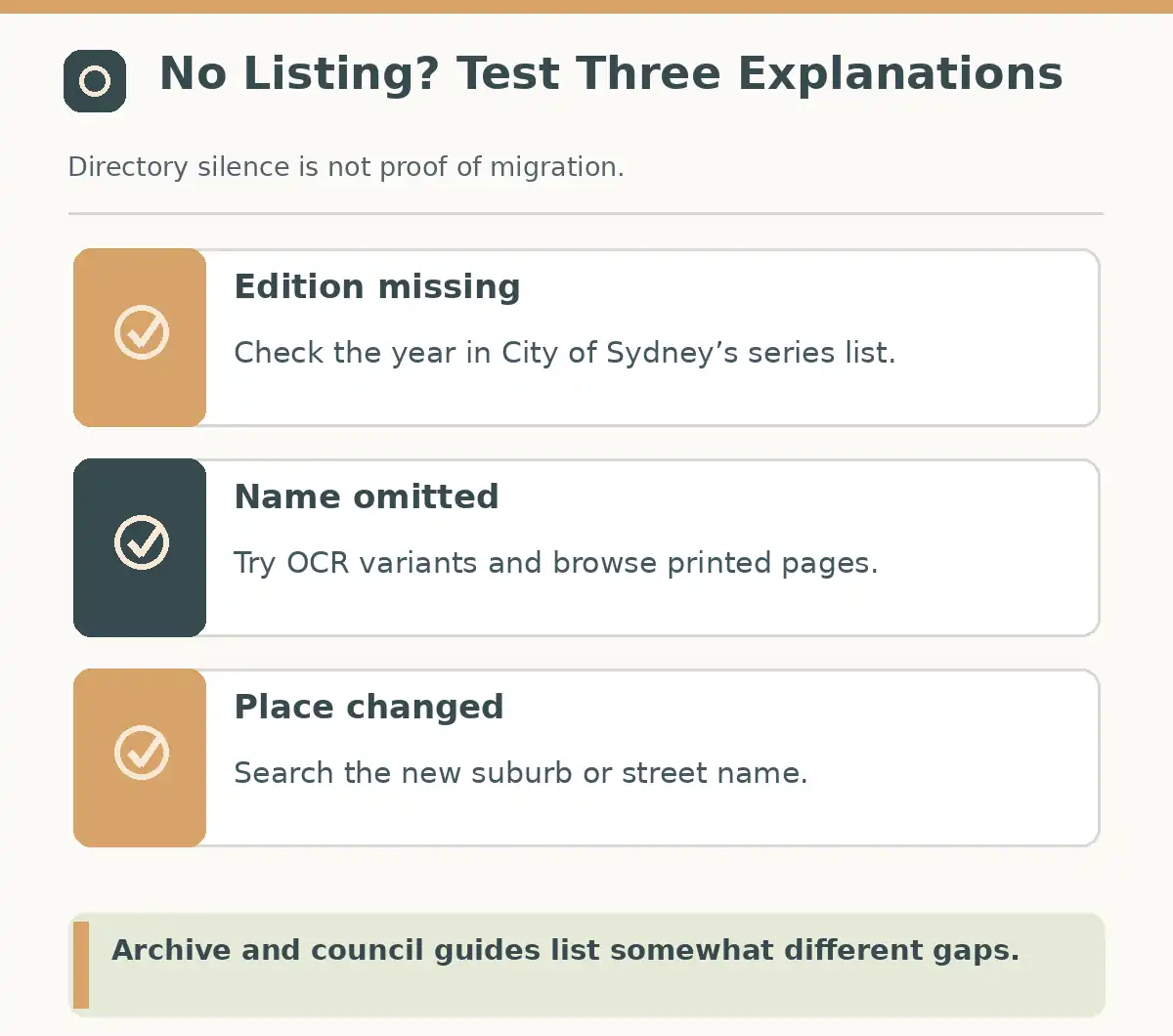
The AS-1202 catalogue description lists no editions for 1872, 1874, 1878 and 1881. The City’s separate public house-history guide describes a partly different missing-year list, including 1860 and 1862. Do not quietly reconcile those published lists into an imaginary complete run. Check the actual digitized edition list for the particular year before claiming a directory existed or was missing. Where Sands has a gap, the City’s guide points to other early Sydney directories and later Wise’s directories, each with different scope. A one-year disappearance from a surname search does not establish a death or departure.
Watch for renumbered streets and renamed suburbs
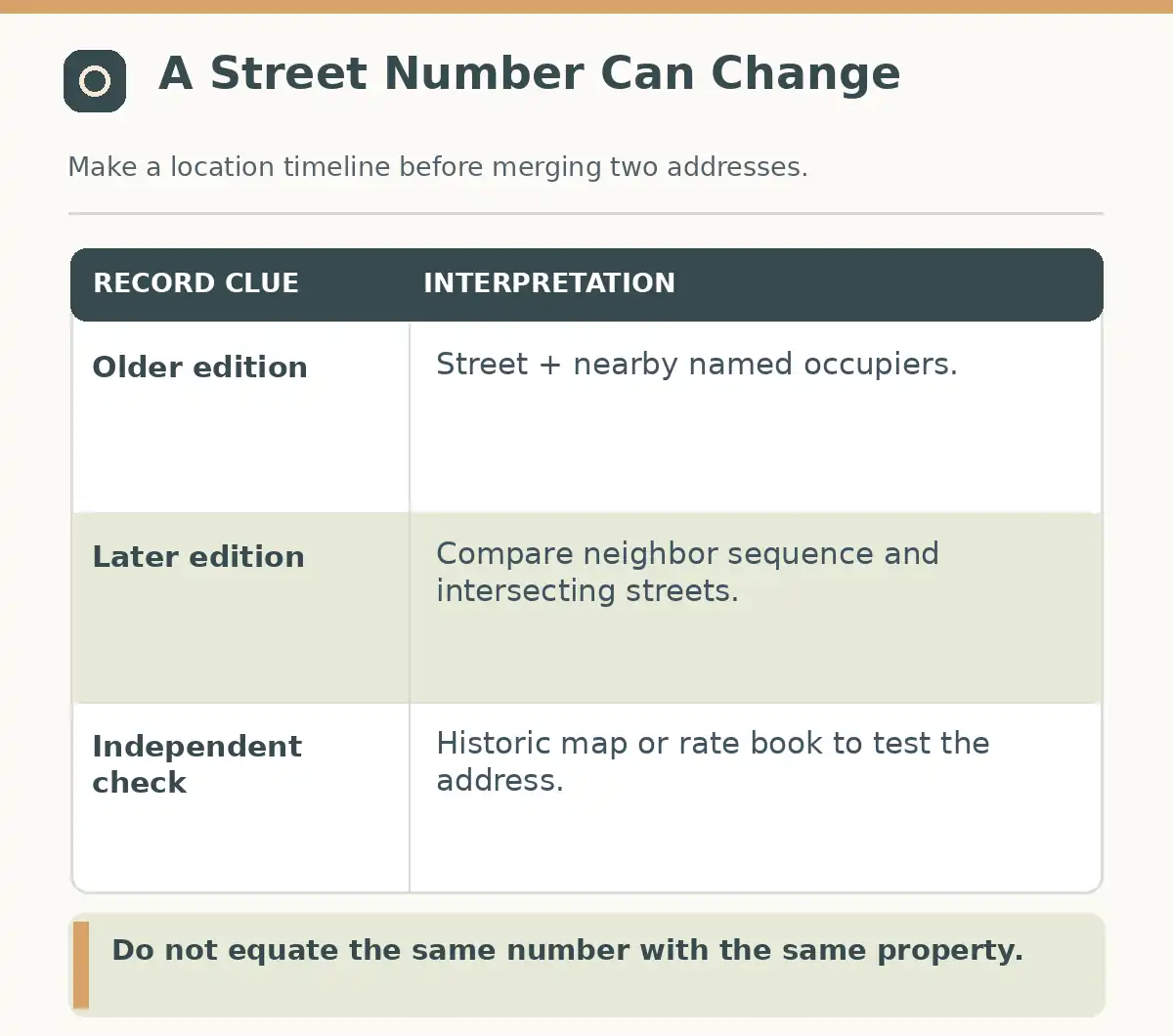
Sydney expanded rapidly; addresses, street boundaries and suburb names changed. To identify a single property over decades, match street name, intersection, approximate building position, contemporary map and directory listing rather than blindly equating one house number across years. In the suburb list, transcribe neighboring named occupiers and businesses in order, then compare the sequence with a later edition. If the house number has changed but several neighbors and intersections align, that is a testable location hypothesis, not yet a proven chain of owners. Maps and rate or property assessment books can help. The State Library of NSW house-history guide suggests directories and newspapers as complementary sources. Keep occupation and ownership in separate timeline columns.
Understand what a published directory can prove
A Sands entry may support that a named person or business was listed at an address in an edition. It cannot independently demonstrate that the person was the registered owner, lived there every day, or remained until the next edition. Production and canvass dates may differ from printed year, and names may be misspelled or omitted. A business address might be distinct from a private home. If you find two E. Williams entries on opposite sides of Sydney, compare trade, neighbors, possible middle initials and later birth or marriage records before assigning them to one relative. Good notes quote the directory entry literally and describe the resulting identity theory separately. Negative results require edition coverage and OCR accuracy checks. Suppose an 1890 directory lists a cabinetmaker on one street, while an 1894 entry with the same name appears several blocks away. This is an address-change hypothesis, not a documented move until other records tie the two occupations, spouses or associated people together. Check the edition’s specific street section for neighbors and businesses near each address. Then compare rate books or an electoral roll in the intervening period, remembering that not every resident qualified to vote and a ratepayer may be an owner or an occupier under different arrangements. A printed address can strengthen a dated timeline while leaving both ownership and identity unresolved. Our guide to Sands Sydney Directories, 1858–1933 adds more detail on this.
Cite the specific directory section and page
A useful Sands citation combines creator or publisher, printed title, edition year, relevant section and page or digitized item ID; add City of Sydney Archives, its series number when shown, the URL and date viewed. Because City of Sydney sections can appear as distinct digital items, a URL for the general collection page may not guide someone back to the exact evidence. Preserve the section heading and any page image index. Check if the record is digitized from microfilm and whether an odd OCR string is a scan artifact. When sharing an extract, use the archive’s own attribution and reuse information. For a family tree, add a separate citation to deeds, electoral rolls or civil registrations when those different claims are made.
More House and Local History Guides
How We Research Sydney Sands Directory Entries
We use the actual City of Sydney series description for edition ranges and the archive’s search instructions for the two routes into pages. The council’s house-history guide is checked separately because its omission list differs from the catalogue. This article treats an address listing as an observation of occupancy or business association, never proof of land title. Our affiliate disclosure applies; the public archives are first-choice sources.
The City of Sydney archives holds editions from 1858–59 to 1932–33, with missing publication years.
No. It supports a directory association or occupancy; deeds and rate books address title and ownership.
Open the correct year and browse its alphabetical and suburban pages, checking spelling and scans.
No. City archival and council guidance identify gaps; check the edition catalogue for your exact year.
Compare adjacent named occupiers, intersections, historical maps and separately dated property evidence.