
For a Catholic ancestor in Drumcree (Portadown), County Armagh, the National Library of Ireland (NLI) provides a concrete, readable entry point: microfilm 05586/04 and 05586/05. The official parish listing confirms that Portadown is a variant parish name. Film 04 contains baptisms from January 1844, marriages from February 1844 and a short run of deaths in 1863; film 05 carries later baptisms, marriages and deaths into 1881. These spans differ by event and have breaks. Starting with the correct film and record type avoids treating an unsuccessful browse as evidence that a person was never in Portadown.
Map the Portadown name to the Catholic Drumcree parish
A town name is not automatically the same as a parish jurisdiction. The NLI parish catalogue calls this Catholic parish Drumcree and lists Portadown as its variant. First decide whether the ancestor’s known address actually belonged to the Catholic parish serving that family, rather than to a Church of Ireland parish, a civil parish, or another nearby Catholic parish. Record the family denomination only when there is evidence for it; a Portadown address alone proves no religious affiliation. With an estimated baptism, marriage or burial year, open the NLI parish page and look for the event-type dates under each film. Note the form of the parish name used by the catalogue and the reference numbers separately. A descendant might refer to ‘Portadown registers’ while the images are catalogued under Drumcree; search both labels before marking coverage absent.
Browse NLI film 05586/04 with its separate event dates
The official 05586/04 page describes 123 microfilm images. Baptisms run January 1, 1844–June 30, 1864, marriages February 9, 1844–November 23, 1863, and the small death section May 26–December 22, 1863. A death dated 1858 cannot be ruled out merely because no entry appears in this film: no death sequence for that year is catalogued here. The film’s baptism and marriage sequences should be inspected on their own terms. Choose the appropriate date segment and read several neighboring images, not just an auto-highlight. Transcribe names and dates exactly, preserving abbreviations and uncertain letters. If a film frame contains multiple entries, cite the film and exact image number along with the act’s date and the persons named, not simply ‘Drumcree records.’

Use film 05586/05 for later event categories
The NLI 05586/05 page lists 96 images, baptisms June 17, 1864–January 31, 1881, marriages July 23, 1864–April 18, 1881, and deaths June 24, 1864–April 6, 1881. Because the baptism dates overlap the previous film in June 1864, do not invent an unrecorded month-long gap in baptisms. Marriage and death boundaries are different. A 1864 marriage between the film dates may require special scrutiny of parish registers or a separate civil record. The film labels describe dated content, not a guarantee that each intervening day has a complete original entry. Use the internal register date headings to find the likely leaves and check legibility. When more than one similarly named couple appears, note each witness and the recorded place before accepting an identity.
Compare Armagh Ancestry transcription coverage and microfilm coverage
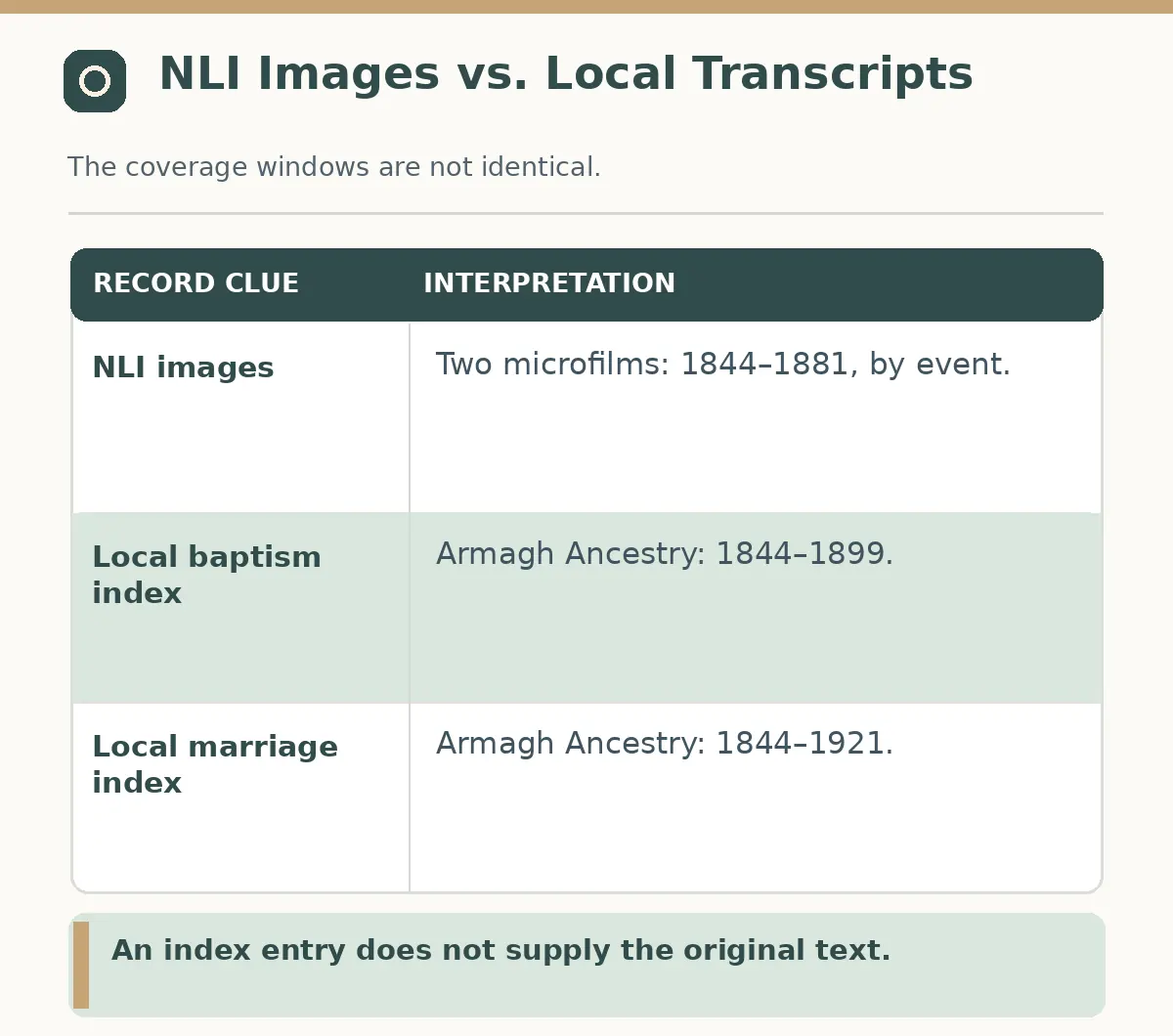
Armagh Ancestry’s church-record inventory gives a broader local indexing picture for Drumcree (Portadown): Catholic baptisms 1844–1899, marriages 1844–1921 and burials 1863–1900 in its transcribed records. These dates should not be copied onto the NLI microfilm description: NLI films shown for this parish end in 1881. The longer transcription spans may offer an index lead where the NLI online film no longer covers the date. An indexed name cannot establish the wording of a later original entry. Determine the index’s cost and options for consulting the source, and seek the local parish or relevant archive for original-record access where appropriate. Never portray these as continuous, complete, freely imaged NLI registers through 1921. Record source-specific coverage in two separate columns.
Separate baptism, death or marriage evidence from civil registration
Ireland’s civil registration of births and deaths began in 1864, and non-Catholic and civil marriage registration has different chronology than Catholic church marriage registers. For a nineteenth-century Portadown event, specify whether you are seeking a sacramental baptism or a government birth entry. A baptism may give parents and sponsors yet record a date later than the child’s actual birth. A death or burial note in a parish volume may reflect a church rite rather than an exact government registration date. A marriage witness’s name helps form a candidate network but does not itself prove kinship. If an original page is illegible, compare independent civil certificates or other documented church records rather than inventing a legible transcription. Use recorded townlands, occupations and family relationships only where actually written; otherwise label them as hypotheses.
Create a defensible citation and a no-result record
A full entry in a research log should include source creator (Drumcree Catholic parish), NLI electronic microfilm reference, film suffix, image number or frame locator, event date, names as written and the date you accessed it. Keep separate rows for each alternative reading of a hard name. If you checked images around March 1867 but found no baptism, state the actual search extent, the page chronology and the relevant film; do not claim the family did not live in Portadown. A missing result could be due to a neighboring parish, an infant recorded under a variant surname, a poor scan or a damaged leaf. When using Armagh Ancestry transcription as a lead, cite that index as a separate derivative source and request the precise original register reference where possible. That is more reproducible than a screenshot with no date or frame.

More Records and Archives Guides
How We Research Drumcree Register Coverage
Our date ranges and film references come directly from the NLI’s Drumcree page and its two individual film descriptions. We compare those with Armagh Ancestry’s transcription inventory rather than mixing film dates with transcription dates. The illustrations show which event types are described for each film and which later years require another custodian. No example invents a real person’s record or implies that a baptism proves birth in the same day. See our affiliate disclosure for editorial transparency; catalogue links are research references, not affiliate offers.
The NLI catalogues Drumcree with Portadown as a variant name; verify the ancestor’s actual parish jurisdiction.
NLI 05586/04, whose baptism dates run from January 1844 to June 1864.
No. Film 04 lists only a short death run from May to December 1863.
The transcript inventory extends later than NLI’s two listed online microfilms; it is a different access scope.
Film suffix, precise image or frame, date and the act or names transcribed, plus the NLI catalogue reference.