
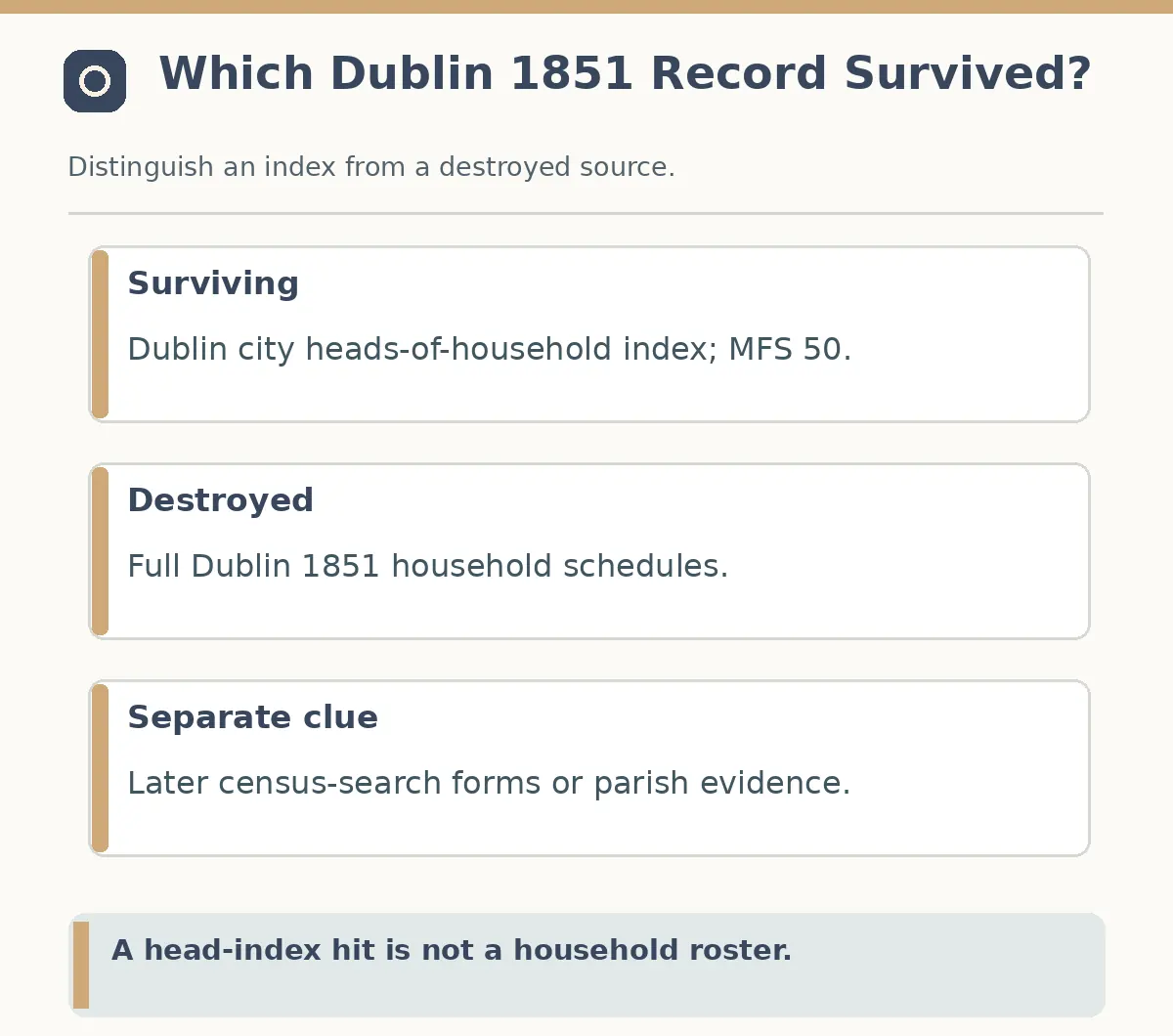
Most of the Irish 1851 census household returns were destroyed, but a Dublin city index to heads of households survives. The National Archives of Ireland distinguishes this Dublin index from actual surviving individual returns in other counties. Its microfilm inventory identifies MFS 50 as ‘Census 1851, Dublin, Heads of households.’ Use the index to seek one head of household and a place clue, not a spouse, children, full house roster or a completed 1851 schedule that no longer exists. A carefully sourced positive index entry can guide street-level research without recreating lost evidence.
Understand what survived from Dublin in 1851
The National Archives’ pre-1901 census guide says that Dublin city retains an index to heads of household only for 1851, whereas different counties retain different fragmentary original schedules. That distinction changes what can be proved. A name in a head index does not establish that the named person’s spouse or all children were present on census night, and no family-member columns can be reconstructed from the index. Much of the nineteenth-century census material was destroyed in the 1922 Public Record Office fire, with other decades lost in separate circumstances. When documenting a Dublin ancestor, note whether your source is the surviving index itself, a later derivative transcription or the full 1901/1911 census in a different year. A positive 1851 entry is valuable, but its evidentiary scope is narrow.
Use MFS 50 instead of assigning a destroyed census reference
The archive’s microfilm holdings table assigns MFS 50 to the Dublin 1851 heads-of-household index. Copy that reference into the research log before looking for an accessible image or requesting archive assistance. MFS 50 is not a microfilm of complete surviving Dublin household returns, and it must not be cited as if you inspected the entire 1851 enumeration. Where the digital search surfaces a transcript, distinguish its provider, field spelling and date from the underlying archived item. If an archive gives a more granular image or name locator, record it. The manuscript’s survival history should be included in your citation or analysis note so that a later researcher does not assume absent wives or children were omitted by the enumerator. A single index line remains a single index line.
Search the modern pre-1901 census portal and record fields
The current National Archives nineteenth-century census portal offers searches for 1821, 1831, 1841 and 1851 records. Start with 1851, select Dublin where the interface permits it, and use a broad surname rather than relying on exact spelling. Inspect whether each result is an original return from a listed survivor county or a Dublin heads-only entry. Transcribe only the fields visible in that specific result. FamilySearch also describes an Ireland, Dublin and Belfast City Census Heads of Household Index, 1851 whose searchable index may supply the head’s name, townland, parish and county. Treat Belfast and Dublin as separate cities. The presence of both in an index title does not make their archival survival identical. Save search strings, localities and whether original images were actually available to you.
Do not confuse Dublin heads with pension census-search forms
A completely different nineteenth-century census derivative is the 1841/1851 census search form created later when officials checked claimed age for pensions. Those documents may record an applicant’s assertions and a search result but are not surviving 1851 household schedules. If you find the same family through a pension search form and through the Dublin head index, make two source entries and test how they relate. The Dublin head index identifies a named candidate at a documented location. A later search form is evidence of an application or official search, and may include reported familial details that require checking. Neither reconstructs a full destroyed census by itself. This difference is especially important because a genealogical website may mix the two sources under a broad label like ‘Ireland 1851 census’. Read the collection description rather than assuming all indexed names are direct household entries. If that is your next decision, our guide “Irish Census Search Forms, 1841–1851” explains how to find Pension-era family clues.

Turn a place clue into independent family evidence
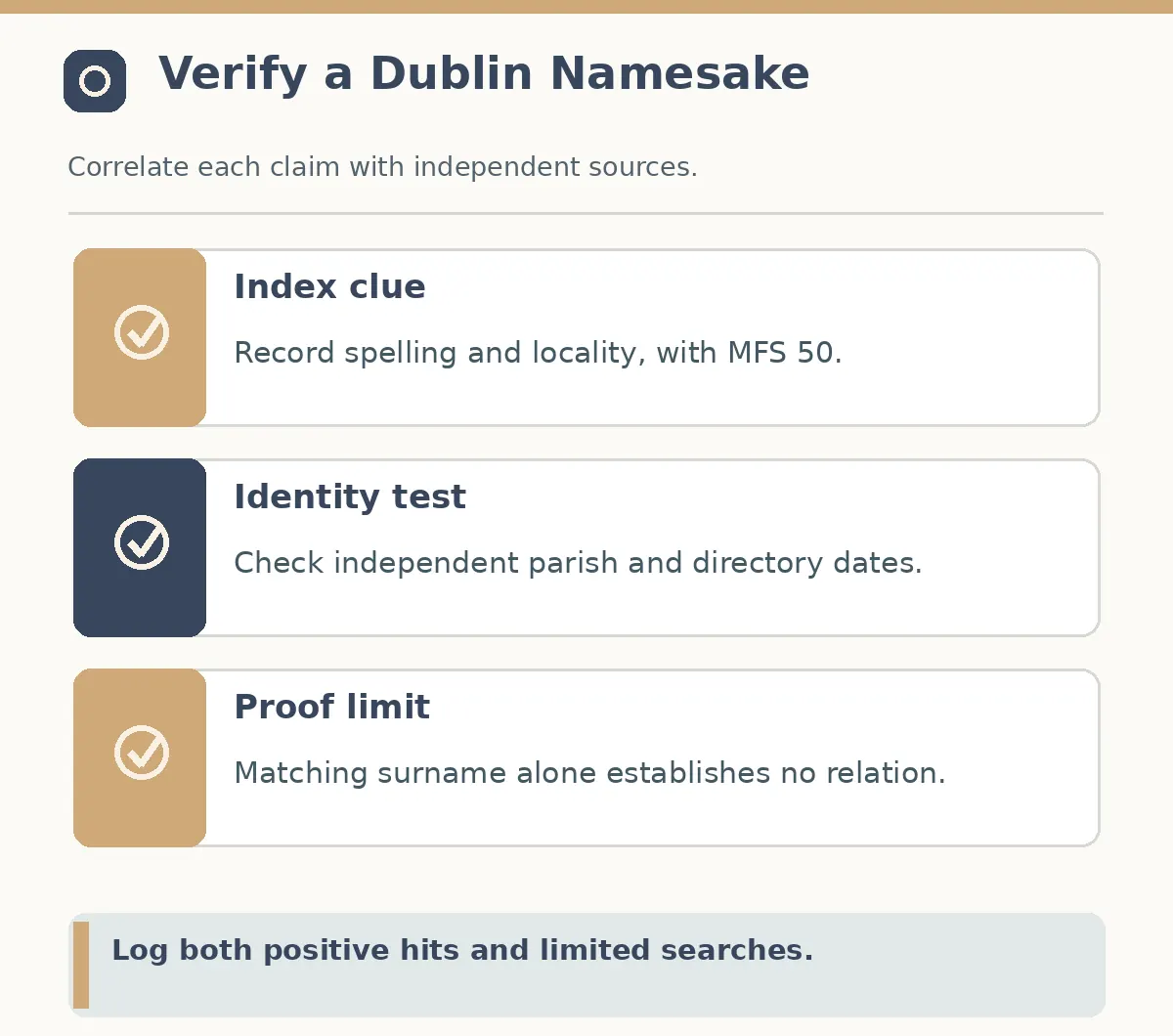
Once you have a candidate head and possible parish or street, use other sources that actually name family members. Dublin city directories can help identify an address in one dated edition but do not define the head’s family. Parish baptism or marriage acts may name parents, sponsors or witnesses, while surviving valuation and property records may identify ratepayers or occupiers. Each source has different date and claim limits. Build a matrix of two same-name candidates with index spelling, locality, occupation if independently recorded, spouse from a separate marriage and dates from church entries. Mark uncertain matches instead of merging households. A parish label might be ecclesiastical, civil or a database normalization. Confirm its type before using it to select another register. A namesake’s occurrence in the same street can remain unresolved until an independent linking source is found. If you want the full process, read how to search Irish census records.
Write an honest negative result and complete source citation
A failed Dublin 1851 name search is not evidence that the person did not live there. The surviving index may omit non-heads, spell a surname differently, cover a narrower place than presumed or have transcription problems. Keep the precise portal, year, place filters and variant names searched. When a record is found, cite the National Archives’ MFS 50 holding where appropriate, together with the index provider and available entry or image locator. Separate a provider-created name transcript from the archival index on film. Do not supply a non-existent full census folio and page. If another archive has a surviving 1851 original from County Fermanagh, that is a different collection and must not be retroactively used as a Dublin 1851 household image. A sound citation makes the survival boundary plain.
More Records and Archives Guides
How We Research the Dublin 1851 Heads Index
We check the current National Archives loss-and-survival inventory, its explicit MFS 50 microfilm designation, the current c19 census search page and FamilySearch’s head-index description. Our diagrams distinguish a head-index hit, the lost full return, and an independent supporting record. They never fabricate a household schedule from an indexed name or turn a census-search form into a census return. For editorial transparency, read our affiliate disclosure; no genealogy subscription is required to understand this survival limitation.
The National Archives identifies a Dublin city heads-of-household index only, not surviving full household returns.
The National Archives microfilm reference for the 1851 Dublin heads-of-household index.
No. Head-index entries do not reconstruct unnamed household members.
No. Later pension searches are a different record type, created for an age claim or official lookup.
Search name variants and locality, then investigate other dated records; absence from a heads index is not proof of non-residence.