
Irish 1841 and 1851 Census Search Forms can preserve family details that ordinary surviving nineteenth-century Irish census returns cannot supply. Many were created when applicants for old-age pensions, beginning in 1909, needed age verification. A form can report the claimant’s parents, childhood townland and a former household—even if an official search for the underlying census entry failed. It is not itself the original 1841 or 1851 census sheet. The National Archives of Ireland now says its older public catalogue microsite has been retired. So verify the present access route before relying on an old search link.
Start with the pension context, not a census-name promise
The National Archives’ current description explains the forms’ connection to the 1908 Old Age Pensions Act, under which payments began in January 1909. Applicants needed evidence of age, and many people born before Irish civil birth registration began in 1864 could not offer a statutory birth certificate. Officials therefore consulted then-existing 1841 and 1851 census returns for dates and family statements. A claimant could list parents and an estimated age long after childhood. Those assertions must be evaluated as information offered for a pension inquiry, not as a contemporary baptism. The archive describes 136,152 names in the forms collection, a count that is neither a complete census population nor a guarantee that a given household was searched successfully.
Extract two layers of evidence from a single form
Begin with fields supplied by the applicant: forename and surname, current address, parental names, estimated 1841 or 1851 residence, townland, parish, barony and county. The applicant’s parents may be valuable leads, but remain statements whose firsthand accuracy varies. Then read any Public Record Office notation about the search outcome. If the office located a suitable census household, a form can include associated household names and ages transcribed at that time. If the notation says not found or no trace, the family names and locality may still be recorded as the applicant stated them. Those are different evidence levels. Preserve the outcome word for word, rather than summarizing all forms as ‘verified census records’.

Do not mistake a search-form abstract for an original census return
Most ordinary Irish 1841 and 1851 returns have not survived intact. A later pension search form is therefore especially tempting to use as a substitute, but the substitution needs an evidence label. Even a positive search may record only selected facts and handwritten or typed extracts; the original census’s page context, enumerator notations or neighboring households might be unavailable. A negative search does not mean the applicant was absent from Ireland, since spelling, changing place names, incomplete descriptions and source loss all limit retrieval. Link the claimed childhood townland to Griffith’s Valuation, surviving parish books or a family marriage record with a clearly dated reasoning step. Do not attach a parent merely because a rare surname appears in the expected county. For a related choice, see our guide “Dublin 1851 Census Index”.
Use the current National Archives access directions
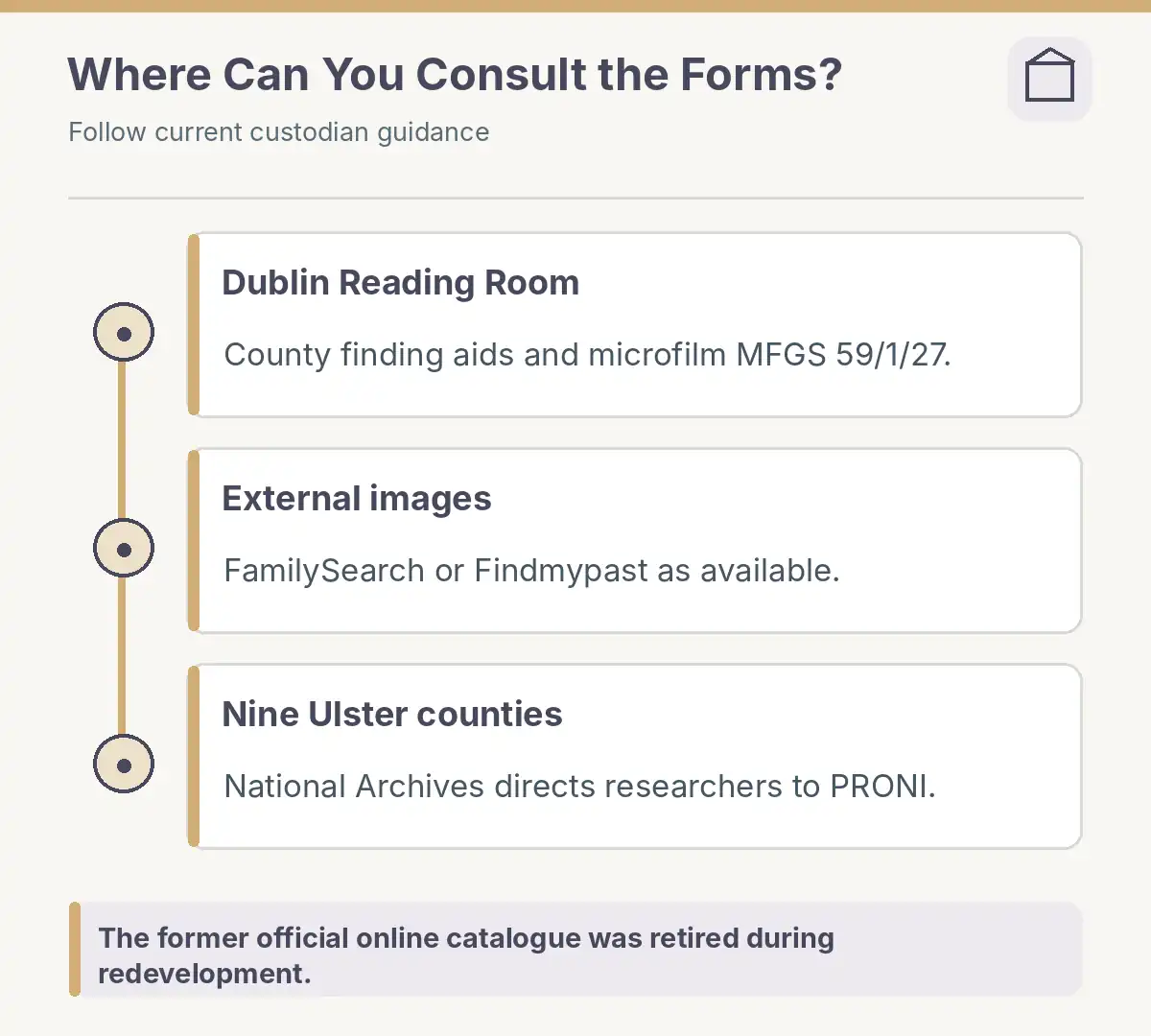
A legacy censussearchforms.nationalarchives.ie interface may still appear in search engines, but the National Archives now describes the older genealogy microsite as retired during its platform redevelopment. Its current collection page identifies Reading Room county finding aids and microfilm MFGS 59/1/27, as well as records on FamilySearch (free) and Findmypast (subscription). Choose the practical route that gives you the form image and its provenance, rather than claiming a legacy query screen is the reliable official destination. When consulting a third-party index, save the archive’s collection name, microfilm reference when available, claimant name, locality and the date you actually saw the original or image.

Send Ulster inquiries to the correct custodian
The National Archives specifically directs inquiries for Antrim, Armagh, Cavan, Derry, Donegal, Down, Fermanagh, Monaghan and Tyrone to the Public Record Office of Northern Ireland (PRONI). Historical county boundaries and current political geography do not remove this custody distinction. Write down the claimant’s location at the pension application and the claimed 1841/1851 childhood residence separately. Those places could be in different counties, even on opposite sides of today’s border. The older catalogue’s county list is not sufficient proof that the relevant image is held in Dublin. A targeted request should identify the claimant, approximate pension period, original parish or townland and whether you want an official search result or the reported family information. For the fuller picture, see our guide “1821 Fermanagh Census Fragments”.
Build a five-column family-claim worksheet
A useful transcription row includes person and role, claim as written, who supplied it, search-office result and independent test. Suppose a claimant says her mother was Mary O’Brien of one townland, but the office records ‘no trace.’ That does not transform the mother’s identity into fact. It gives a testable lead for baptismal registers, marriages or a documented sibling. If a positive form identifies several household members, verify each relationship label and age without treating two present-day family trees as independent confirmation. Record spelling variants from the form rather than silently choosing a standardized Irish surname. Note whose pen or transcription generated each layer, because a later official abstract may still preserve errors from the original claim.
Before deciding a form is relevant, bracket the applicant’s likely age in 1909 from independent marriage, death or baptism evidence rather than assuming every person born in the 1840s applied. Then ask whether a claimant’s parent and townland information agrees with at least two independently produced documents. Maintain a date column for when the applicant wrote the information, and another for the old census year the office attempted to check. If a family moved between those dates, neither the pension address nor the old townland should be silently recast as a permanent residence. Save negative searches together with the exact county and name variants used.
More Records and Archives Guides
How We Research Irish Pension-Era Forms
We use the National Archives’ updated collection and access notice as the source of current custodian guidance. Historical context and searchable fields are checked against archive descriptions, but legacy search-screen availability is not promised. We explicitly separate a claimant statement, a successful record-office comparison and a no-trace notation. No personal family was reconstructed in this article. Our affiliate disclosure explains financial transparency; FamilySearch and archive consultation are viable alternatives to subscription platforms.
No. They are later search forms made for age verification, sometimes recording extracts from census records then consulted.
Yes. It may record an applicant’s claimed parents and childhood townland, but those details need independent corroboration.
The old-age pension system began paying in January 1909 after the 1908 Act.
The National Archives directs researchers to Reading Room finding aids and microfilm MFGS 59/1/27, FamilySearch and Findmypast.
The National Archives directs the nine named Ulster counties to PRONI; confirm the relevant custody route.