
The National Archives’ M1373 publication is a practical starting point for a U.S. lighthouse keeper or assistant keeper between 1845 and 1912. Search both the person’s name and the light station, then use the original regional register, not just an index entry. The NARA lighthouse research path explains that these registers typically show appointments and departure dates, but a keeper’s appointment does not automatically document a spouse, children or the household’s residence at a station.
Understand the Six Rolls and Nineteen Volumes
M1373 reproduces nineteen volumes of registers on six rolls. The NARA descriptive pamphlet divides them geographically into New England, New York through Virginia, North Carolina through Texas, the Great Lakes and the West Coast including Alaska and Hawaii. The Great Lakes material spans two rolls with a 1900/1901 division. These are filing regions for the records, not an atlas of every keeper’s birthplace.
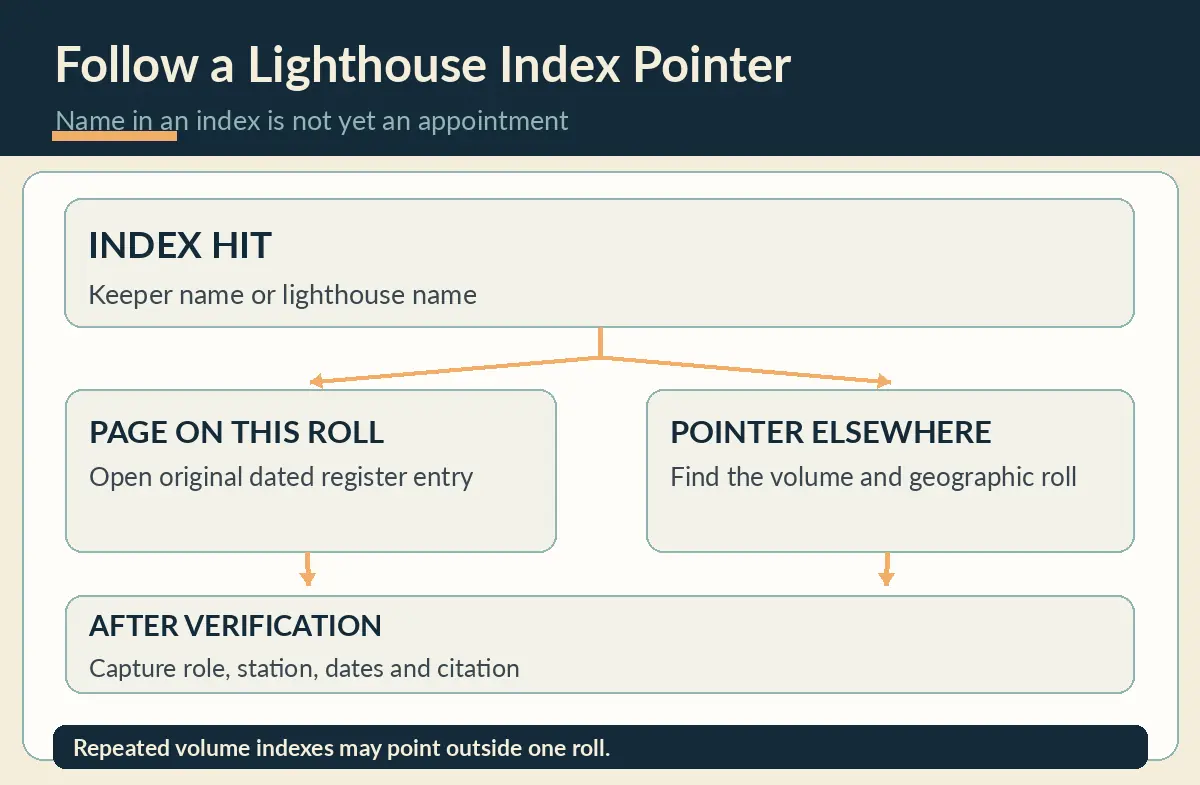
Do not expect an alphabetic nationwide page sequence. The registers themselves were compiled chronologically, and the indexes were filmed with particular volumes or portions. Some older volumes include multiple regions. A name might occur in a filmed index even if the underlying keeper entry is on a different roll. This subtle arrangement is a major reason that stopping at one index page can lead to a false “not found.”
Establish a Keeper and Light Station Pair
Start with a dated photograph, census occupation, directory, family letter, newspaper account or other independently known clue. Record the station’s historical name, possible administrative district and approximate years. Lighthouse stations can change names, and a person may transfer between several lights. Searching only the surname may return unrelated keepers or assistants who worked in different states at different times.
The name of a lighthouse should be treated as a search key as well as a place. An “assistant keeper” is a distinct appointment and should not be silently raised to the role of principal keeper. If a relative’s story names a station but the register identifies an assistant, write the role appearing in the register and investigate the family recollection as a separate claim.

Navigate Volume Indexes Without Losing a Name
The M1373 pamphlet warns that alphabetical keeper and lighthouse indexes are reproduced each time a volume or portion was filmed. Because indexes can point beyond the relevant reel, the presence of a name in an index is not proof that the individual is recorded on the pages currently open. Follow the volume, region and page information supplied, and confirm the full original entry before citing it.
NARA also cautions that, although the register date range starts in 1845, most lists do not actually begin until 1849. A missing entry for the middle 1840s should trigger a holdings check and another personnel source, not a claim that no keeper existed. Record which roll, volume, index and original page you have examined and where a pointer leads.
Interpret Appointment and Departure Columns
The registers commonly identify keepers or assistant keepers, their district and light, date of appointment, and a resignation, discharge or death date; some entries include salary. Distinguish the date the government appointed an employee from the date a family might have moved or begun occupying a dwelling. A register noting that employment ended is not, by itself, evidence of death unless that is the recorded reason or a separate vital record supports the assertion.
Make a station-by-station appointment timeline with columns for date, role, place, recorded action and exact source. A change from assistant to keeper may be a promotion, but confirm that wording. Dates in different registers can overlap if entries were revised or transferred. Instead of forcing a neat uninterrupted career, preserve ambiguous overlaps and seek the appointment correspondence that might explain them.
Search Correspondence for the Missing Story
NARA identifies a related group, Correspondence Concerning Keepers and Assistant Keepers, 1821–1902, arranged by surname. These letters may include nominations, testimonials, examination questions, official appointments, transfers, promotions, complaints, petitions and resignations. They can provide useful context but represent administrative statements and reported claims, not automatically verified genealogical facts.
The personnel correspondence is in Record Group 26 alongside other Lighthouse Service holdings. Identify which type of paper you need: a dated appointment letter to establish transfer, a resignation for a departure reason, or a station log for an event at the light. Do not conflate a relative’s name in correspondence with an actual appointment if the letter merely recommended the person.
Separate Employment From Household Residence
A lighthouse register is primarily a record of employment. It may help place a keeper at a station in an administrative sense, but it does not list a complete family living in a keeper’s dwelling. A census naming dependents, a separate address record or a family letter can test whether a household occupied the premises. A salary amount describes remuneration, not ownership of the lighthouse or its land.
Suppose a hypothetical keeper named Samuel Reed served at one coastal station and a second Samuel Reed appears in a Great Lakes index. Do not join the records just because the name is uncommon. Compare appointment years, region, position, transfer correspondence and independent civil details. A same-name appointment at simultaneous distant locations creates a conflict that must be resolved before a single-person career is claimed.
Handle Missing Rolls, Gaps, and Access Limits
The National Archives keeps different lighthouse record groups at different research facilities; some microfilm may require checking local availability before a visit. Consult the official RG 26 description and the detailed M1373 roll list. A popular online transcription may omit portions of a volume, while a repository’s descriptive index may refer to pages not scanned on that service.
Make a negative-search log with the exact region, roll, volume, index entries, years, stations and spelling variants. If a date falls before surviving register coverage, use a letter or earlier appointment list rather than inventing a blank employment period. If no match appears, distinguish “index not found,” “index pointer unresolved” and “original page checked without a match.”

More Records and Archives Guides
How We Research Keeper Records in M1373
We check NARA’s series-level description, the six-roll pamphlet and the relevant regional volume before treating an index hit as an actual appointment. We compare role, station and dates within the entry, then search surname-arranged correspondence for confirmation or clarification. Our conclusion explicitly separates appointment, possible workplace presence and family residence. This prevents a professional post at a lighthouse from being turned into an unsupported domestic history.
Cite National Archives, RG 26, M1373, roll and volume, register date, original page, station and keeper as written. If using correspondence, cite that archival series separately rather than treating it as part of the register. Read our affiliate disclosure if following an outside commercial image or index provider.
The National Archives microfilm publication reproduces registers of U.S. lighthouse keepers dated 1845–1912; many actual register entries begin later than 1845.
Indexes were filmed with volumes and may reference keepers and lights outside the particular geographic roll.
Yes. The registers may list keepers and assistants, with appointments and changes.
No. It documents the personnel appointment; household residence requires other evidence.
Consult RG 26 correspondence concerning keepers and assistant keepers, arranged by surname, for relevant appointment or transfer letters.