
For a family in the Florentine Republic around 1427, begin at the Archivio di Stato di Firenze, not at a modern land-map search. The Catasto was a fiscal investigation into households, movable and immovable wealth, debts and resources. Its declarations can provide rich genealogical clues but do not automatically prove a continuous family line. The archive’s May 2024 notice confirms new digital access to 100 archival units. A name found in a secondary database should lead you to the specific volume and manuscript page, not become the final citation.
Identify the 1427–1429 Fiscal Collection Correctly
The official SIAS collection description dates this subfonds to 1427–1429 and describes 287 registers and bundles. The 1427 reform was an effort to record both assets and liabilities; later writing or later inventories can label portions of the same accounting activity differently. A single date in a title is therefore not an assurance that every entry was written on one day or in identical form.
The records reflect fiscal administration within Florence and its wider jurisdiction. Different towns and districts belong to different archival divisions. Establish where a person lived at the time rather than searching every city-name match as though it were the same urban household. A person with a Florentine name in Prato may require a different bundle from one resident within the city’s quarters.
Understand Portate and Campioni Before Searching
The archive calls out portate and campioni among the digitized holdings. A portata is a taxpayer’s presented declaration of property and household particulars; campioni are associated organized fiscal registers. They can report overlapping information through distinct administrative processes. If the two sources differ, preserve the wording of each instead of treating the register as an exact copy of the declarant’s voice.
Note whether a reported possession belongs to the taxpayer, is held for someone else, or represents a stated debt. Financial terms may include obligations that change a household’s apparent wealth. The fiscal unit is not necessarily a modern nuclear family, and a listed worker, dependant or relative should be interpreted according to the entry’s language. Write the original Italian term and a cautious translation side by side.
Use the New Digital Volumes Without Assuming Full Coverage
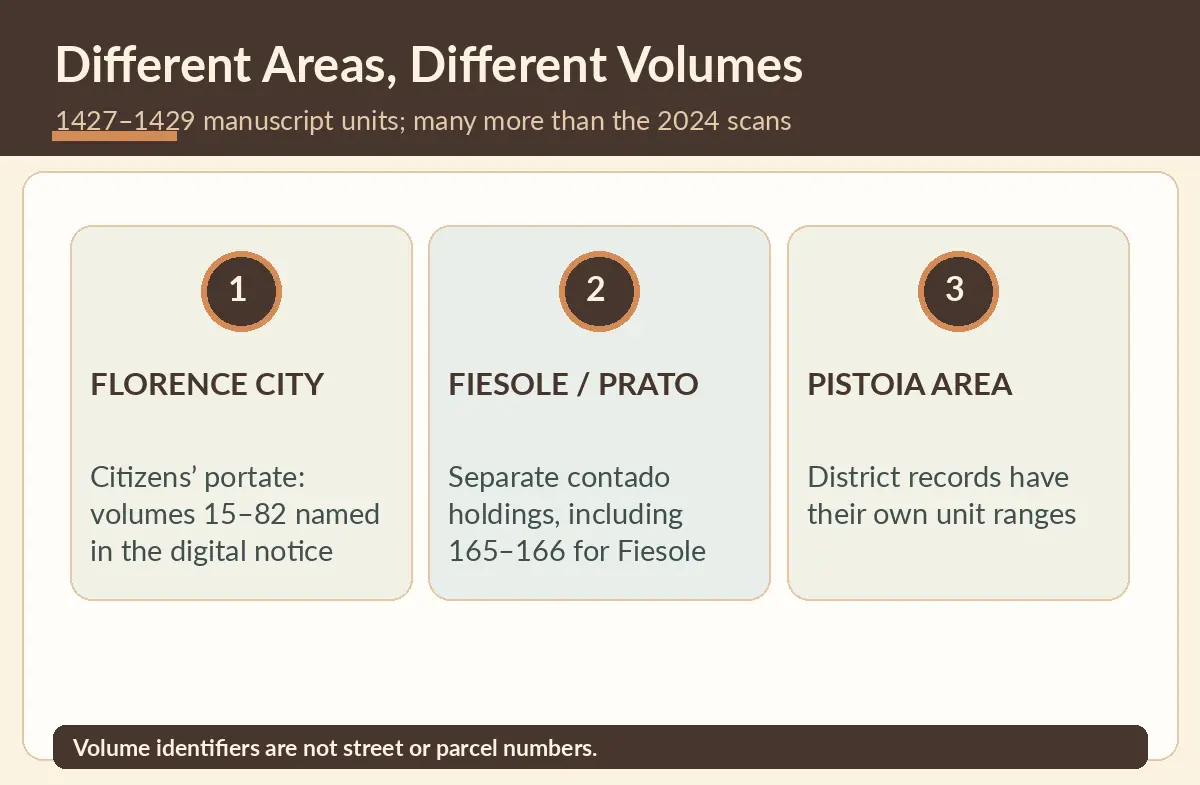
The 2024 publication notice lists digitized citizens’ volumes, Fiesole material, parts of Prato and Pistoia, religious and exempt institutions, and several other specified localities. It does not claim that the whole archive is imaged. The SIAS description counts 287 original units for this subfonds, whereas 100 is the announced digital release count. Distinguish those numbers and check the present digital inventory before asserting a missing manuscript.
Start at the archive’s Catasto inventories page, which links its inventory N/92, a microfilm index for citizens’ portate and the digital images. Use the locality and volume information to reach the file most likely to contain the family. Where a typed database supplies an entry summary, follow it to the manuscript image and record any uncertainties in the reading.
Find a City Quarter or Contado Community
For Florence proper, the fiscal framework often places declarations within civic subdivisions; for residents beyond the city, contado and distretto groupings matter. The archive’s digital notice specifically identifies citizens’ volumes numbered 15–82 and Fiesole volumes 165–166, while other localities have their own listed spans. These are archival identifiers, not house numbers and not parcel IDs. Never put a volume number on a modern street map and label it a house location.
Search the person alongside an expected spouse, occupation, civic quarter or known associates when those are independently documented. Historical names can have patronymics and variable spelling. The same man might appear under a full patronymic in a declaration and a shortened name in another register. Use several contextual clues before collapsing these references into one ancestor.

Transcribe the Fiscal Claims Before Drawing Conclusions
An entry may give property, cash, business assets, debts and dependants in the same administrative account. Create one table of statements with source folio, original term, monetary amount if applicable, the informant when discernible and an uncertainty note. Translating debito as debt is safer than silently subtracting a value and presenting the result as a verified net worth. If figures are damaged or abbreviated, say what is illegible.
Do not turn a tax description into legal title without further proof. It can show that an individual reported possession or an interest in an asset; the record is not a continuous conveyance chain. Likewise, an individual appearing in a household statement does not prove that person was a biological child of the declarant. A marriage, baptism or notarial act may be required to establish the claimed relationship.
Distinguish Two Renaissance Same-Name Households
Consider a hypothetical pair of men named Matteo di Giovanni. One declaration names a trade, a quarter and a household with two sons; another has the same broad name but a different district and economic profile. The match is not secured by the forename and patronymic alone. Build parallel timelines that preserve each person’s district, associates, declared dependants and any occupation rather than merging the families on sight.
A strong test would compare a separate notarial contract or baptismal record with the specific Catasto individual. The fiscal source may help identify a plausible neighborhood or relative, but its assertion is only as exact as the original wording. When a name could describe a patronymic reused over generations, note that possibility and hold the proposed family link open.
Date, Number and Cite Each Original Image
Use Archivio di Stato di Firenze, Catasto del 1427, portate or campioni, exact register or filza number, folio or image sequence, and a persistent archive locator when provided. Record the year represented by the entry and any later additions, because a later annotation does not necessarily describe the original 1427 assessment. A screenshot without folio context may obscure which named household was being described.
Check adjacent leaves for continuations, totals and other people with the same name. Negative searching should state which volumes and subdivisions were actually inspected, including whether digital images were absent. If a specific holding is unavailable online, the appropriate next step may be a catalogue-based inquiry to the State Archive rather than a fabricated negative result for an entire Florentine district.

More House and Local History Guides
How We Research the Florentine Catasto
We compare the official SIAS subfonds description with the State Archive inventory and its 2024 release notice, then locate an actual volume and folio. Each research note labels whether it summarizes a declared financial fact, a named household relation or a separate interpretation. We use other period sources to test disputed relationships; our report never confuses fiscal residence with modern land title.
Any link to outside digitized indexes should be evaluated for coverage and access restrictions first. Our affiliate disclosure explains the site’s approach to commercial references. The goal is a replicable manuscript citation and a bounded family-history claim, not the largest possible machine-generated list of Florentine surnames.
No. It is an early Florentine fiscal declaration system that describes resources, liabilities and household information, not a modern parcel-by-parcel deed register.
No. The archive announced 100 digital units in May 2024; check the current catalogue and finding aids instead of assuming all holdings are scanned.
Portate are fiscal declarations presented in the survey; campioni are corresponding organized register material. Cite the specific record type that you read.
Not without examining the wording and other records. Fiscal enumeration and reported household roles are evidence to evaluate, not automatic proof of kinship.
Use Archivio di Stato di Firenze, Catasto 1427, record type, volume or filza number, folio or image number, and the digital or inventory locator.